
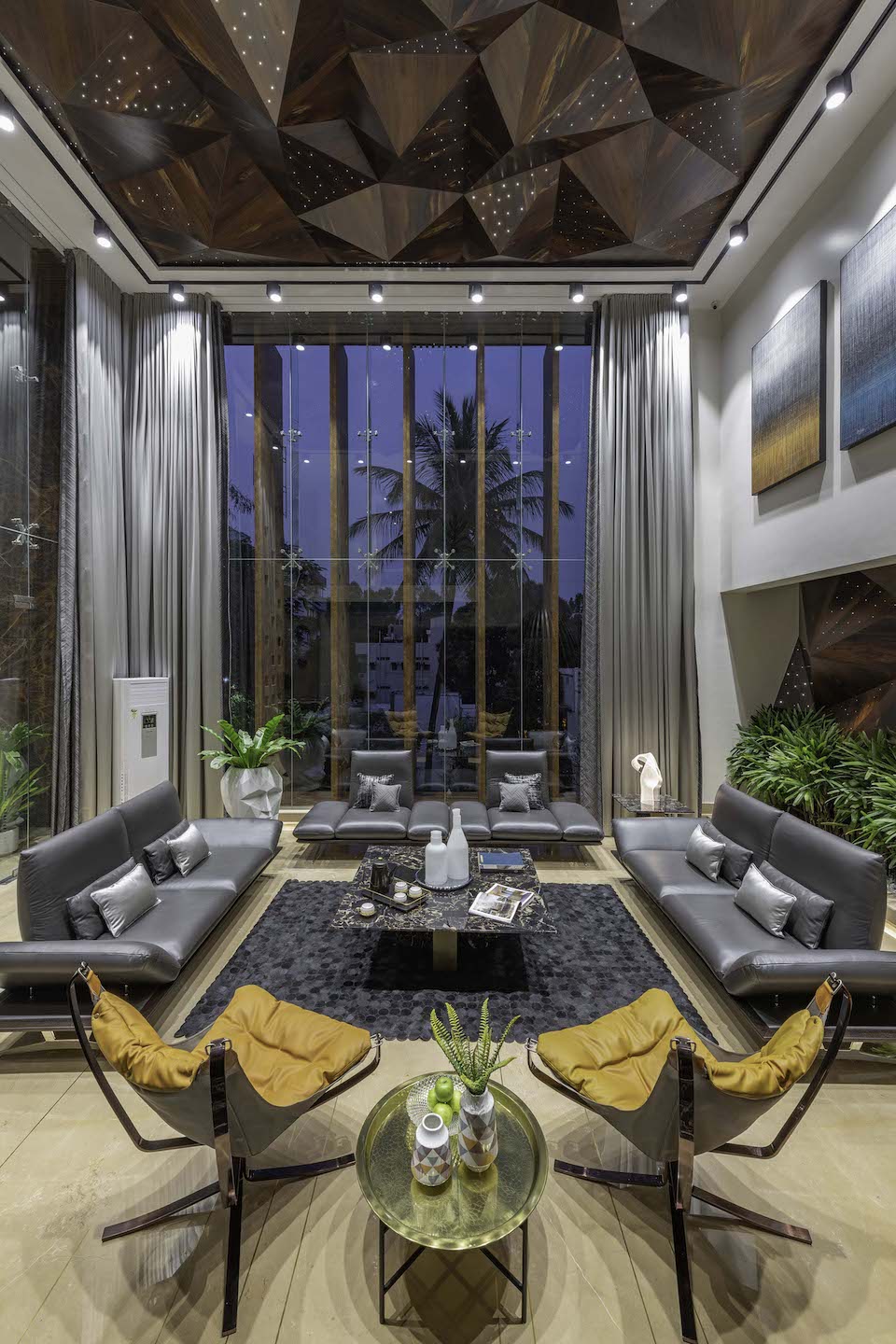
Part of a private mixed-use development, The Urban Peek House designed by PDP Architects in Nashik, exemplifies a contemporary living in an environment delineated by generous scale.
Curated by: Rupali Sebastian
Photographs: Photographix India; courtesy PDP Architects
The site
The project involved creating an expansive office+residential premises on a compact plot in Nashik, Maharashtra. The site was densely wooden and had an existing bungalow, which was around 50-60 years old. “The plot was abutted by a large open space on the west and a school on the east,” states Darshan Sancheti, who helms the studio along with partners Pratik Surana and Pramit Burad. “During the process of building the new mixed-use structure, we carefully retained all the trees, while the existing structure had to be completely razed.”
The brief
The client brief listed down a large parking space on the ground floor and an office on first floor, besides a multi-level residence for 12 members from the second floor onwards. On the aesthetic front, he spelt out a desire for a residence that would not only hold its own in the neighbourhood now, but also retain a stamp of uniqueness in the coming years.
The architecture
The built-form takes advantage of the openness on the west side. Elevationally, the design team strategised to scale down the structure to a more intimate scale through materiality. Thus, while the first (office) level and fifth floors are defined in paint, levels two to four are wrapped by a natural store-clad projection. “This visually modulates the ground + five building into a smaller, three-storey bungalow form,” elucidate the architects. Connections to the outside are achieved through bespoke MS vertical louvres and horizontal louvres inserted in a band-like manner for visual relief.
In addition to being Vaastu-compliant, the spatial programme needed to accommodate a multitude of activities within relatively modest dimensions. At the same time, these functionalities had to be connected to create a sense of cohesiveness and expansiveness. This was facilitated through strategic placement of double-height volumes and triple-height courtyards that, together, also engender an interesting spatial play and experience.
The spatial flow
The ground floor is earmarked as an expansive parking space, beyond which are positioned the staff quarters and other back-of-the-house areas such as laundry and other services. In addition to the regular areas such as the reception, general staff area and conference room, the office on the first floor also accommodates a spacious MD suite with its ante chamber, meeting lounge and rest room facilities.
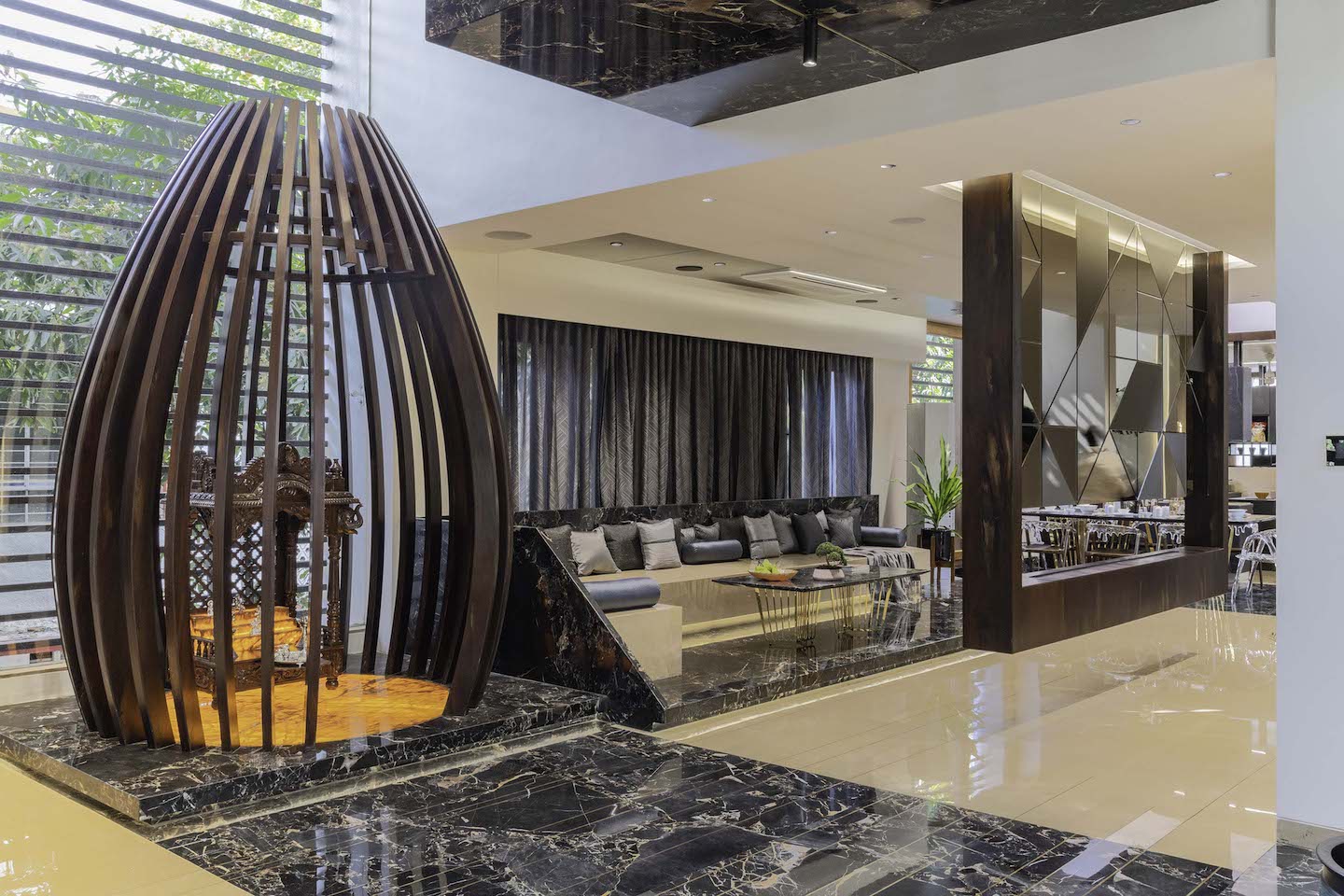
In the four-storied residential part, privacy increases with upward movement. The first level (second floor of the building) is allocated to the public and semi-public zone — family seating, formal living room, dining area and kitchen. The only exception to this is a bedroom for the senior couple, which was placed on this floor for it to enjoy proximity to the primary living spaces and the puja area. The spatial orchestration places the family seating in the centre, flanked (on the right) by the formal living and the rest of the spaces to the left. Privacy to the family living — which is the first area one encounters — is ensured by a levitating, ceiling-hung TV unit. “The grandness of scale required for living and arrival areas,” discloses the trio, “collectively requiring an expanse of 30’x30’x24’, was functionally and structurally achieved by making the structure partly post tensioned and partly regular RCC.” Adjacencies of varied heights keeps the spatial experience dynamic and engaging. For instance, the single-height family living flows, on one side, into the double-height formal living area and the triple-height puja section, and, on the other, the double-height dining area and a court. Large 30’x24’ openings bring in a welcome sense of openness and connect to the urban fabric. To ensure privacy, these were lined in automated and pivoted metal screens, perforated discreetly for ‘breathability’.
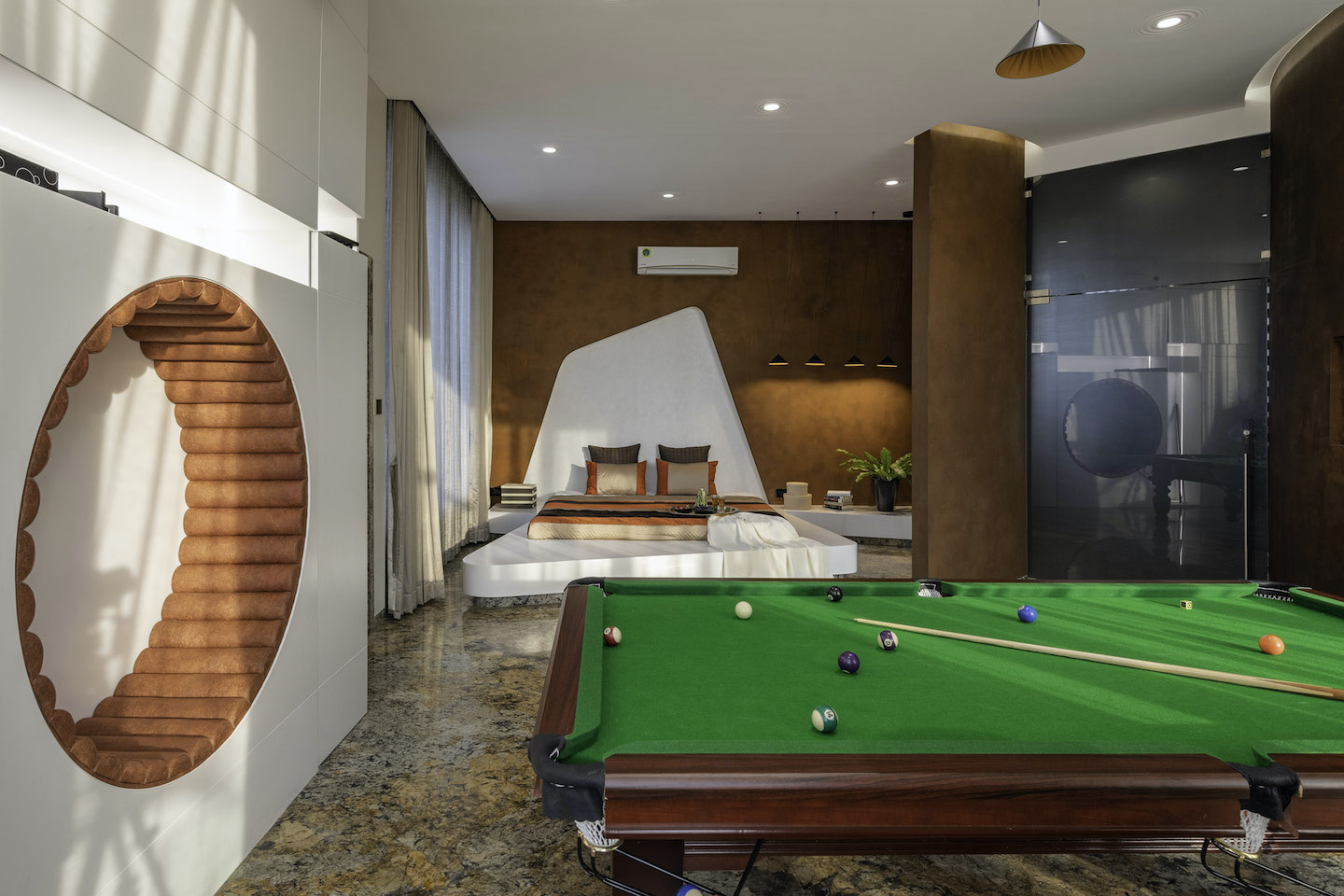
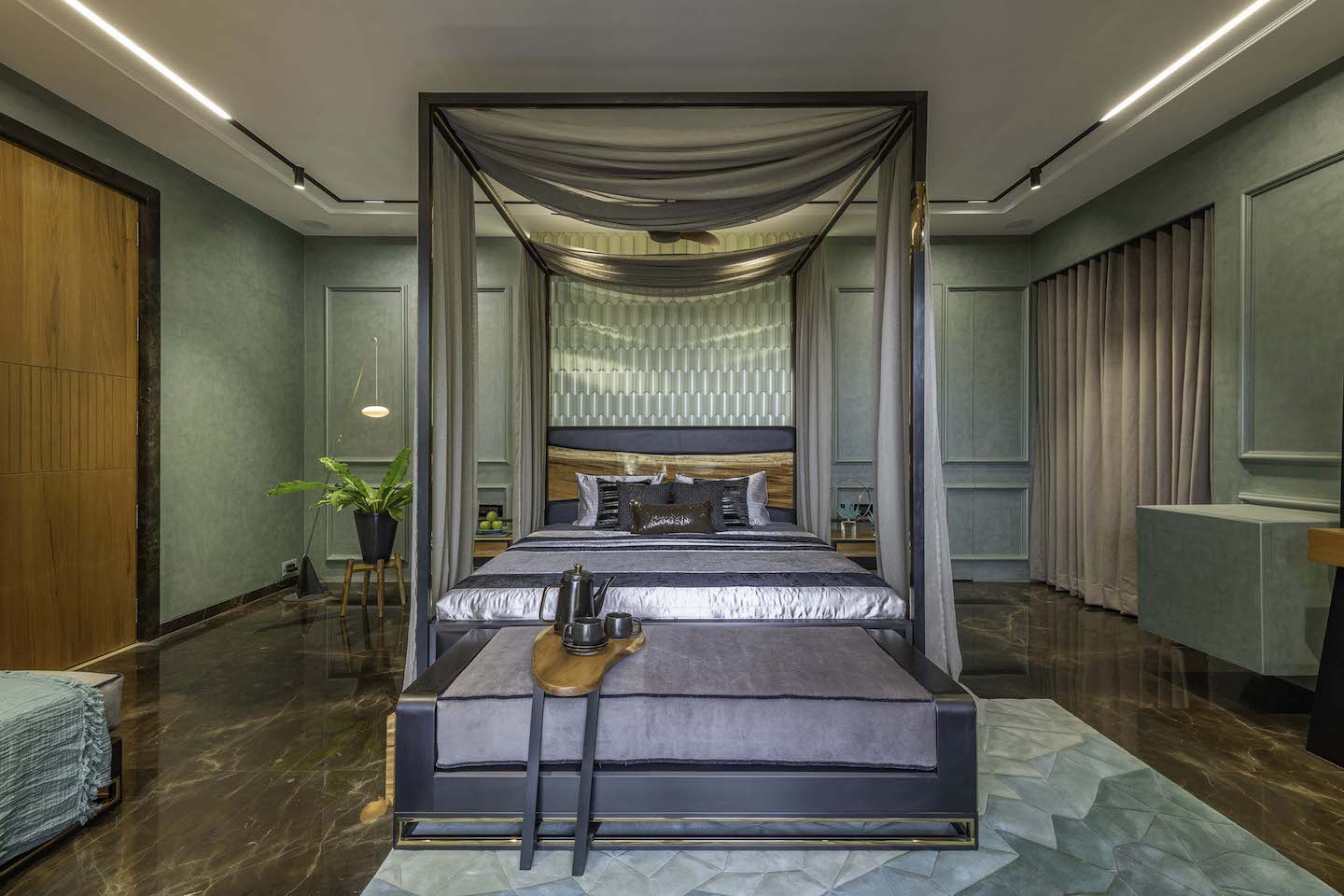
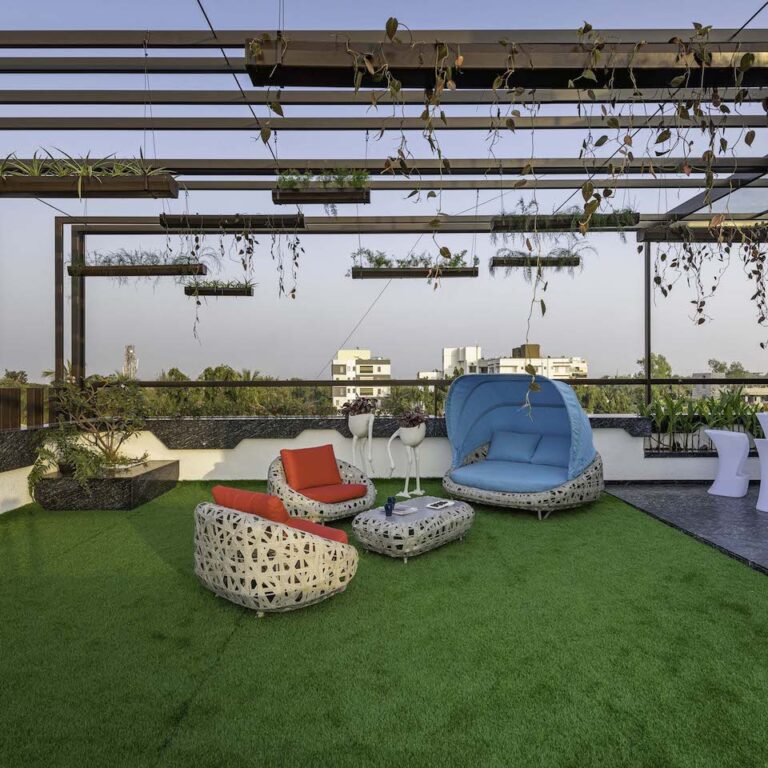
The levels above the ‘public’ floor house the remaining six bedrooms (one with its own gym), a home theatre, and a terrace garden (on the topmost level). As with a residential project of any scale, the design expression is an attempt to capture the emotive and aspirational considerations of the occupants. This manifests intensely in the most private areas, that is, the bedrooms. Here too, these spaces express themselves in diverse ways while adhering to an overall language of contemporary eclecticism.
The material and colour palettes
Material and chromatic directions uphold the sense of uniqueness that is central to the narrative. Materiality spans wood, natural stone, textured paint, sensual fabrics and brass, amplified with a spectrum of surface finishes and techniques. Beautifully-grained beige and black marbles with brass inlays used as flooring throughout the residence tie the story together. Materials are applied emphatically for visual drama — such as the faceted MS ceiling and wall of the formal living area. Light and greenery, also treated as important materials, add their own muscle to the narrative. Natural lighting is welcomed through large openings shielded by louvres and fabric, while verdure is woven in the narrative in the form of beds and planters. Harvesting of solar energy and rainwater, in addition to a climatically responsive design exemplifies the design’s sensitivity to the environment.
Fact file
Project: The Urban Peek House
Location: Nashik, Maharashtra
Area: 9169.64 sq ft
Principal architects: Pratik Surana, Darshan Sancheti and Pramit Burad
Design team: Pratiksha Sharma, Namita Challani, Preeti Sharma, Darshana Agrawal, Irshad Pathan, Sayali Sawant, Akshay Bhatjire and Sanjana Chopda
RCC designer: Sudarshan Anawade
Supervisor: Santosh Tupe
Artists: Vastushilp
Add a Comment