
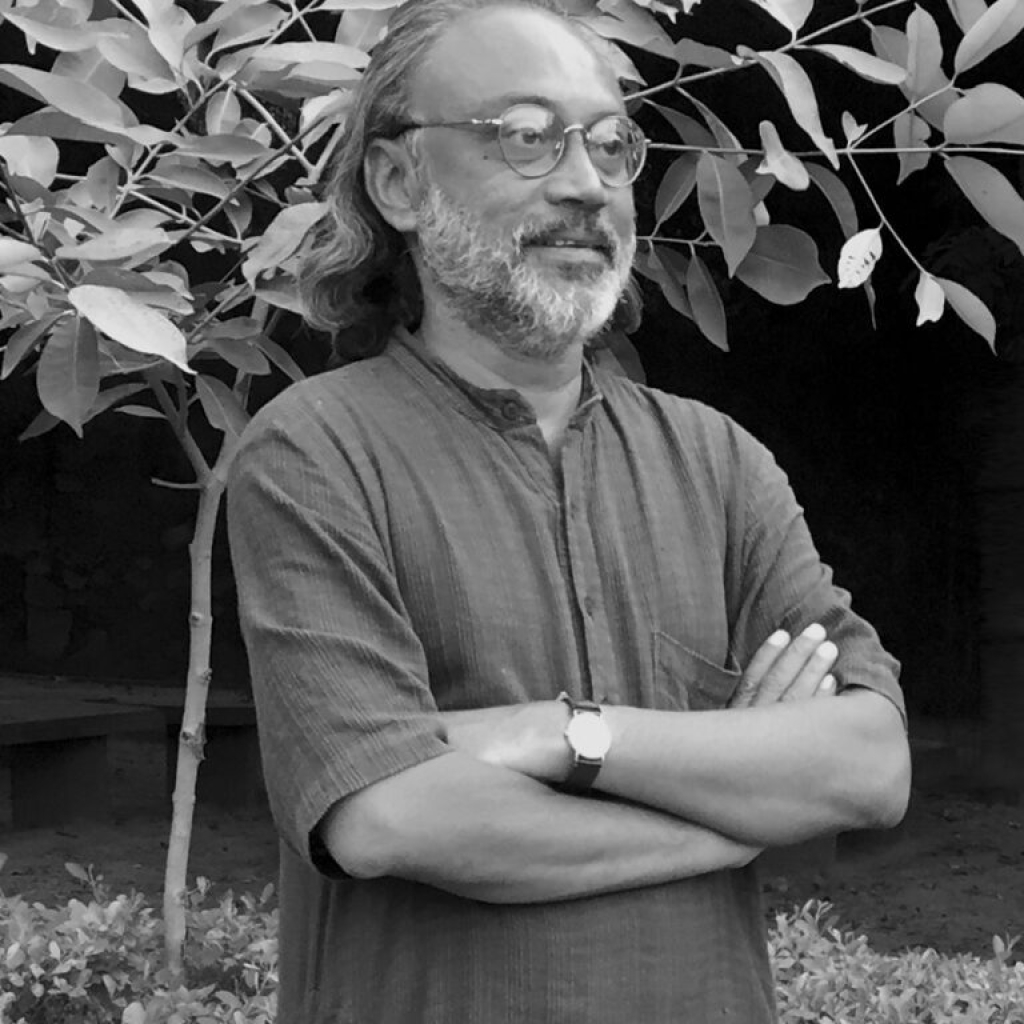
Kumar Moorthy and Associates takes cues from Kerala architecture to create an ecologically sustainable farmhouse brimming with flora and fauna on the outskirts of New Delhi.
Curated by: Ambica Sharma
Photographs: Eyepiece Photography; courtesy Kumar Moorthy & Associates


The site
The Gopalakrishnan Farmhouse designed by Kumar Moorthy & Associates is centered on a built-up area of 700 sq m, on a 2.5 acre plot, on the outskirts of New Delhi. The grounds of the site contain an organic farm, active ecological interventions, apart from private gardens, next to the main structure.
The brief
The owners, Gopi and Chitra Gopalakrishnan are a couple engaged in literary and non-profit activities, and, “With tastes quite far removed from the flashy farm houses in New Delhi’s hinterlands. They envisaged in their mind’s eye, a quiet, unassuming refuge, in the midst of greenery, and a place to try out initiatives in organic farming and sustainable living,” informs architects Narayan Moorthy and Mallika Kumar, who head Kumar Moorthy & Associates. Therefore, the architecture and design of the home had to be a culmination of a life lived and loved, and futures invested in.
The design response
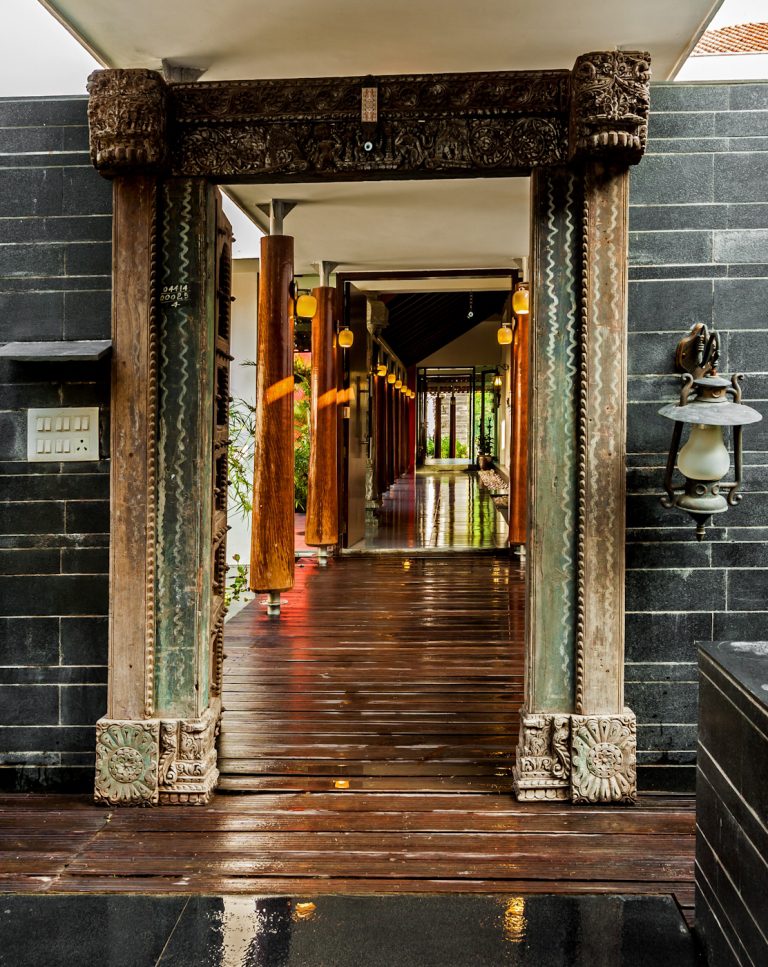
The clients wanted their home to reflect their roots in Kerala. Hence a selection of components from the distinctive architecture and culture of the region were invoked to create this retreat-like home. The farmhouse was also designed and fitted to cater to the extreme heat and cold of north India. “Lofty internal volumes under pitched tiled roofs, deep surrounding verandahs as shading devices, courtyard centric planning for the effect of cooling, the presence of numerous water bodies to cool prevalent breezes, and other design interventions like plan orientation towards desirable sun and breeze directions, and massing, to help mutual shading, all help to adapt the idiom of southern architecture to another climatic zone,” explains Narayan.
The spatial flow
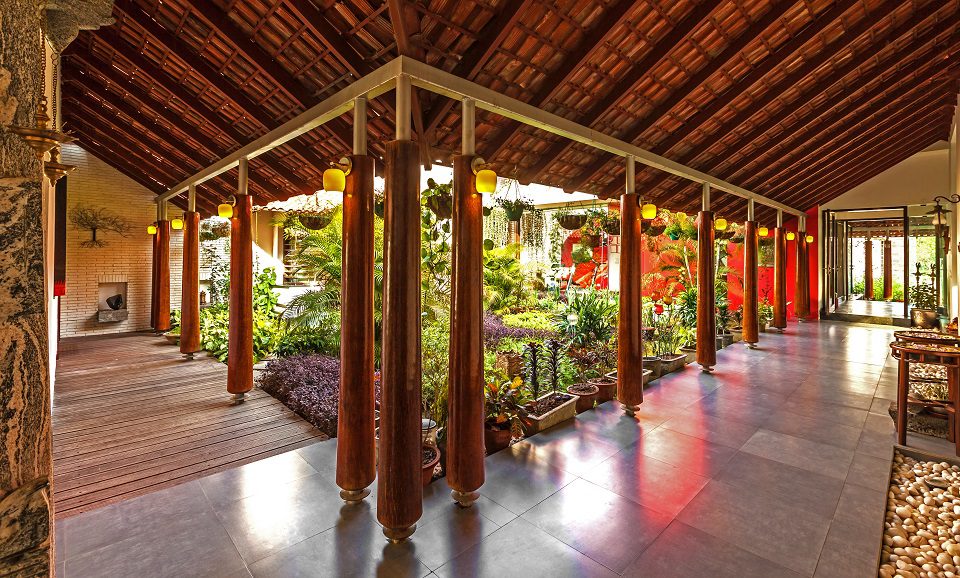
Created to beat the extreme climate of New Delhi, and avoid over-dependence on electricity for artificial lighting and cooling, this home has been given an open-plan design, passive cooling techniques, as well as active eco-friendly features.
Passive cooling has been achieved via a two-pronged approach. Firstly, the length of the house is oriented east-west to let in maximum sunlight in the mornings into the bedrooms; and the winter morning sunshine across the whole length of the house. Secondly, cross-ventilation has been maximised by shaded openings and courtyards, while deep verandahs keep the sun out. Active eco-solutions include complete water-recycling including grey and black water via a non-chemical-based recycling system, rainwater harvesting (including channelisation and harvesting of even off-site water), use of solar energy for water heating, and the use of local as well as recycled materials.
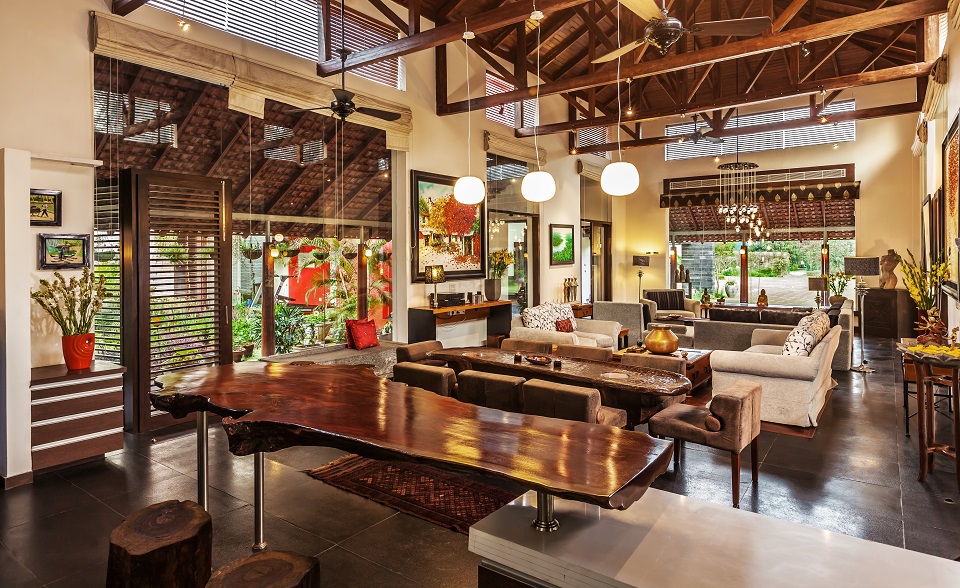
With the open-plan design approach there is a clear distinction between the private and public areas. While the living and entertainment areas come together as one cohesive space, the bedrooms are secluded spaces with their own verandahs. All rooms are approached via a verandah, originating at the entryway. It is colonnaded and bifurcates at the main interior courtyard — one arm leads to the guestrooms, and the other to the living spaces. A central lobby adjoining the living room separates the public areas of the house from the private ones. “Exterior landscaping of the garden amalgamates with interior entertainment rooms through multiple and large openings, to form large flowing spaces for extended entertainment activities as a country home,” says Mallika.
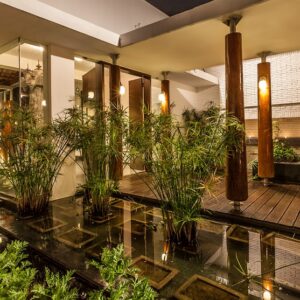
The owners have extensive and deep knowledge about trees and to enhance the experience of the house they have planted fragrant trees such as Indian magnolia, Spanish cherry, cape jasmine, and ylang ylang. Meanwhile, trees with colourful flowers, such as the African Tulip, pink trumpet tree, pride of Burma, and the cannonball tree, have been planted at the periphery in order to enjoy the changing colours of the seasons.
The material and colour palettes
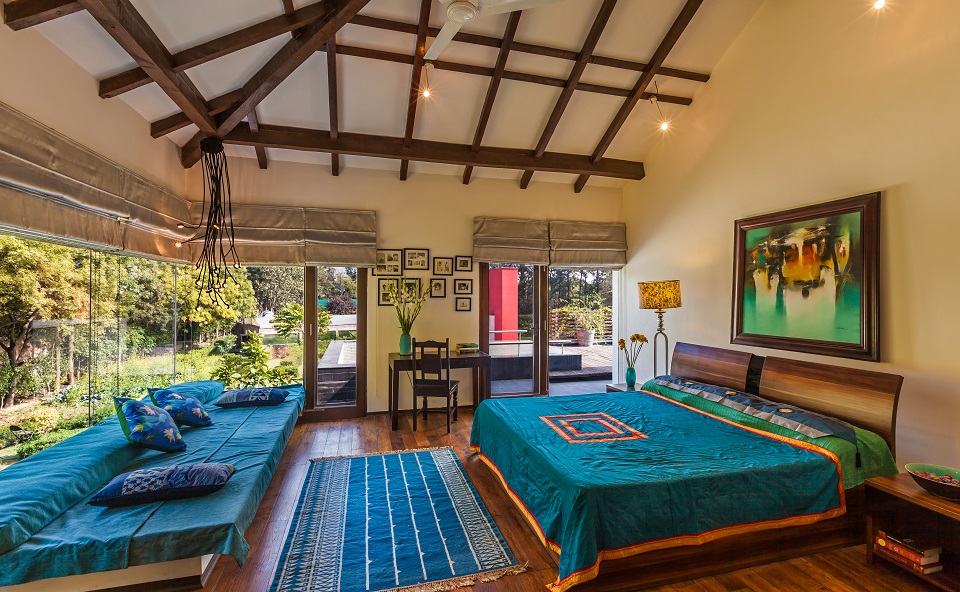
From renewable coconut tree trunk wood columns and polished cuddapah stone for the floors, to rough wood for the bar and trees and plants from across the globe, the colours and materials for this home are all natural and sustainable.
Fact file
Project: Gopalakrishnan Farm House
Clients: Gopi Gopalakrishnan and Chitra Gopalakrishnan
Location: Radhey Mohan Drive, Jaunapur, New Delhi
Area: 2.5 acres (site) and 7,534 sq ft (built-up)
Principal architects: Narayan Moorthy and Mallika Kumar
Design team: Bhupesh Tandon, Amit Sheokand and Sonal Dongre
Add a Comment