
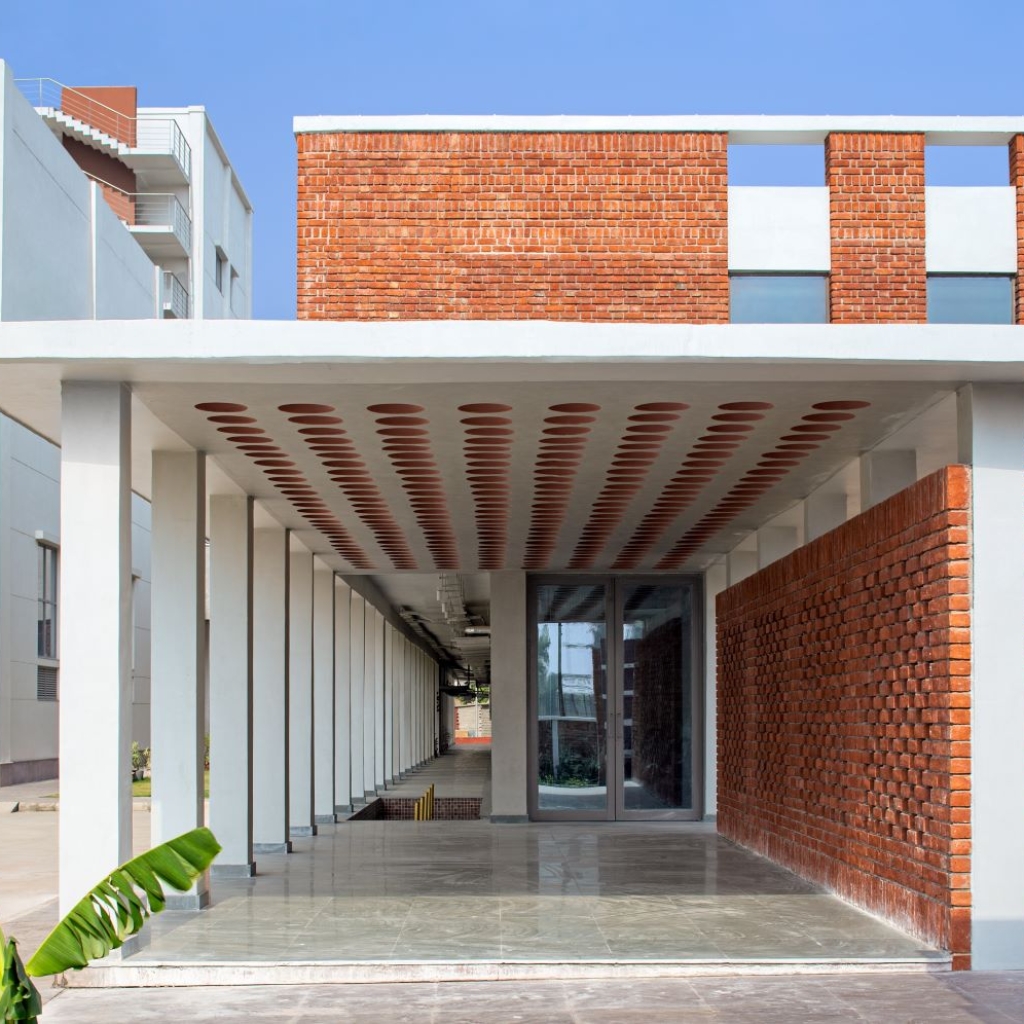
The Integrated Production Facility for Organic India designed by Studio Lotus in Lucknow is not only an exemplar of sustainable development, but through its sensitive and clever built environment it also caters to the physical and psychological wellbeing of its occupants.
Curated by: Deepa Nair
Photographs: Andre J Fanthome; courtesy Studio Lotus
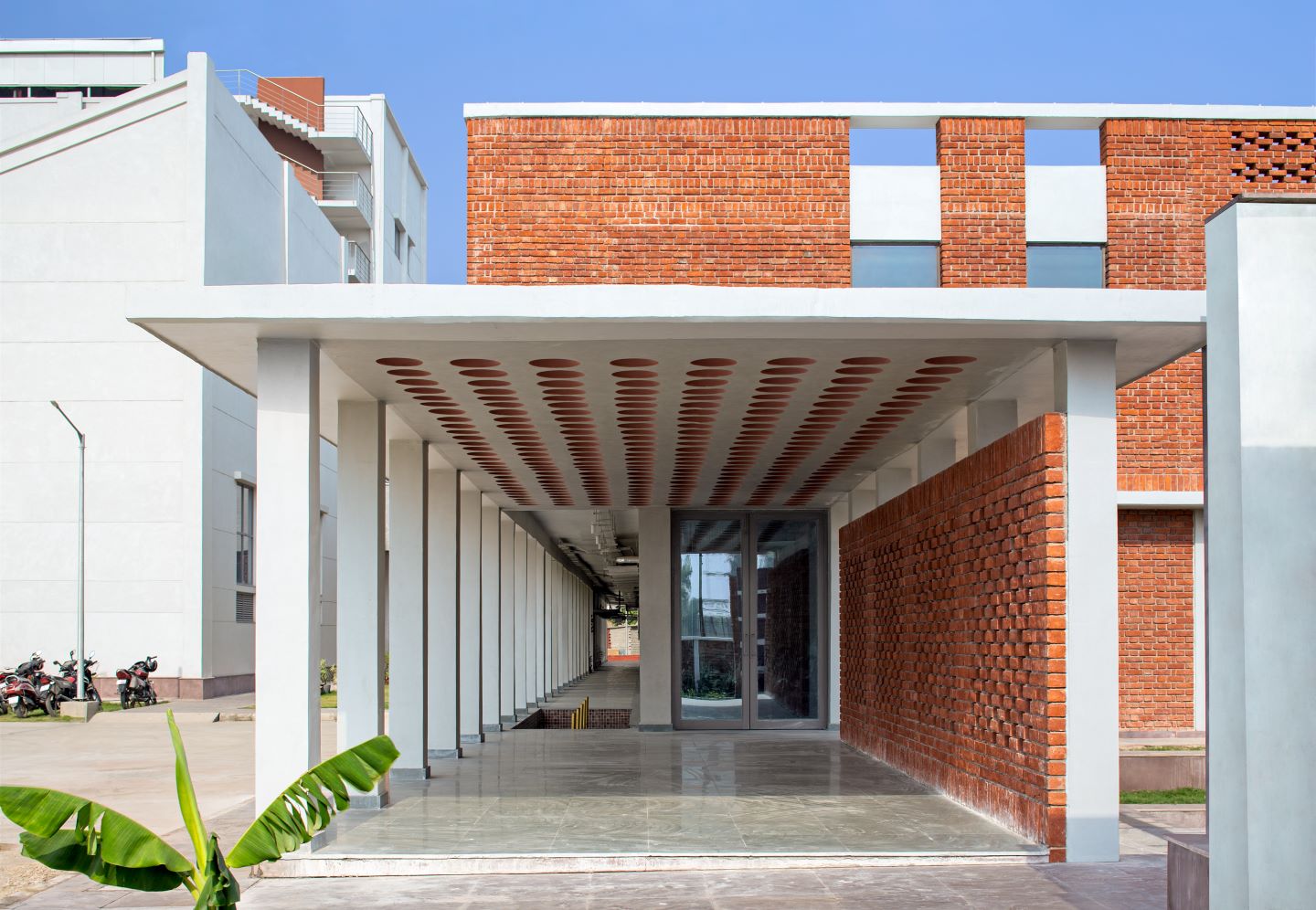
The site
The Integrated Production Facility for Organic India in Lucknow is a sprawling campus designed to support the production, processing, and administrative functions for the holistic wellness brand. Located in Chinhat, an industrial area on the outskirts of Lucknow, the site surroundings are characterised by low-rise developments and small manufacturing plants interspersed with fields of barley and legumes.
The design intent
The Integrated Production Facility for Organic India stands as an exemplar of sustainable development — not only in tangible terms of material use and energy consumption, but also through the provision of a built environment that caters to the physical and psychological wellbeing of its occupants. The expansive open spaces, permeable built fabric, focus on community and introspection, and prioritization of the workers’ safety and comfort over all else has created an architectural template for all future properties for the company.
The facility has been designed to capitalise on the abundant open space (four acres) to provide an atypical work environment for its factory workers and administrators alike. The built vocabulary of the facility has been articulated in brick and concrete, with sleek lines and planar symmetry characterising the facade design.
The spatial configurations
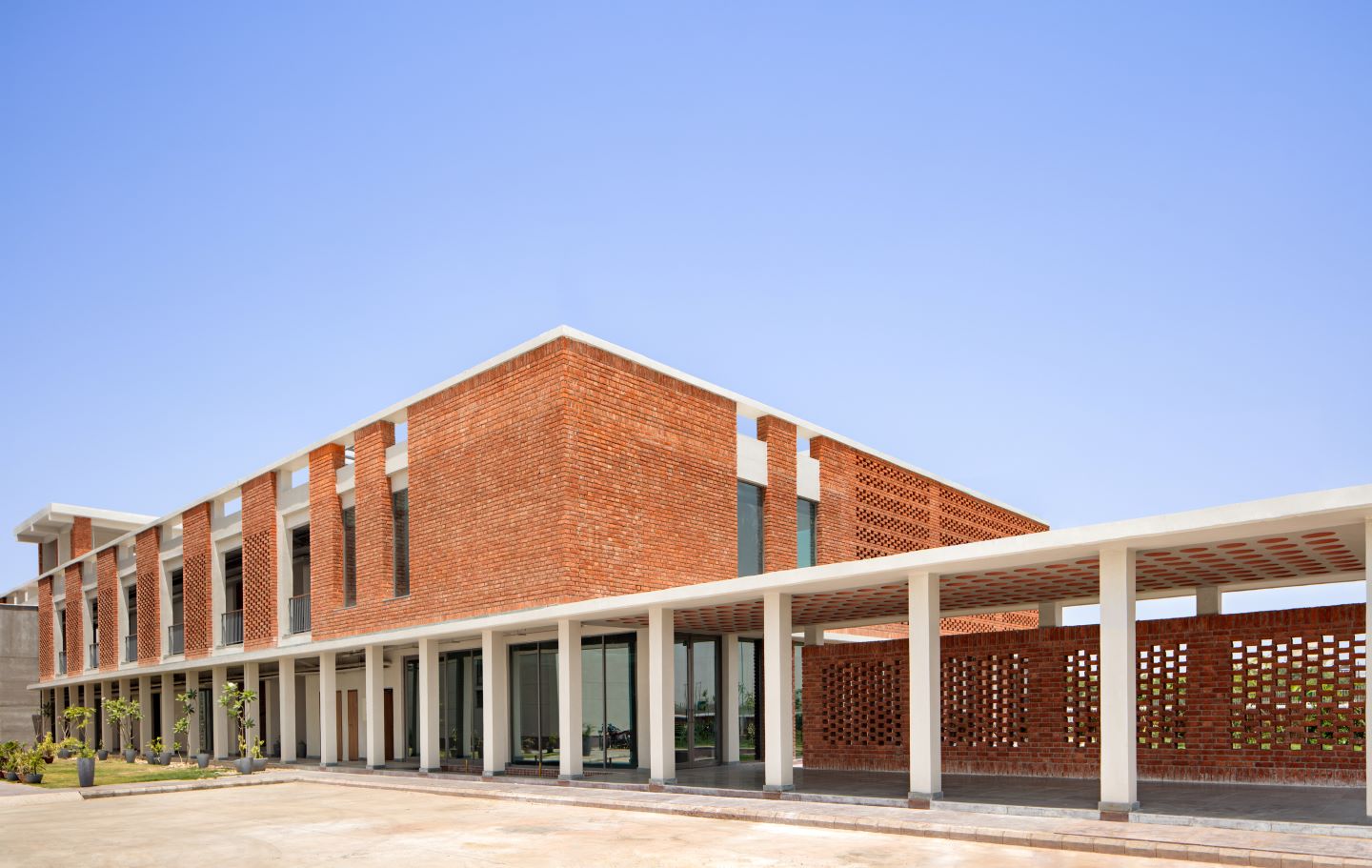
Two sets of intersecting axes characterise the building footprint of the facility; the resulting interstitial spaces emerge as courtyards, lightwells, and lawns that provide space for interaction as well as relaxation for the facility staff. The axes conceptualised for the facility’s design have been staggered to lay at an angle to the site boundaries. The resulting footprint creates large open spaces along the periphery to accommodate staff parking, heavy vehicle manoeuvring and off-loading, and recreational zones towards the east, west and north sides; the southern side of the site has been reserved for services, in tune with vastu recommendations. To segregate employee and visitor traffic as well as pedestrian and vehicular access, however, the entrance for the Production Wing has been provided from the western flank.
This relatively private access provides employees the opportunity to assemble before starting work as well as clears the driveway for incoming lorries. Preceded by a large lawn, the entrance along the western flank opens into a set of decontamination chambers for the employees, which allows them to systematically execute hygiene procedures before entering the production wing and subsequently the Raw Materials section.
The Production Wing has been designed to ensure seamless transfer of raw material to individual processing units, and their subsequent movement to the packaging department. The Raw Materials section is a triple-height space, with a sophisticated pulley system installed to move goods to the top floor — from where they are moved laterally to the processing units. The processing units are housed in modular rooms that are 3m wide each — each designed to specification for the machinery housed within. The goods are then moved through a top-down processing system, with preliminary steps like sorting and drying executed at the topmost floor, and more sophisticated secondary functions executed on the ground and first floor.
The goods, having moved down the production line, are loaded onto a conveyor belt connecting the Production Wing to the Finished Goods Block, which is located towards the northern end of the site. Here, the processed goods are inspected, packaged and made ready for dispatch. The Finished Goods block — which is set adjacent to the Quality Control Department — opens into a driveway with restricted access, allowing approved goods to be moved off-site without disturbing the functions of the rest of the facility. This movement of goods from the eastern to western side of the site marks the production line, forming the functional spine of the facility.
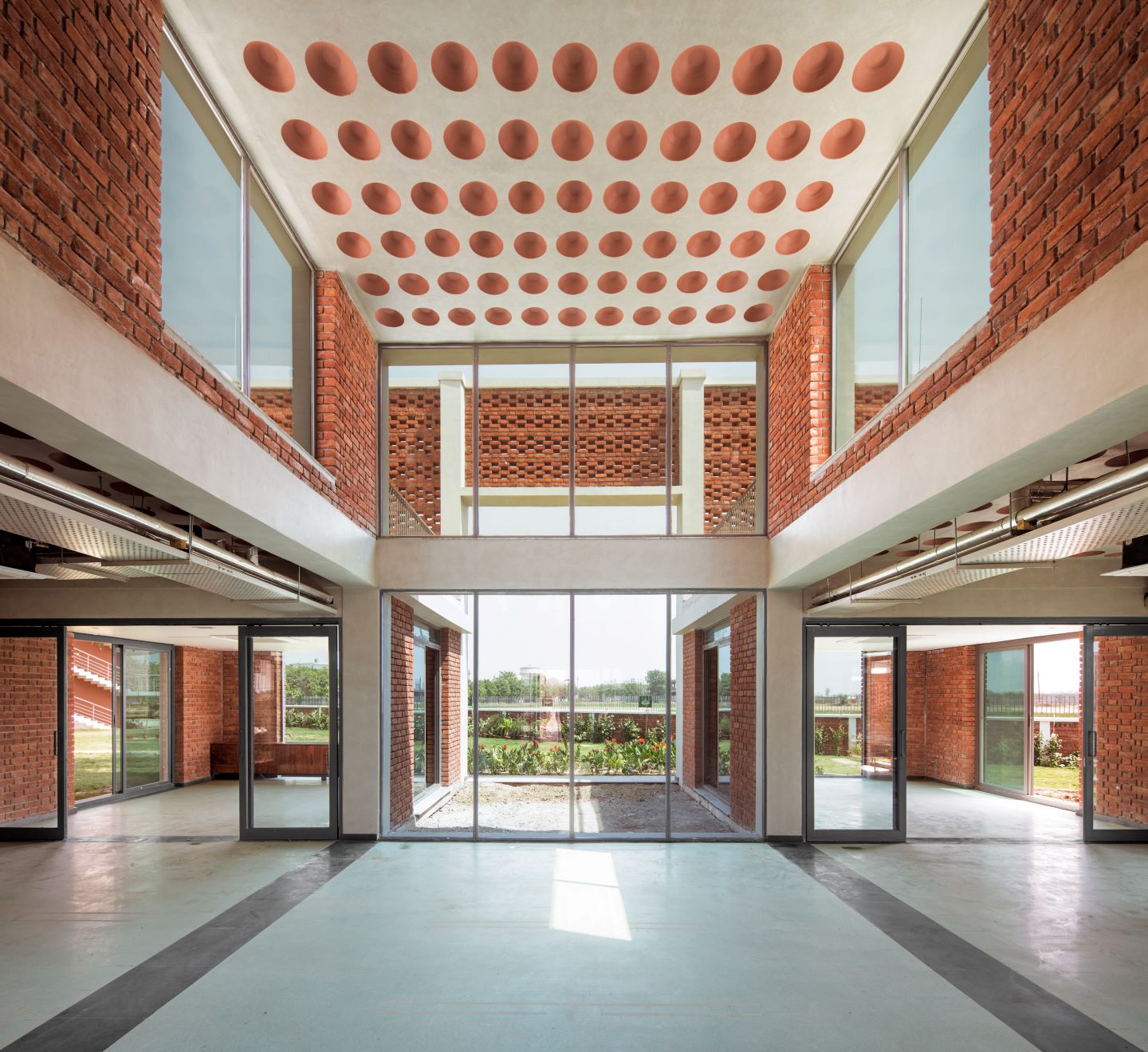
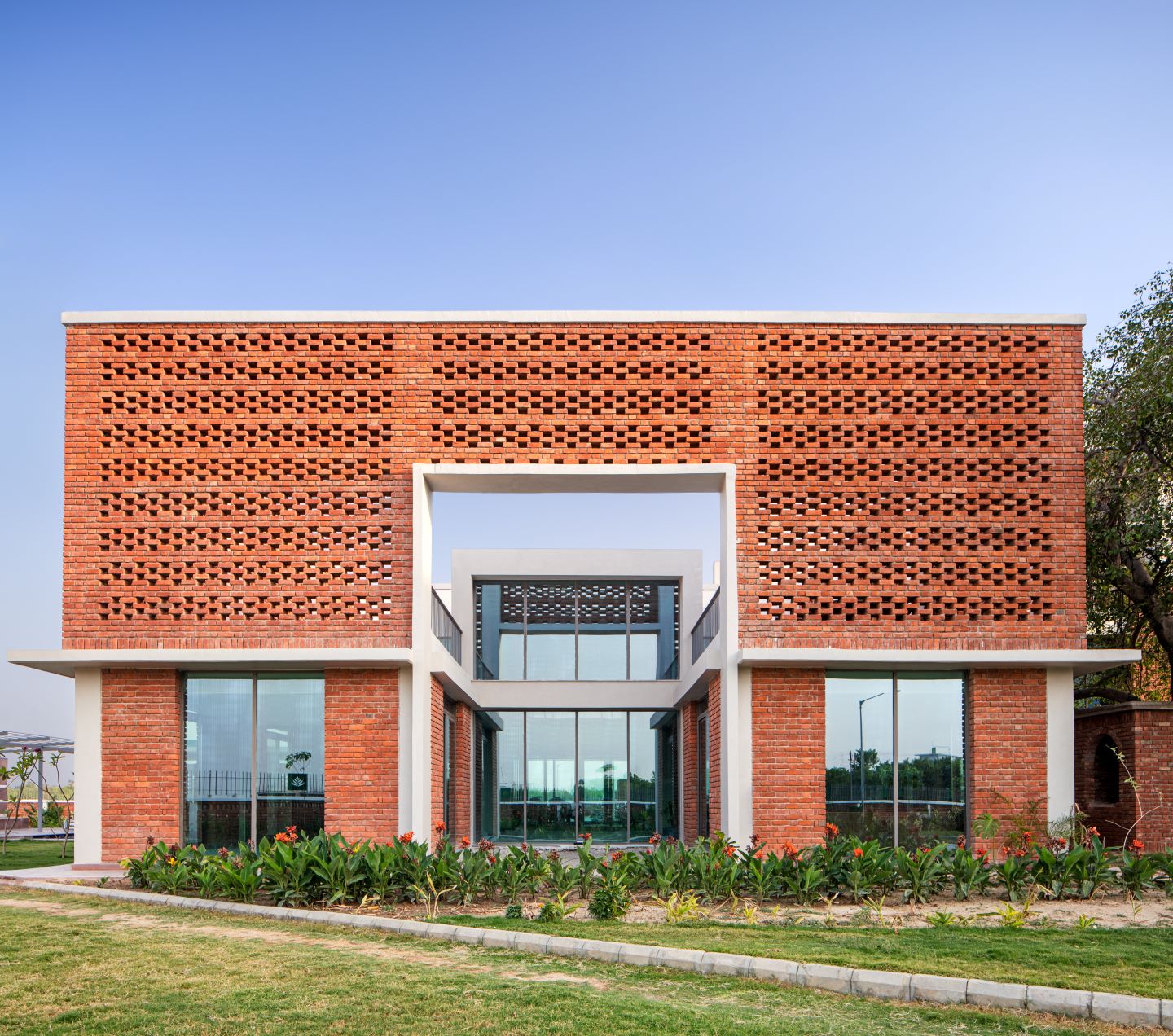
The spaces supporting the administrative functions of Organic India complement this functional spine, extending from the Finished Goods block to the drop-off for the Raw Materials section. The built vocabulary of these blocks is porous and composite, as compared to the monolithic appearance of the processing wings. To the eastern end is the Experience Centre, a two-storey space wrapped in a tessellated brick screen. The facility’s amphitheatre and temple precedes this centre — the three, in conjunction, mark the visitors’ zone of the facility. The office spaces, expressed in a similar vocabulary, abut the Experience Centre — extending towards the west in a linear configuration, and housing the Finance, HR and Sales departments. Ancillary functions for the administrative staff are located towards the end of Administrative Block, and comprise of meetings rooms, a gym, and the cafeteria.
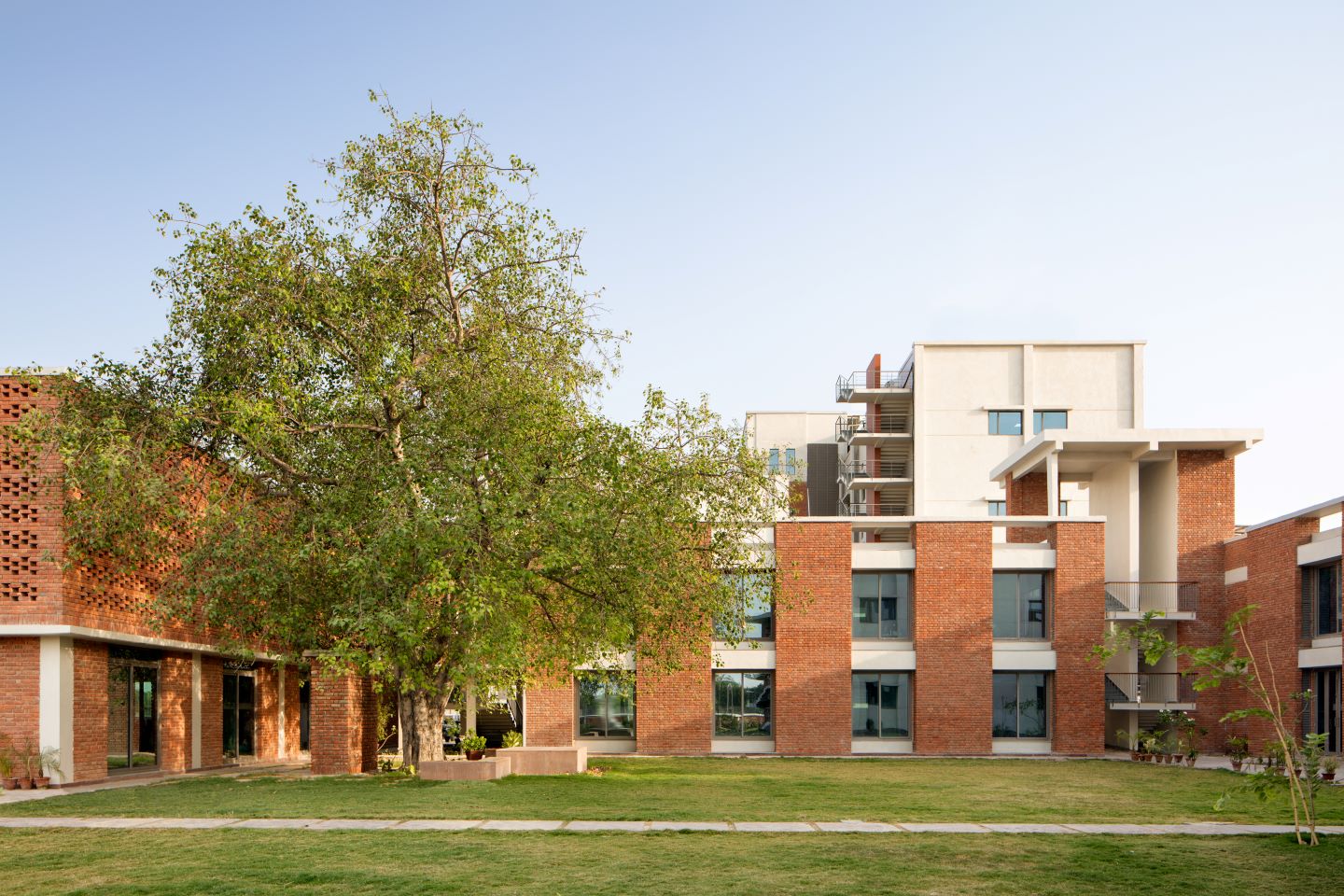
The administrative spaces of the facility wrap around a large lawn, facing north. A large tree retained on site stands in this lawn, and has been christened the Bodhi Tree for the campus to pay homage to Organic India’s commitment to mindfulness for the self and for the community. The administrative spaces, through numerous balconies and box windows, look into this lawn. The provision of nooks and perches along the building envelope lends a meditative quality to the workspaces.
The sustainable features
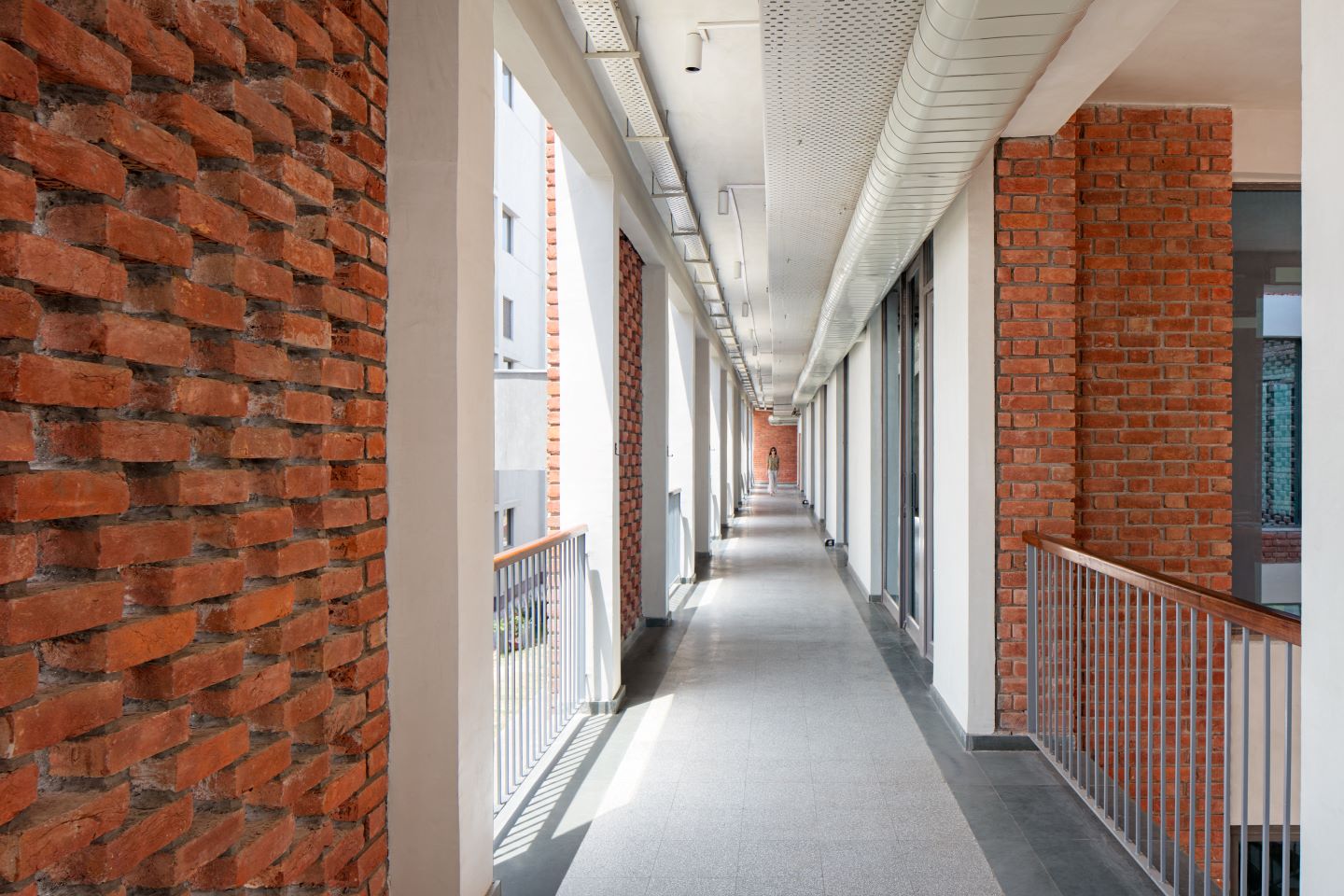
The design scheme of the facility imbibes local influences to create a sustainable built environment with the use of bricks as the primary infill material. Left exposed, the facility’s brick shell harkens to the regency structures of colonial Lucknow; bricks are also locally available due to abundance of labour-intensive kilns and availability of pliable clay, lowering the carbon footprint of the campus. The fenestration strategy, in tune, has been devised to provide the optimal wall-window ratio to each zone: the processing blocks have limited ingress of light, facilitated through skylights and north lights, to prevent spoilage of goods. On the other hand, high ingress of light has been enabled in the administrative blocks, to help lower dependency on artificial means of lighting.
The interstitial open spaces on the campus further aid climate control in multiple ways, primarily by enabling passive cooling of the blocks through stack effect. The abundance of open spaces and limited hardscaping also increases potential for recharging the ground water table. The design of the facility also ensures the channelling of surface run-off for reuse, as well as recycling of greywater discharge — the result has been the reduction of potable water consumption by more than half of the initial demand.
The design scheme utilises, in addition, a gamut of passive cooling techniques — such as terracotta filler slabs in the large-span spaces, and recessed openings to cut out solar glare. Over one-tenth of the material used in the construction of the facility is recycled. As a result of these interventions, among many others, the project has been awarded a LEED Platinum rating.
Fact file
Project: Integrated Production Facility for Organic India
Clients: Bharat Mitra and Bhavani Lev (Organic India)
Location: Chinhat, Lucknow
Area: 1,20,000 sq ft (built-up)
Principal architects: Sidhartha Talwar and Ambrish Arora
Design team: Nitika Srivastava and Raman Vig
Add a Comment