
Eight Degree Design House gives a refreshing new life to Nightingale, the Italian cafe and bar located in the mountain town of Naggar.
Curated by: Deepa Nair
Photographs: Rishi Raj Singh Rathore, courtesy Eight Degree Design Studio
The site
Nightingale, the Italian cafe and bar is located in the quaint town of Naggar in Himanchal Pradesh. Resting on the banks of the Beas, this mountain cafe is a standalone structure embedded along a sloping topography leading up to the popular tourist destination, Naggar Castle.
The brief
As the first and longest existing Italian cuisine speciality house in Himachal Pradesh, the client commissioned Eight Degree Design House to redesign the weathered interiors of the cafe to give it a new lease of life. “The studio was brought on board to morph the depreciating ambience quality of the dining sections which were beginning to impact the client’s business notably. Patrons at the restaurant were increasingly leaning towards solely dining in the outdoor section while engaging with panoramic views of the valley, avoiding the indoor area due to its unwelcoming persona,” informs Chrisann Rodrigues, principal architect, Eight Degree Design Studio.
The design intent
The design intent was to continuous establish a dialogue between the spaces and the verdant landscapes, wherein nature deftly envelops everything that shared its threshold.
The inspiration stemmed from the need to create a milieu in which this youthful mountain cafe could allow diners to unwind in the warmth of its embrace, all while staying sincere to its grounded history. The conscious framework pivoted around harnessing the materials that were indigenous to the site, and simultaneously appointing local artisans and business owners for the project. These processes also ensured that the footprint of the project is minimal on the environment.
The spatial flow
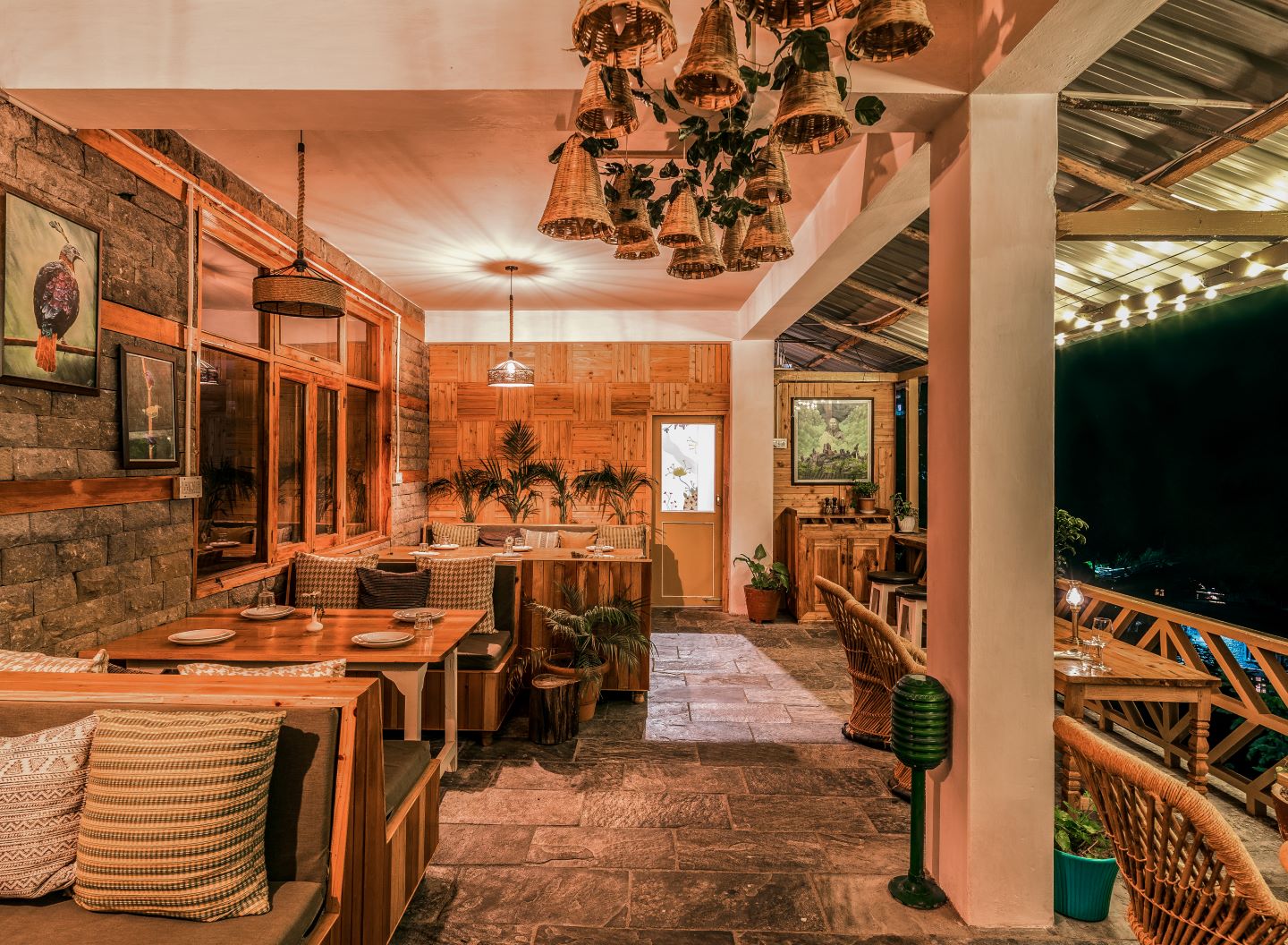
The interiors of Nightingale is imagined as a seamless medley of spaces that transition between an indoor dining cum bar area, a dedicated outdoor section hugging the exterior facade of the structure looking into the hills, and a private dining segment peacefully tucked away to enjoy arresting views.
The indoor segment concocts an immersive environment that instantly evokes a sense of ingrained nostalgia and a lived-in aura. Layered with murals against the warm undulating mud walls, vintage collectables and treasured keepsakes, each element comes forth to chronicle the twenty-year legacy of this picturesque venue. A juxtaposition of three-dimensional elements across the walls adorned with hand-illustrated murals create an additional sense of dimension. Painted by local artists Jitendra Pradhan and Sanjay Thakur, the imagery depicts the owners enthusiastically labouring over the kitchen island and brick oven respectively. This visual originates from the private kitchens of the restaurant wherein a classic brick oven fires the sought-after baked goods on the menu. The walls pose as intentional canvases that recite the honest history of the venue and the hands that pieced it together. A half-wall panelling of natural wood strips lines the perimeter of the walls, imbuing the indoors with umber warmth, characteristic of hill cottages and dwellings.
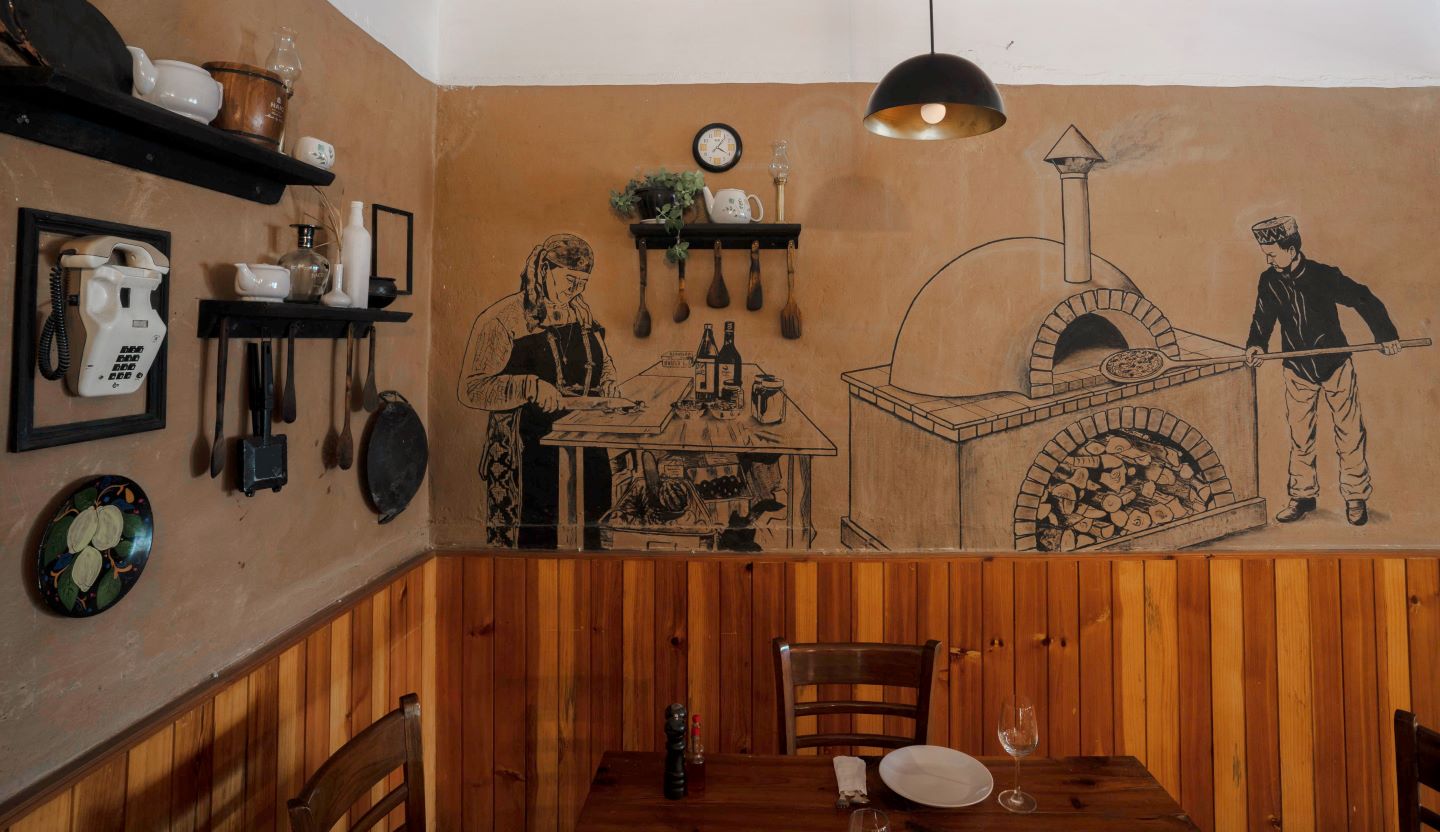
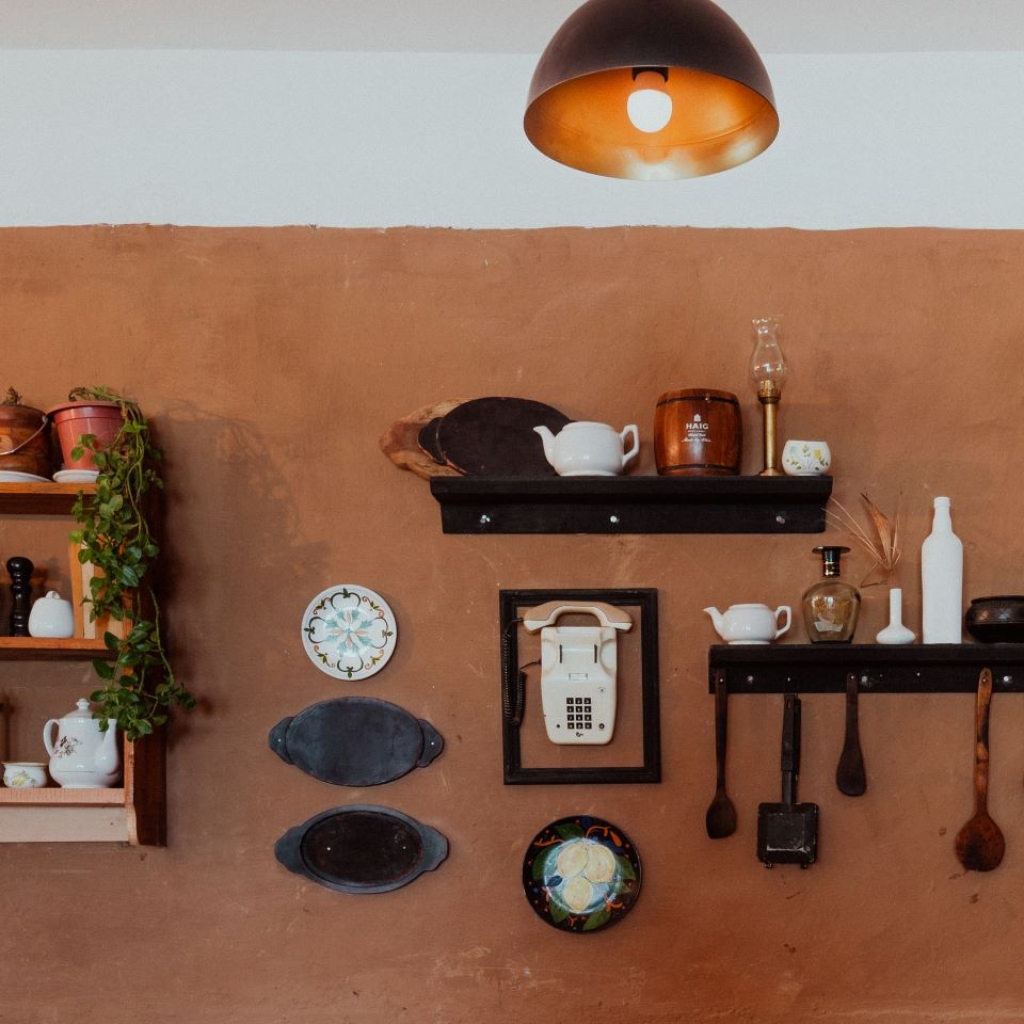
The bespoke quality of the interiors is further iterated through the addition of hand-carved spatulas crafted by the client in his days of yore as a novice chef, utensils that have graced the kitchen for years, and mundane objects from the past that don a decorative presence today. This creates a visual collage of bric-a-brac that holds sentimental value to the family. The wall plates and framed avian paintings have been painted by the client’s daughter Simran Dharwal; she has created an ensemble of embellishments that are an ode to the cafe’s whimsical narrative and aesthetic. The fireplace makes for a fitting addition into the construct of the space, functional for when the temperatures take a plunge in the crisp winters.
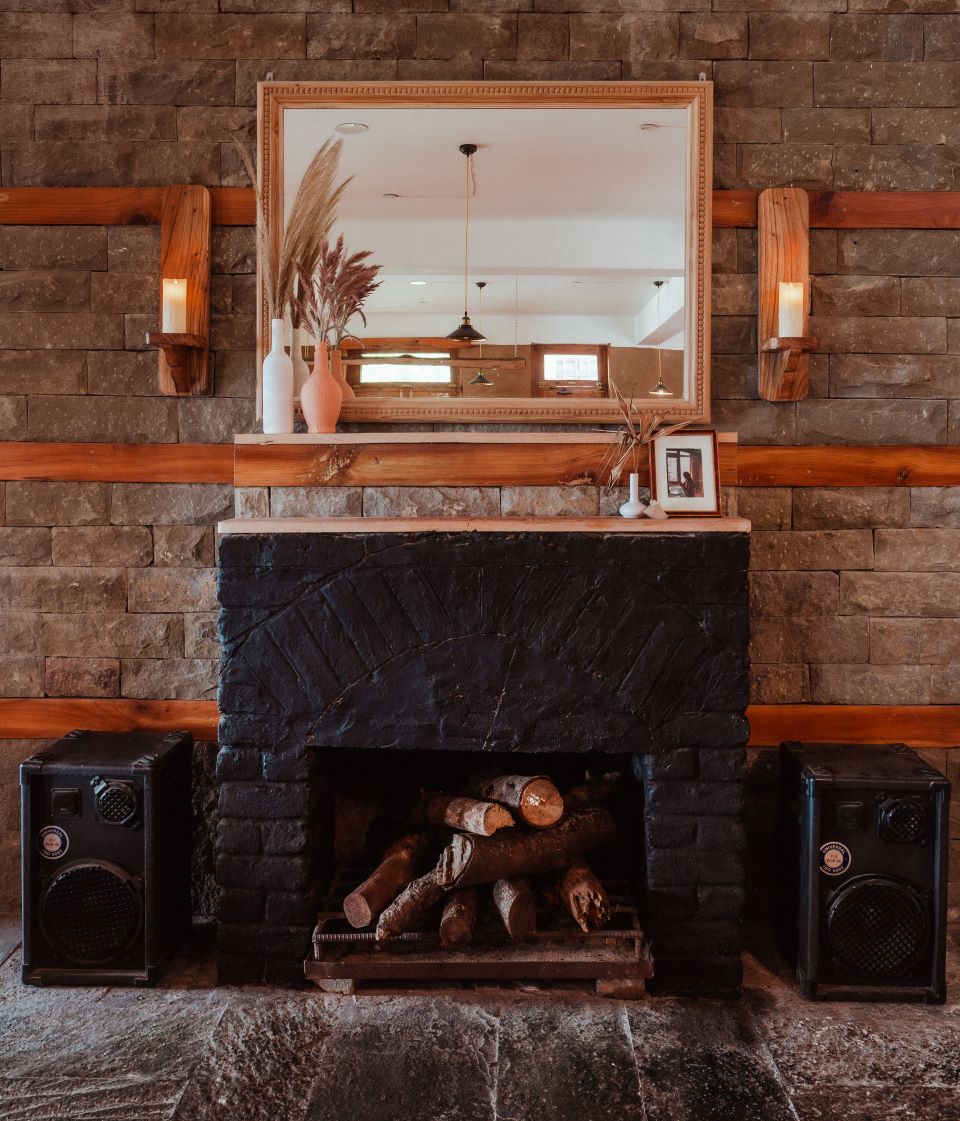
Built in brick and superimposed over a stone wall, the fireplace has been conceptualised as the hearth of the venue which rests upon the rugged charcoal slate floors. A custom wood-framed mirror rests above the wooden mantle, doubling the sense of visual volume indoors. The bar nook is earmarked by a hemispherical arched mirror lined with ebony voussoirs that recall the cafe’s visual branding as seen in their logo. Lined with a mirrored surface, the back-lit bar further amplifies the visual perception of the expanse of the bijou interiors and is neatly cordoned off by a pragmatic wooden bar counter.
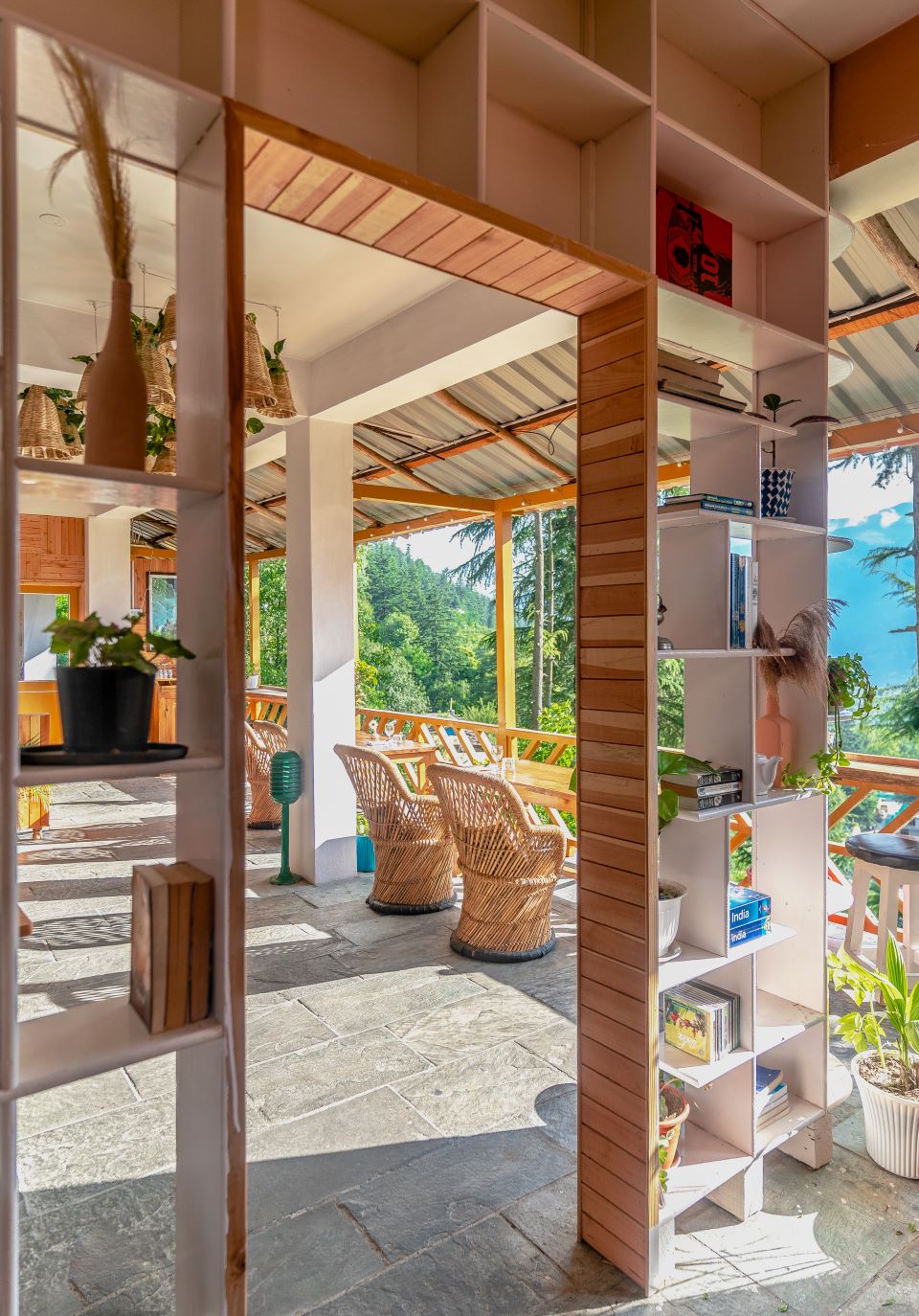
The homely identity of the cafe unfurls impeccably into the outdoor section, crossing over to the outside gently while silently communing with the surroundings. Versatile in its hosting configurations, the outdoor segment is a mix of cosy two-seater booths and larger community tables with wooden ledge seating.
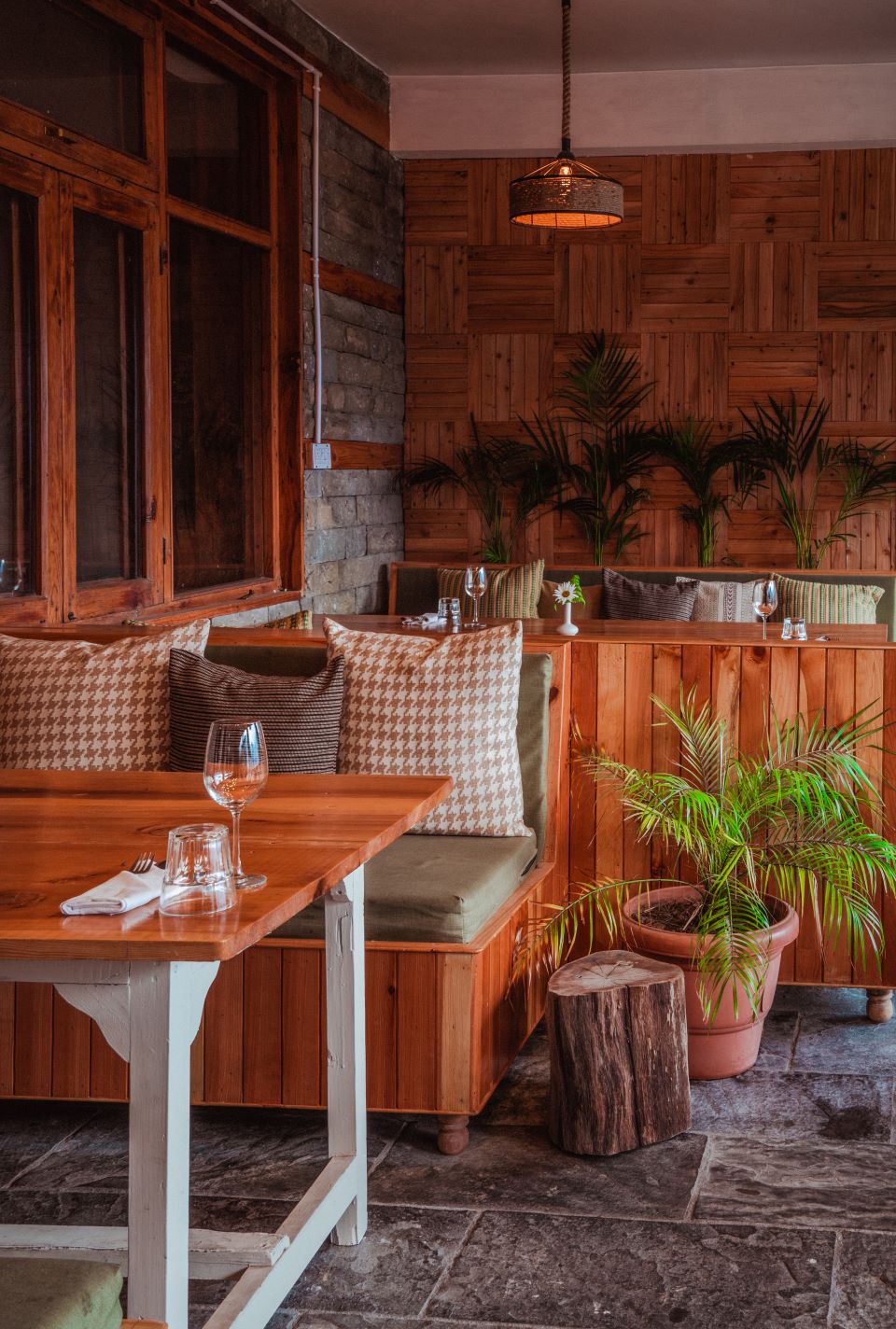
A voided geometric bookshelf cum partition system marks the entry into the outdoor section, defining the pattern of circulation. Raw and earthy materiality douses the alfresco dining area, highlighting the use of cane, jute, and natural wood in the palette. Locally bought cane chairs (mooda stools) have been oriented towards the views of the valley; they cast fleeting slatted shadows as the sun playfully traces its trajectory across the sky. Jute and cane get further carried on over to the lighting elements that crown the outdoor space, binding the visual montage. The dining booths and primary custom furniture have been finished in a collage of wooden strips with pronounced grains, a detail typical in mountain homes.
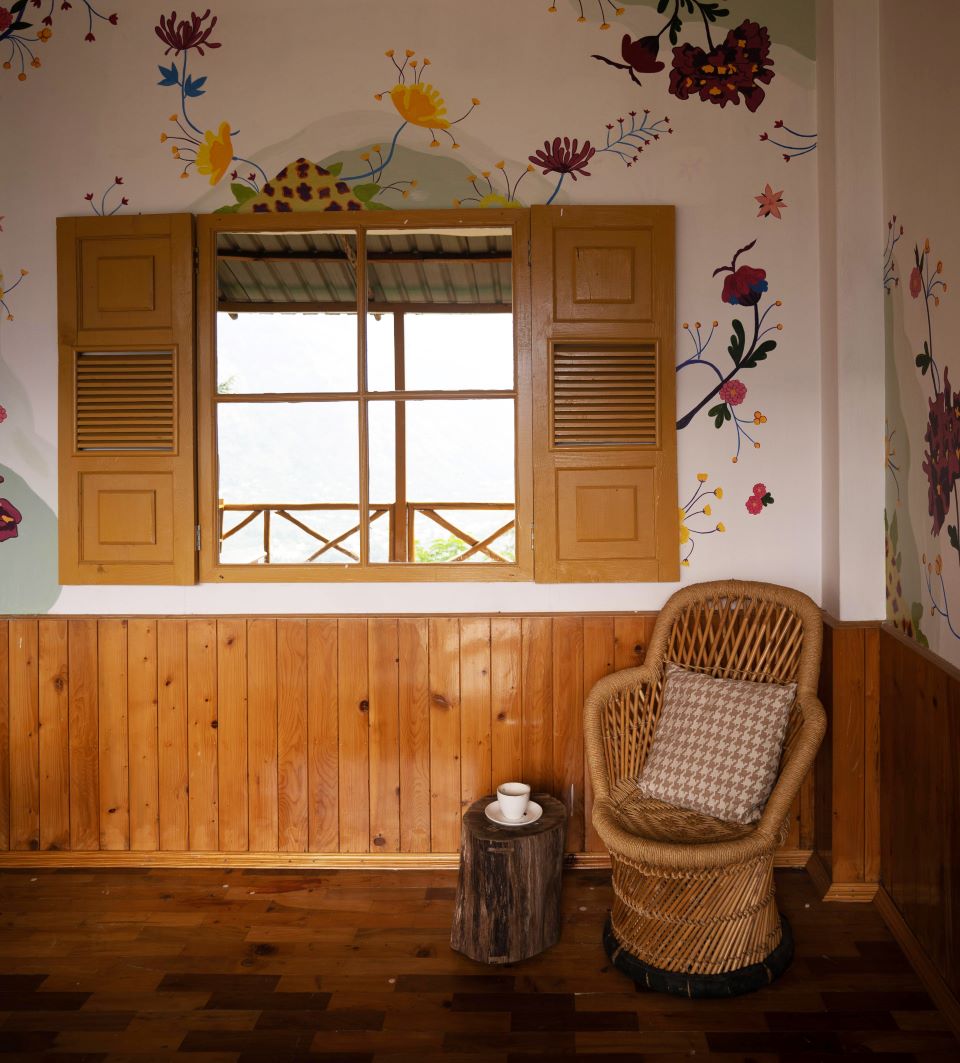
Housed behind a bright ochre door, the Secret Garden is a private dining section that enjoys surreal views of the surroundings. The pièce de résistance within this secluded nook are the walls that have been bedecked with hand-painted floral blooms to enliven snow-laden gloomy days (a composition ideated by graphic designer Anahita D’Souza and illustrated at the site by the client’s daughter Simran). An artisanal window frame in yellow has been fitted out with a mirror, creating an object of art that doubles up on the reflections of the pristine valley. This creates a lively backdrop for the low-seating configuration for patrons to gather around.
The material palette
Staying true to a context blessed with the bounty of nature in its untainted and lush demeanour, the design grammar resorted to at The Italian Café and Bar employed a sustainable and all-natural take on the materiality which manifests as an array of tactile textures that dot the spaces homogeneously. Walls clad in mud, the inclusion of stones, bricks, and natural wood layered with breathable upholstery make for a spatial scheme that is climate-responsive and habitable all year round.
Fact file
Project: The Italian Café and Bar
Client: Nightingale Cafe
Location: Naggar, Himachal Pradesh
Area: 3,000 sq ft
Principal architect: Chrisann Rodrigues
Design team: Keshvi Parekh
Add a Comment