
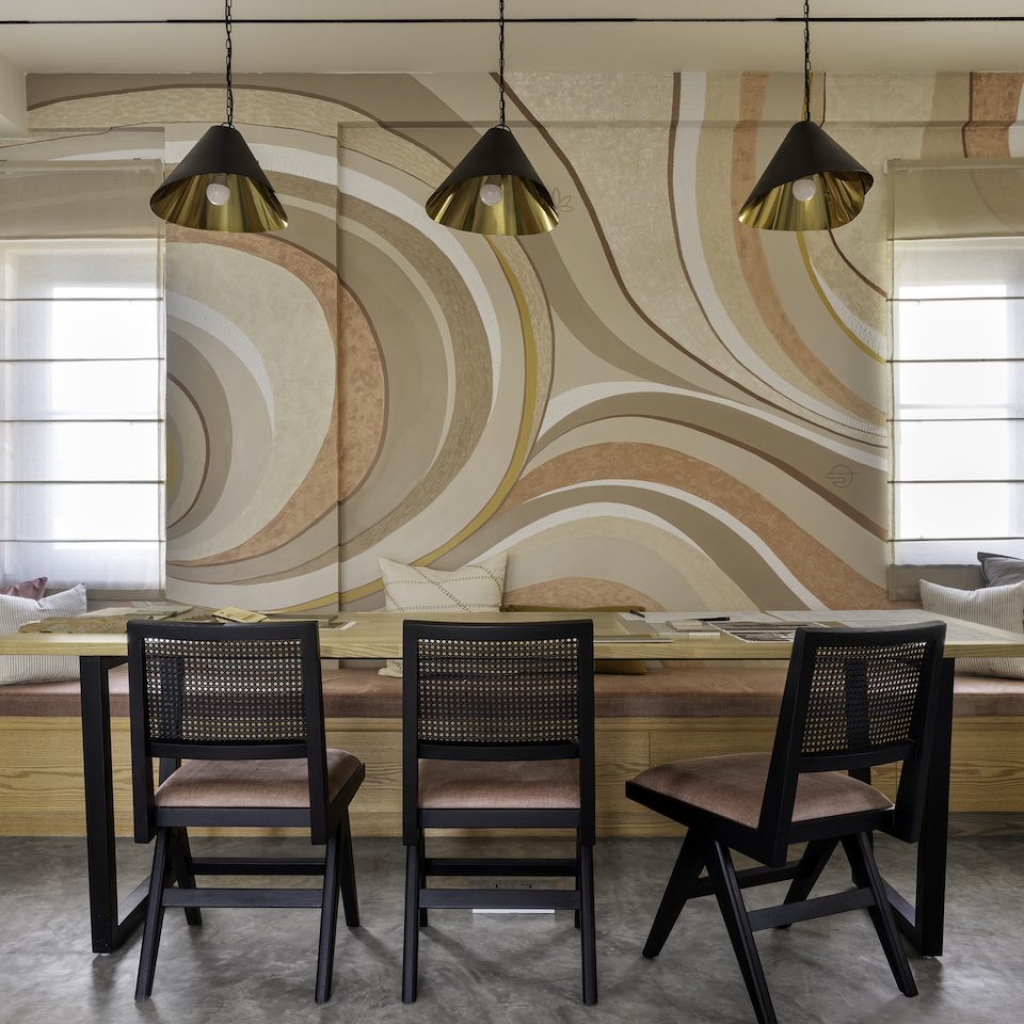
The Bengaluru workspace promotes interaction, collaboration and creativity.
Curated by: Rupali Sebastian
Photographs: Photographix India; courtesy House of Ruya
The site
This is the terrace floor of a building, and was constructed to satisfy House of Ruya’s requirements. Good daylight and ventilation drove the choice of site, with the view of the tree canopies being a bonus.
The brief
The brief was very simple in terms of layout: the team needed a workspace for the principal designer, an open workspace for the team, a conference room for discussions with clients and a small discussion table for the team. “The view of the tree tops gave us an opportunity to add a recess zone, a balcony. Apart from these major areas, we needed to accommodate a lot of closed storage space to keep our materials, files and catalogues,” says principal architect Aishwarya Govind, House of Ruya, of what they wanted out of their workspace.
“Aesthetically, we were always sure the space had to reflect some of the principles of design of the firm while not leaning towards any particular style ,” she adds. “We opted for a minimal space with a combination of traditional and contemporary vibe. This guided in the choice of materials and overall look and feel of the space.

The design intent
The design team needed a space that would serve them functionally and reflect their design principles in a subtle manner. They also opted to bring in the logo colour in a couple of spaces to reflect the brand image. Minimalism was the over arching design philosophy, seen in the manner in which the layout has been planned, the choice of materials, the colours, etc. Working with local craftsmen was also something Aishwarya’s team consciously did. “In this case, we worked with craftsmen from Karaikudi, Tamilnadu to get the oxide flooring and walls done in the most traditional/age-old method,” says the architect. “There are no chemicals or additives added to the material, thus making it sustainable and safe. We also worked with brass artisans to get inlay work done on the flooring. The large mural on the conference room wall was custom-painted by artists.”
The civil intervention
The complete space was built from scratch. “We followed basic vast and respected the plumbing lines of the building for ease of construction,” reveals Aishwarya.
The spatial flow
When you get off the lift on the fourth floor, you are welcomed by a cluster of rattan lights f on one side and simple brick cladded wall on the other. The main door bears a clean design with teak framing and laminated glass that gives you a glimpse of the office inside while it also lets in sunlight into the otherwise dark foyer.
As the door opens, you see a red oxide wall which carries the colour of the logo with the actual logo and name of the firm installed in brass. A simple waiting space with a couple of chairs completes this area. It connects to the balcony on one side and to the rest of the office on the other.
From the waiting area, the office opens up into one large space. The singularity of the space was maintained as a response to its compactness. The workstations are lined along the walls, keeping the central area free for a discussion table. On the farther end of this area lies the conference room and the principal designer’s office space.
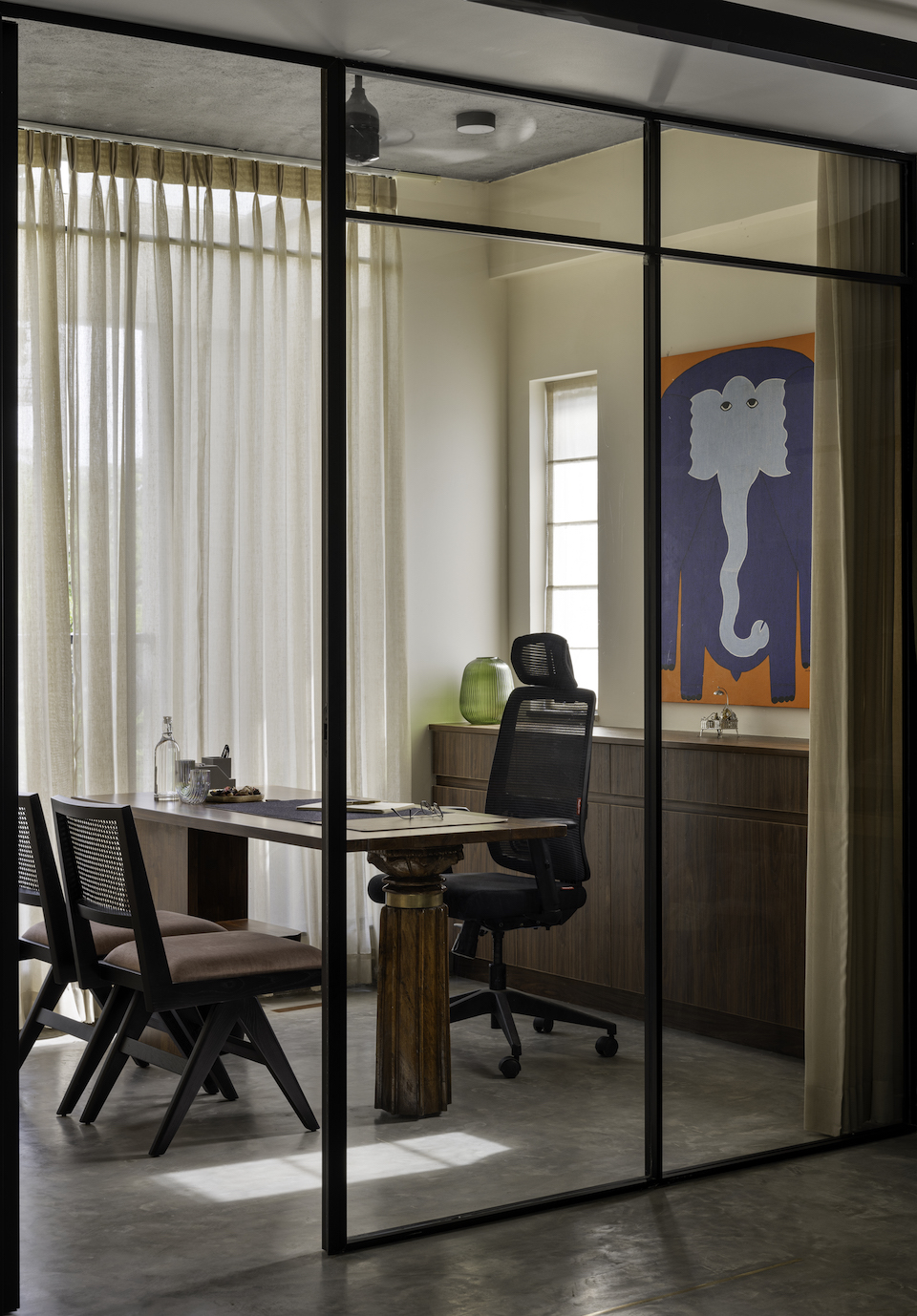
The principal designer’s office is planned in such a way that it enjoys adequate privacy, and, at the same time, complete visual connection with the rest of the office. Aishwarya’s desk has a teak wood table top with an interesting base. It has a contemporary look on one side with a shelf and clean lines, and a carved traditional teak leg on the other. This piece of furniture embodies the firm’s principle of juxtaposing traditional and contemporary elements.
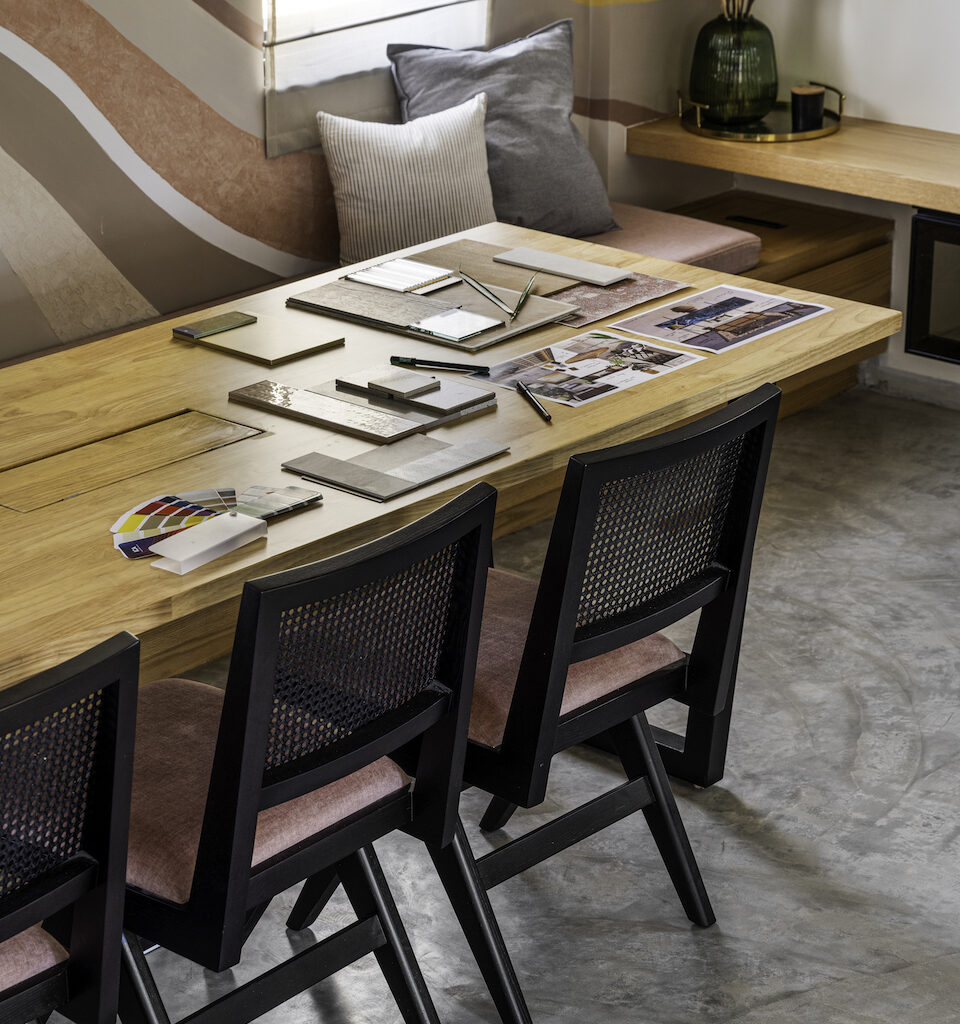
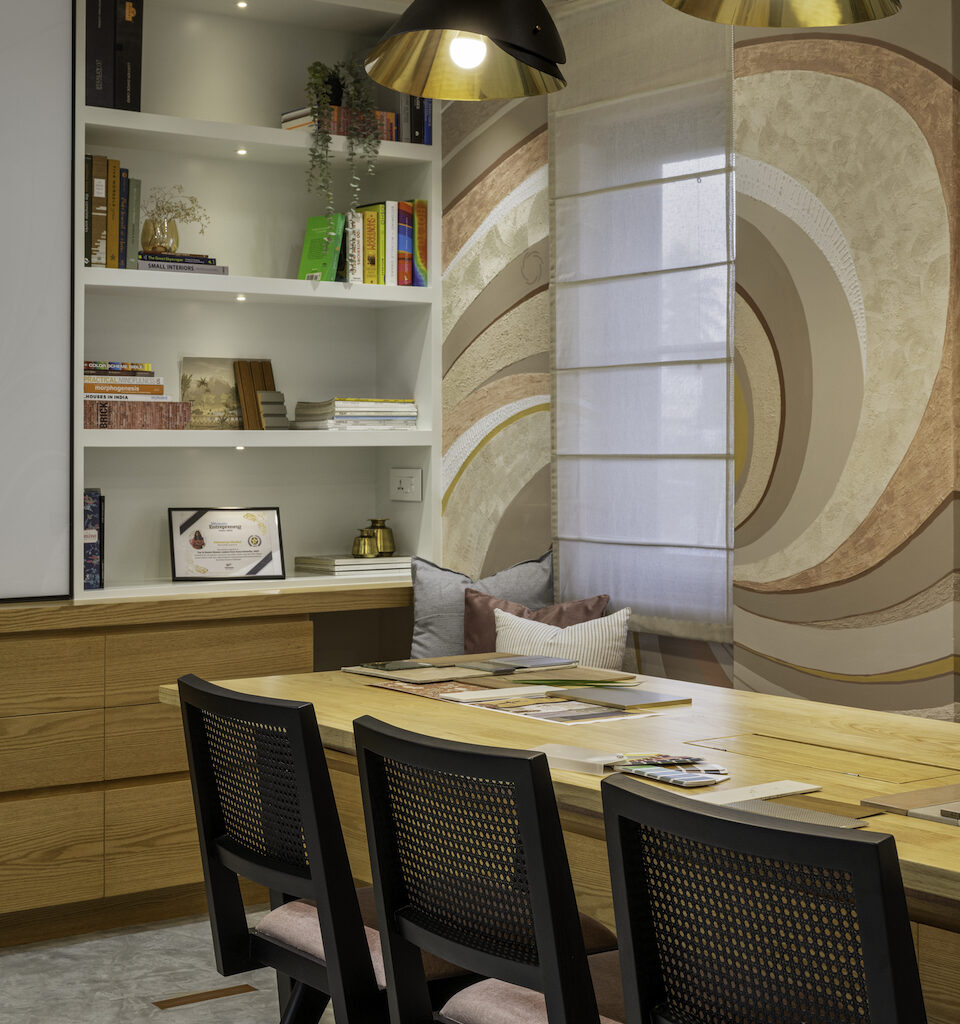
The work desk for the team sports a fixed rubber wood top with a pinboard above and combination of open and closed storage for immediate access to materials and files. In the middle sits a wrought-iron table with a glass top for quick discussions.
The conference room is segregated from the rest of the space with the help of clear-lass synchronised sliding doors. The back-wall is custom painted with abstract art in earthy pastel colours to give a soothing feel. The conference table features a simple rubber wood top with metal legs and Chandigarh chairs in black stained wood as a contrasting element. The conference room has a small pantry beside it followed by a toilet.
The balcony also carries a bit of the logo colour in the custom-printed tiles. The glass balustrade offers an unhindered view of the tree tops. “It is a pleasant way to spend evenings there with parrots and other birds right beside us,” smiles the architect.
The material palette
The material selection is eclectic and brings together vintage and current elements. The flooring is a spread of oxide with brick and brass inlay. Feature walls sport oxide finish, again, in red and off-white, while partitions are rendered from aluminium and glass.
The challenges
“When you are your own client, some decisions are quicker while some take a bit of time,” states Aishwarya. “We had to overcome this challenge. Also we had to get this 650-sq-ft space to accommodate our current and future needs — a challenge which was tackled with smart planning.”
Fact file
Project: House of Ruya Office
Location: Bengaluru
Area: 650 sq ft
Principal architect: Aishwarya Govind
Design team: Nida Afreen Nizar and Yeshaswini Mallidi
Add a Comment