

Studio Lagom script a distinctive and exuberant narrative by deftly balancing the old and the new.
Curated by: Rupali Sebastian
Photographs: Talib Chitalwala; courtesy Studio Lagom
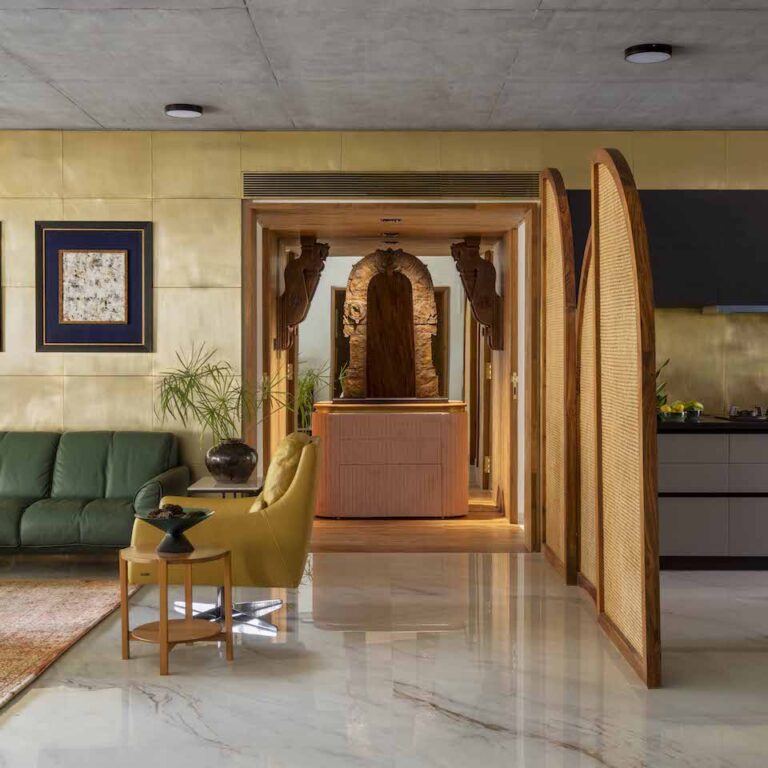 The brief
This 4BHK, 2550-sq-ft apartment had to be transformed into a home for a family of six: a senior couple, a junior couple and the latter’s two young children. The brief wasn’t elaborate, but its pithy content spelt out the entire design direction: a luxury that is sensed rather than overt, and a home with an Indian heart. “With this as a guide,” says Hardik Shah, founder, Studio Lagom, “the decision became to create a design with clean, simple bones, and then overlay this contemporary base with material applications that were subtle yet striking.
 The spatial flow
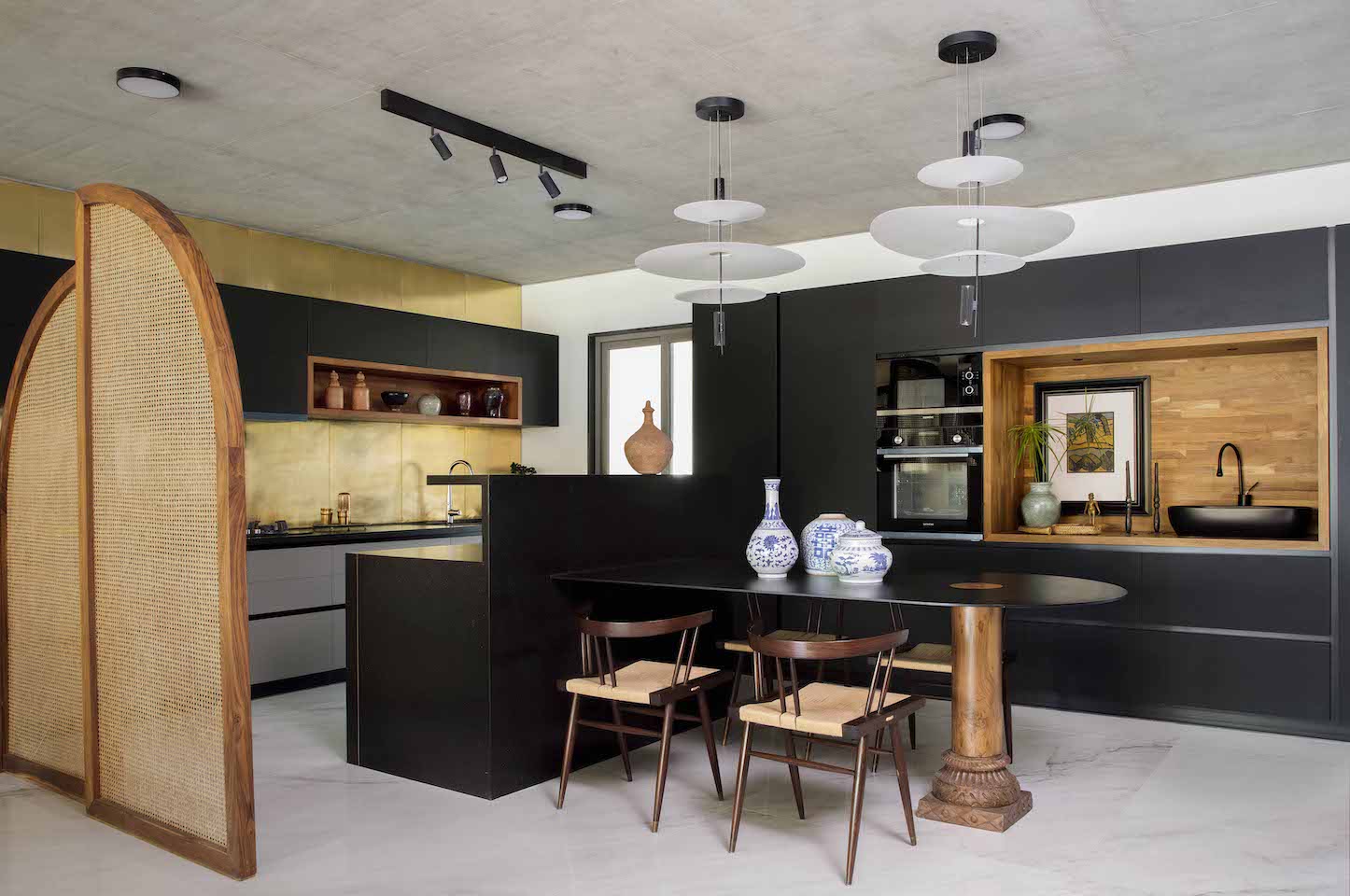
The spatial configuration is fairly straightforward: a central public/semi-private living-dining-kitchen zone is surrounded by three bedrooms and a multipurpose room (guest room cum family room). The living room, at one end, continues outside as a deck. Behind the living, a small nook is delineated as the puja area. Floor-to-ceiling mirrors increase its compact volume, and since it is positioned directly opposite the door to the living room, add illusory depth to the room. In the kitchen-dining area, the two functions are separated by a unit that functions as storage in the kitchen side and transforms into a dining table on the other.
 The material and colour directions
Materiality was articulated as reclaimed teak, metal (coated and natural), and tactile fabrics such as velvet. The chromatic direction remained on the neutral, earthy side (with the exception of the children’s room), accented with black. The finishes were consciously kept matte, rather than glossy, to strengthen the concept of effortless and timeless luxury.
Most of the entrance foyer is lined in reclaimed teak wood (which is the timber used throughout the house), and extends, quite literally, a warm welcome. One wall is clad in brass tiles, as a contrast and complement to the organic beauty of wood. The same material unfurls its burnished beauty on the 35-foot-long wall which spans the living room and the kitchen/dining functionality — establishing a singularity of volume.  However, an arched wood-and-cane screen achieves functional segregation while maintaining visual permeability. The ceiling was maintained in its exposed state, so now the concrete expanses lend a brutalist and solid counterpoint to the narrative that unfolds beneath. Soft furnishings are natural and detailed: quilted bed linen or velvet upholstery introduce tactile comfort and soft sensuality. Throughout the home, potted plants, small and large, add inimitable freshness to the spatial experience.
 The visual expression
Toeing the line of ‘just enough’ became critical to the success of this project. Luxury was interpreted as a luxury of materials, detail and traditional spirit rather than mere ornamentation. So while the material applications are generous, they are minimal, and entire volumes or expanses are delineated in a single material. Indian-ness is woven into the narrative through strategic infusions of materials and elements. The brass expanse is one stunning example. Others include the Prabhavali and wooden brackets of the puja area and the wooden column base of the dining table. Both have been salvaged from old homes.
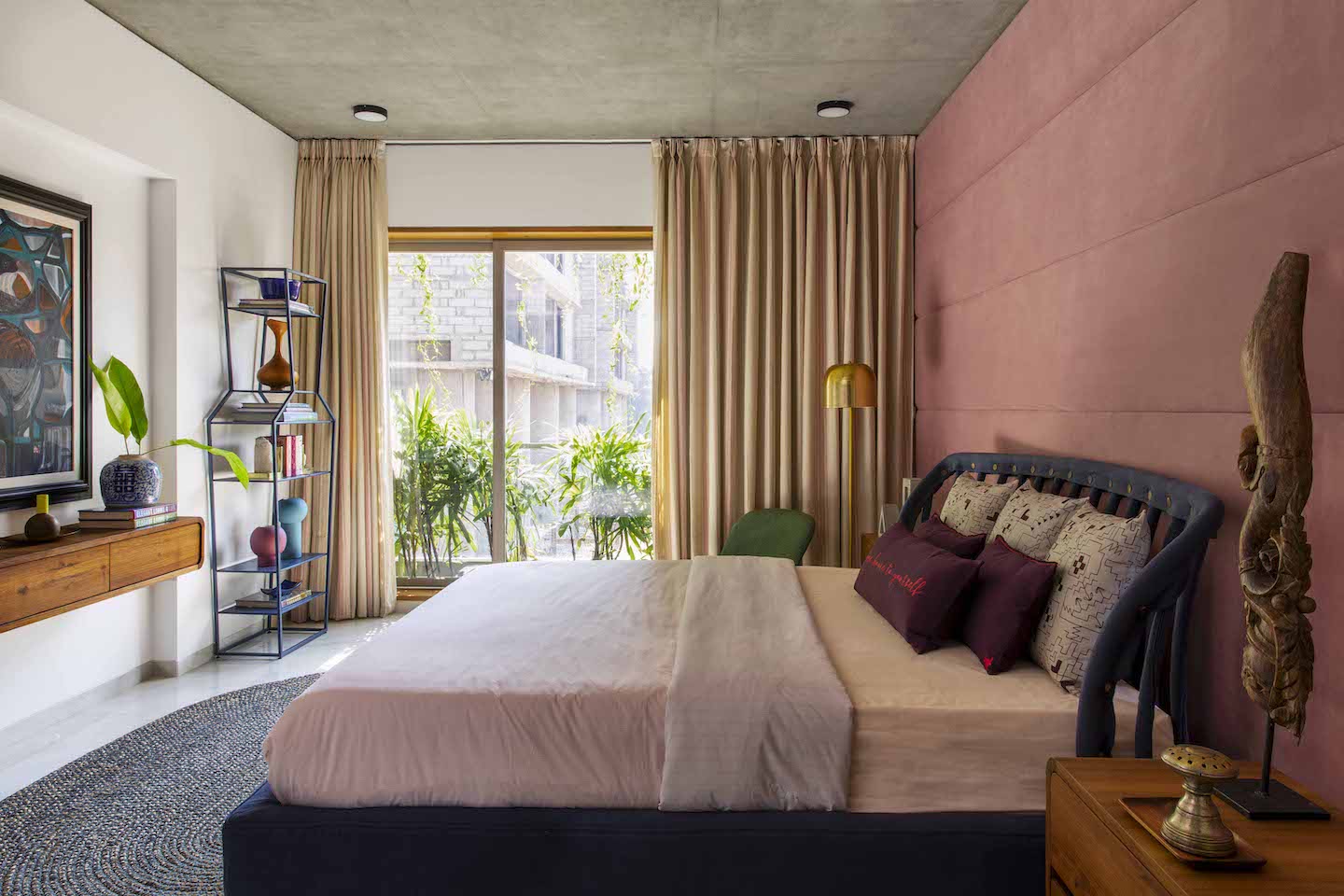 The private areas are tailored to the occupant’s age and preferences. While the senior couple’s room is distinguished by a deep forest-green wallpaper ornamented by motifs of fruit-bearing plants behind the bed, that of the junior couple has its wall behind the bed upholstered in dusty-pink velvet. The children’s room has a study table showcasing vibrant Piet Mondrian-like shelving. The multipurpose room, with its low platform bed, is surrounded by a lushness of frangipani, rendered as a bespoke wallpaper and blinds.
Fact file
Project: The Brass Wall House
Location: Surat
Area: 2,550 sq ft
Principal architect: Hardik Shah
Project architects: Krishna Kapadia and Madhavi Gumasana
Design team: Arpita Joshi, Shweta Gajiwala-Doriwala and Vishnu Rabari
Styling: Samir Wadekar
Add a Comment