
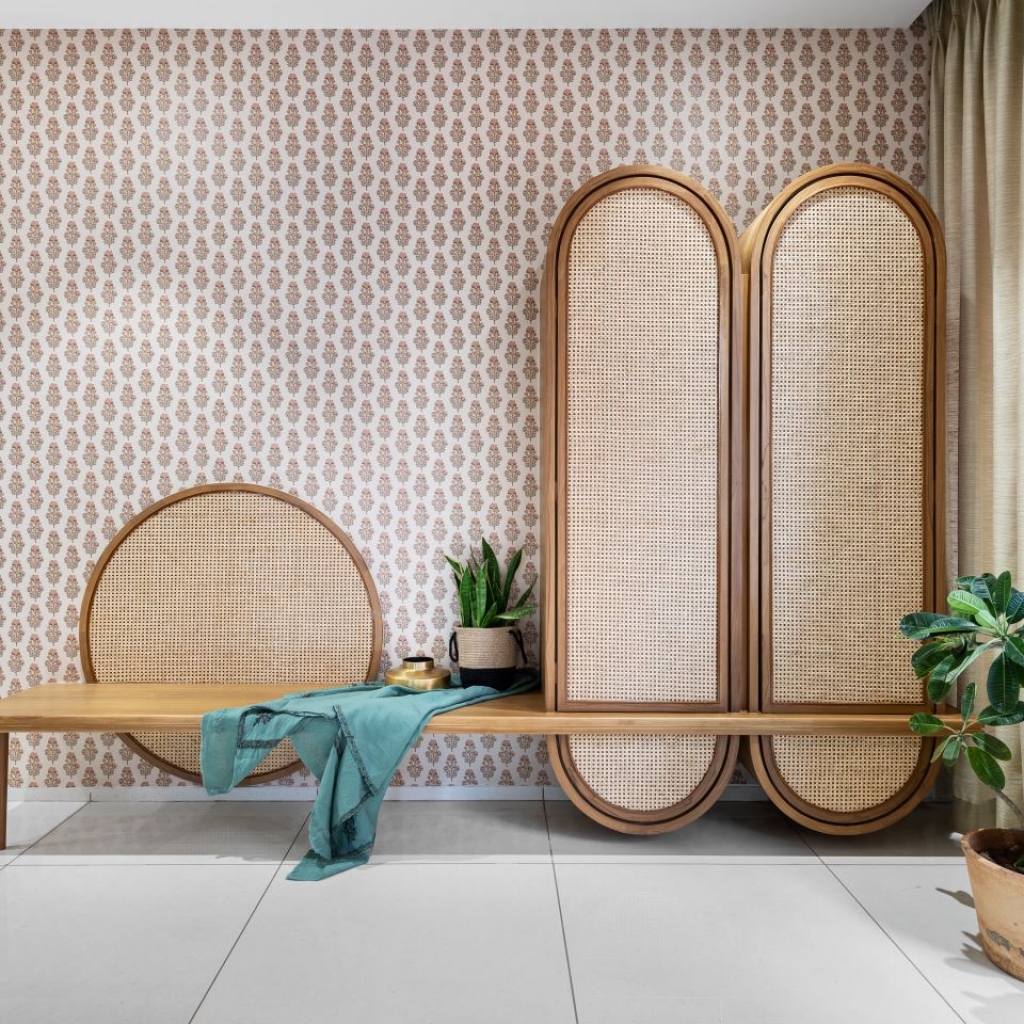
Green Squares Design Studio designs a functional and contemporary apartment with traditional touches for a nuclear family in Gandhinagar.
Curated by: Deepa Nair
Photographs: Photographix India; courtesy Green Squares Design Studio
The site
Megh Malhar project designed by Green Squares Design Studio is a 3BHK apartment which is spread across 1,200 sq ft. Located at Sargasan, a newly developing residential area in Gandhinagar, the apartment is part of a building which faces a central open space that comprises of multiple green pockets, sitting areas and a play zone for children.
The brief
The clients assigned architect Bhavik Mehta and interior designer Jaimini Mahida, founders and principals of Green Squares Design Studio, to craft a contemporary home with hints of the traditional Indian aesthetics. The pooja space was important to them and they wanted it to be a well-lit, open corner and the highlight of the whole apartment.
The spatial configuration
The apartment’s original floor plan called for an open living room with a huge gallery space. This space connects the master bedroom, dining area, and kitchen with a spacious passage where the puja is located. The dining room is the apartment’s principal gathering place, and it was designed with great care. This area also serves as a link between the daughter’s room and the guest bedroom.
The design intent
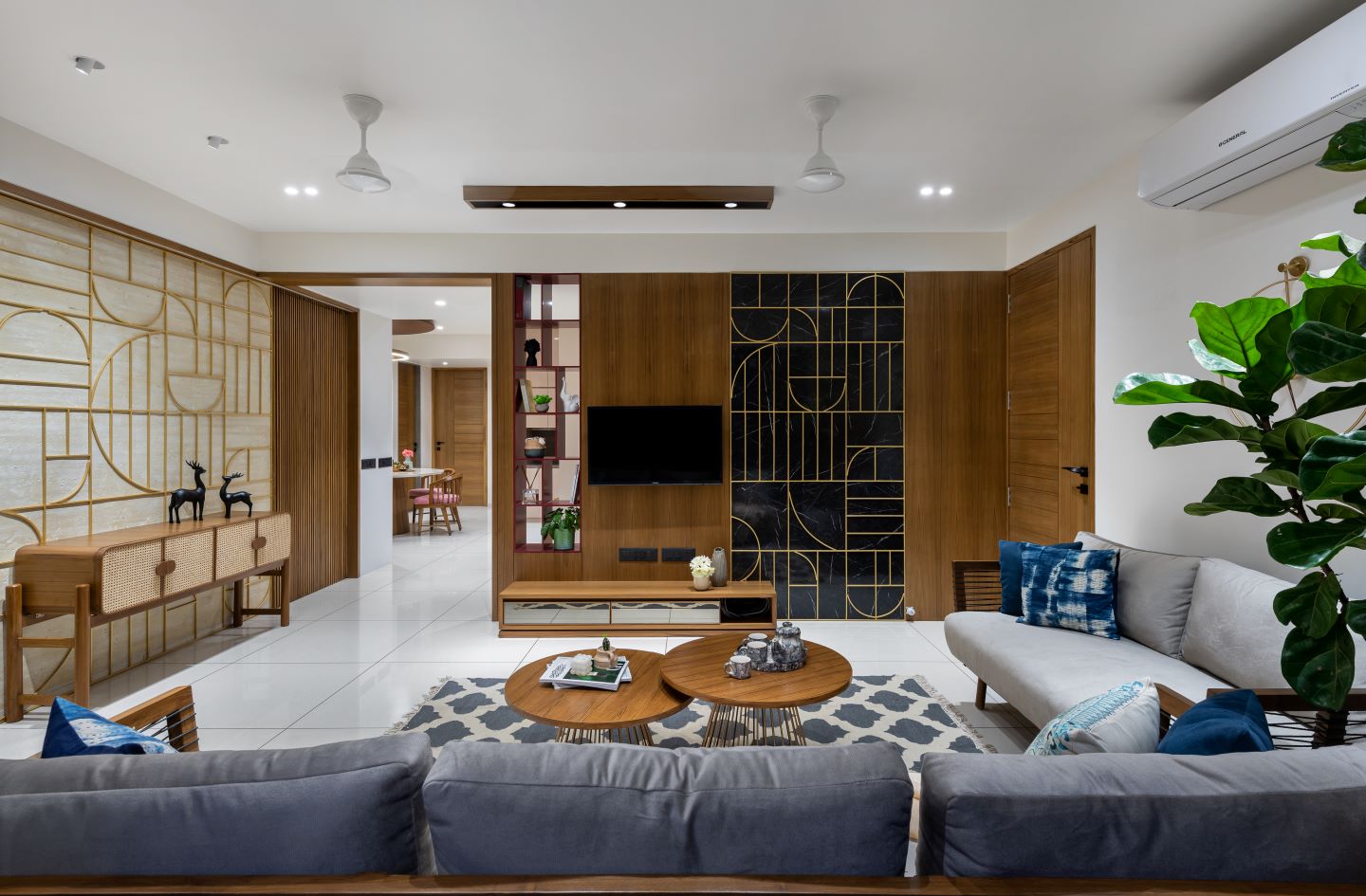
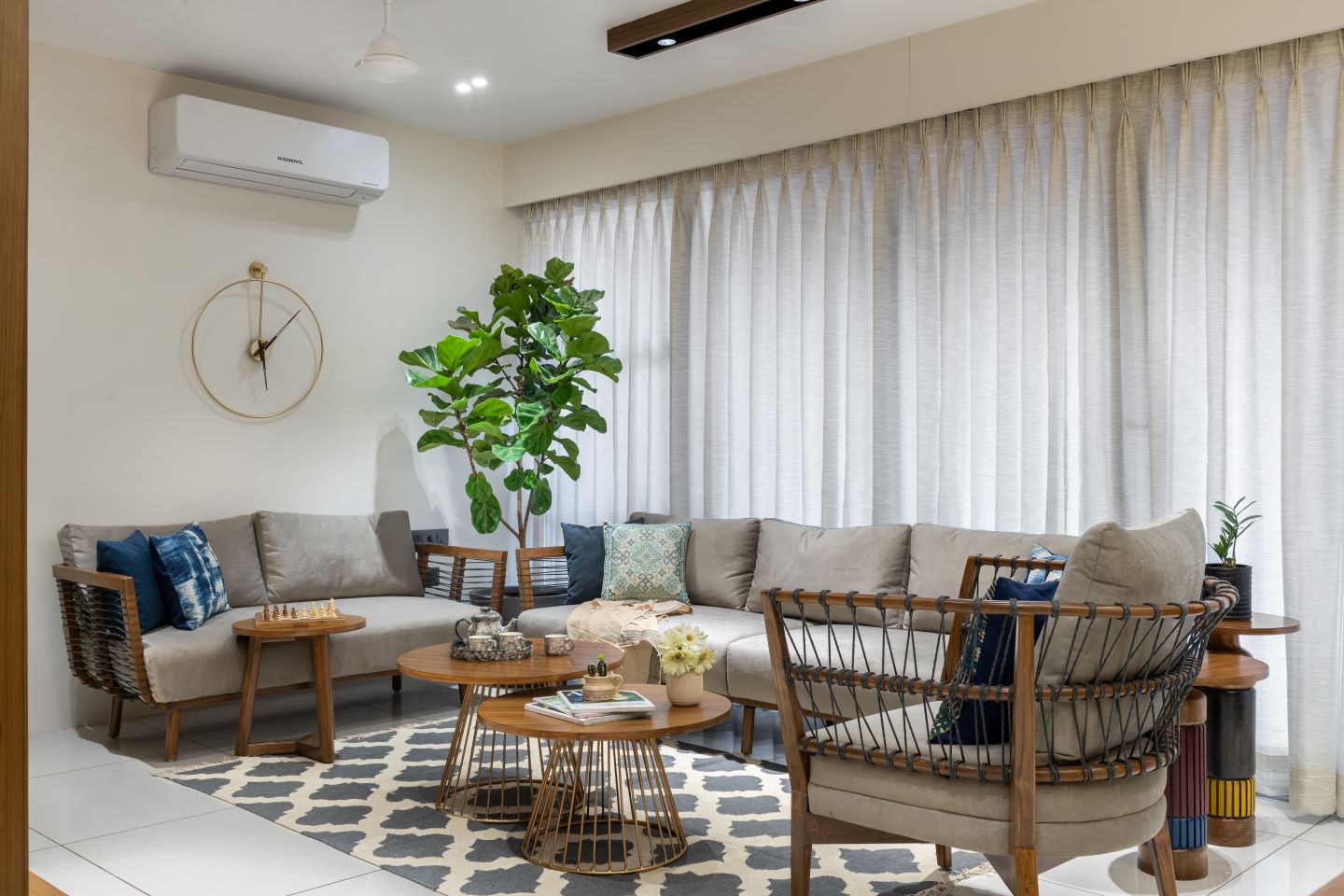
“The residence is a manifestation of vernacular methods in a contemporary manner. The material palette is a combination of the subtle and earthy beige of cane, and the strong and impactful wooden brown highlighted with the sheen of brass. They are all bound together with the neutral grey,” says Bhavik. “The entire house is sown together in this palette with curves as a highlighted geometry. Arcs, arches and circles tie the house in a singular theme and allow seamless transition from one space to another,” adds Jaimini.
The design and material details
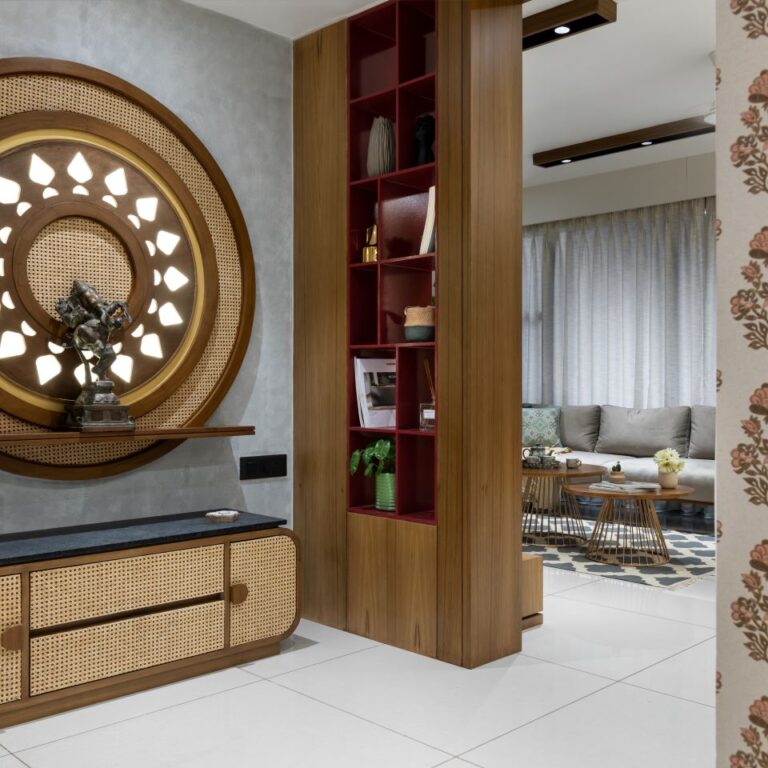
The entrance door (featuring wooden jaali-work and squares in granite) opens to reveal a feature wall in the living room. The living room wall is designed with a beige travertine and brass-plated rod frame, supported by wooden strips. The TV panel continues the brass plated frame of the main feature, but with a contrasting black marble finish laminate as a background. These panelled walls are further highlighted with a subtle grey modern sofa with a roped armrest design. The centre table with brass legs continues the use of the material palette. Another key feature of this room are the wooden side tables designed as an extension of the theme — circular geometry and hues to contrast the subtle colour scheme.
The pooja space is manifested as a complete circle resembling the aura around the idol. The element is designed such that each layer incorporates the material palette within it. The panel is supported by a cane console with a granite top. Both the living room and the pooja space consoles are crucial to create a seamless transition from the living room to the dining.
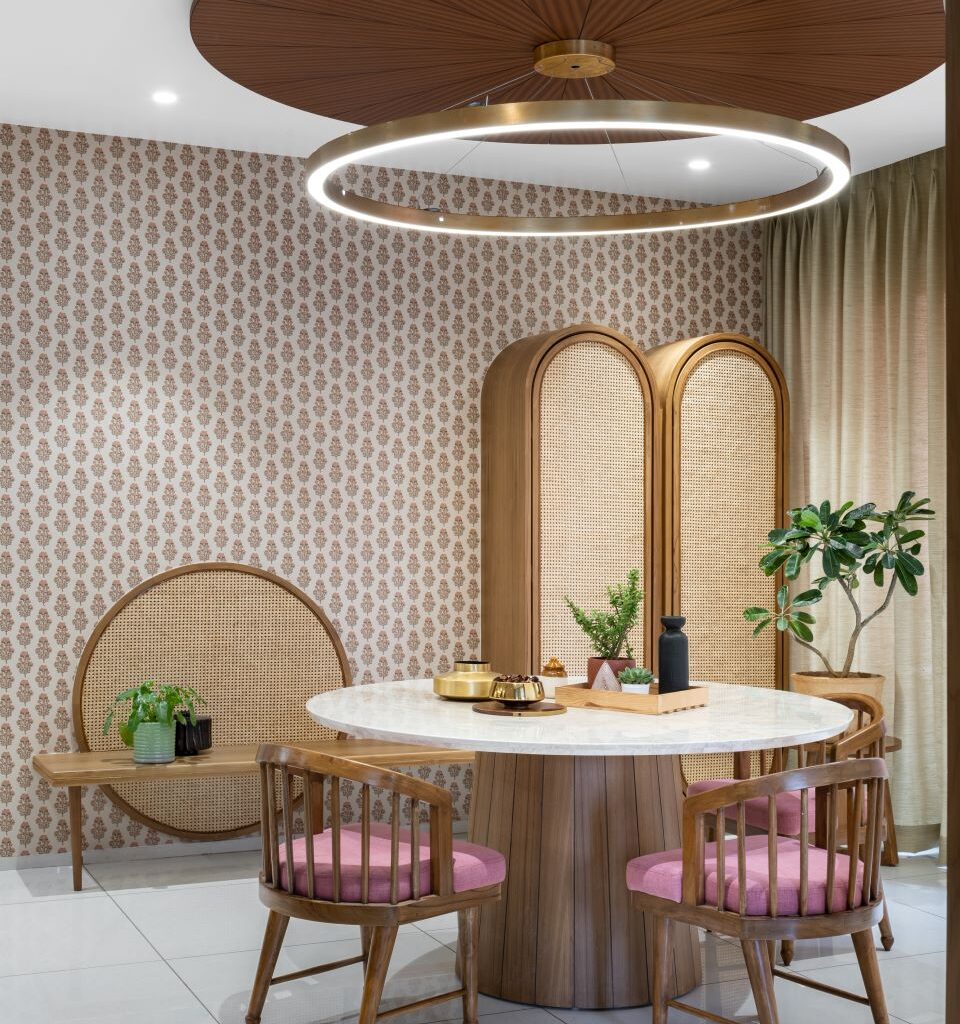
The dining room is a crucial space as this is where the family meets, eats and converse gets-together after a busy day. This brief led to its design as not just a functional space but as the core of the house. The Italian marble top of the dining table has a circular wooden ceiling and a circular suspended light fixture hovering over it. The crockery unit in cane and the cane back panel of the ledge continues the design language. The space is completed with Sabyasachi’s Nilaya wallpaper. Adjacent to the dining area is the kitchen with earthy-hued overhead units that complements the dining space, and dark-coloured lower units to give the platform a floating effect. This also help reduce the emphasis on the kitchen space and highlight the dining area.
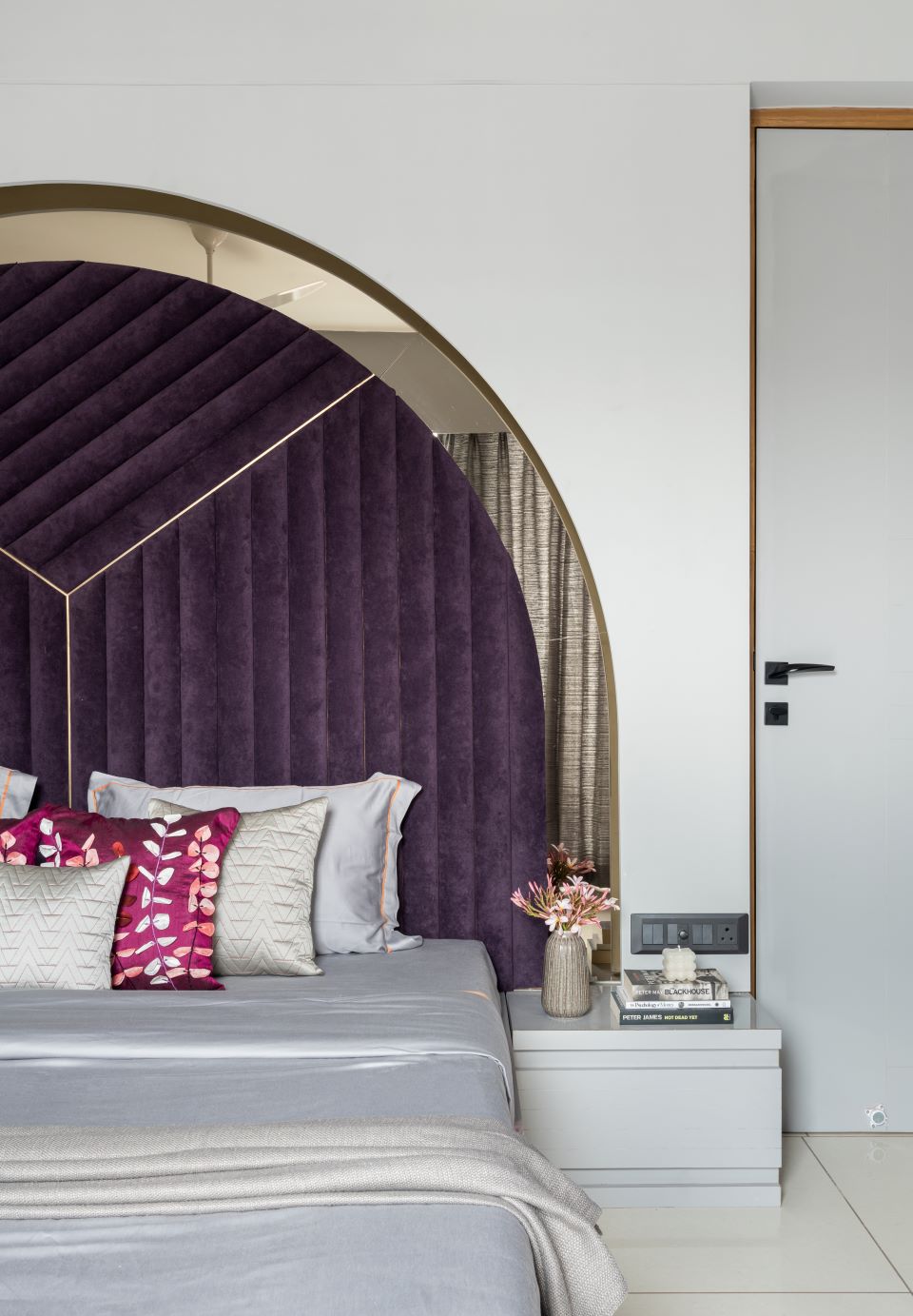
Close to the dining are the bedrooms for the daughter and guests. The daughter’s room with a window in the east wall brings in the morning sun which is enhanced with a deep purple upholstered headboard, and bronze mirrors lining its edge. This semi-circular headboard is matched with a similar mirror on the wardrobe doors. The shades of purple are a reflection of her personality and which is celebrated in her personal space. The guest bedroom’s window lets light into a camel yellow fluted wall behind the bed. The golden glow emitted by it is supported by a black upholstered headboard. To help perceive the room as a bigger space, the wardrobe is designed to float with a bronze mirrored lower cabinet and a deep niche created at the bed level.
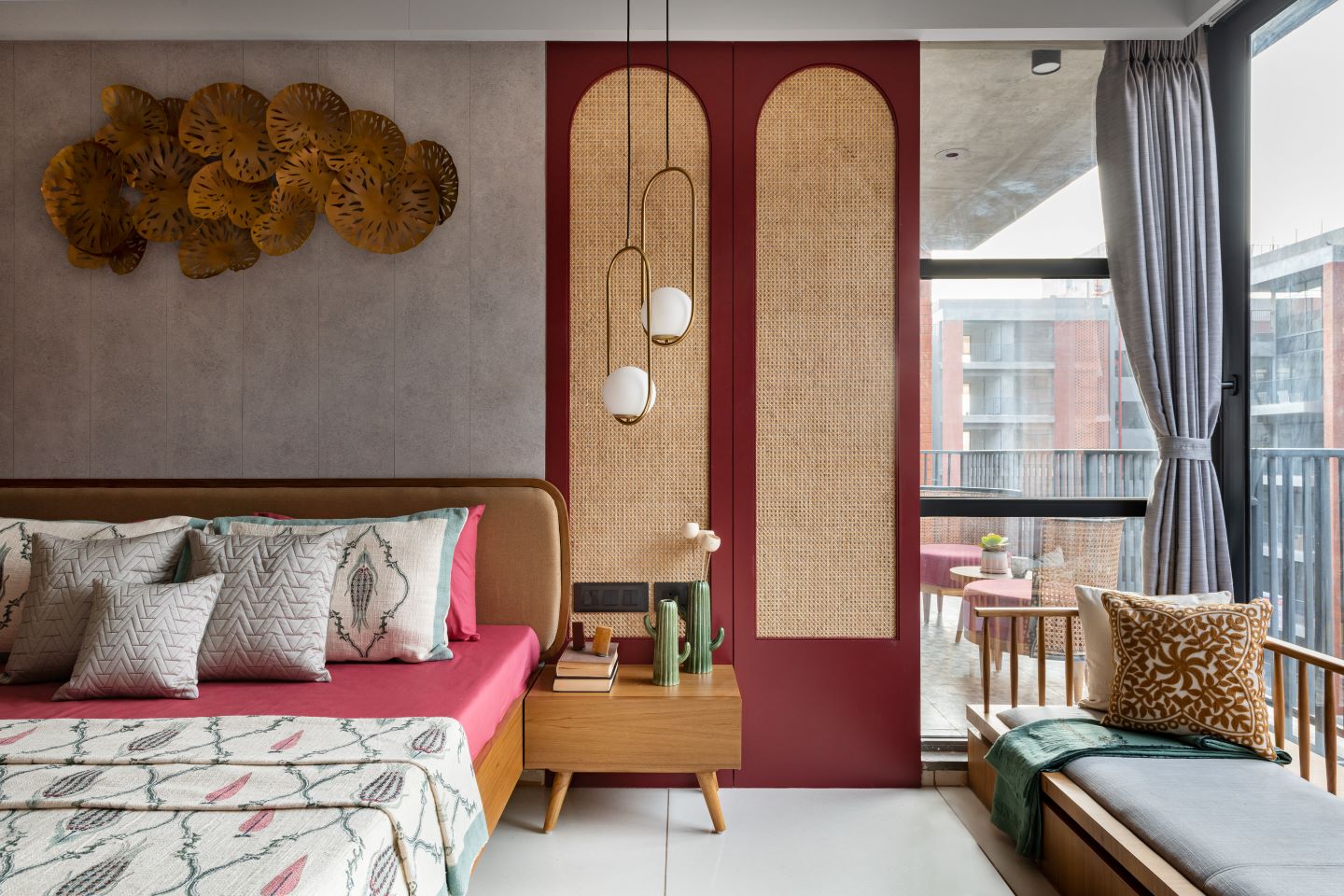
 The master bedroom sees a play of crimson and grey on its walls — the use of crimson helps acknowledge the evening sun which floods the room. The low Indian seating adjacent to the window makes for a comfortable space to look over at the landscape area of the apartment scheme. The seat continues to form the study table tucked along its line and this unit acts as a clear demarcation of these spaces from the sleeping zone. The bed has a symmetric back panel in cane with brass-hued artefacts in the centre.
The residence is a showcase of exploration of material under a theme, from brass plated frames to bronze mirrors and from beige cane to beige Italian marble. Also the selection of curtains, upholstery, bed linen, artefacts and house plants all complement and highlight the space and its various elements.
The challenges
“The brief which did not bind us in any constraints was a challenge in conceptualising the design. With numerous possibilities of creating a balance between contemporary and traditional, choosing a final palette of design, materials, colours was demanding. The transition from living to dining houses the pooja space and the entry to the master bedroom. The door to the master bedroom was directly visible from living and requirement of a privacy was a big challenge. The door to the master bedroom is camouflaged in the feature wall panelling,” says Bhavik.
“Also, dividing and uniting the dining and kitchen was another pause in the design process. The length of the dining space, passage and kitchen had to be controlled. We decided to extend the platform kitchen towards the dining to balance out the length making each space of equal size connected by an open, unobstructed passage,” adds Jaimini.
Fact file
Project: Megh Malhar
Client: Abhishek Davda
Area: 1,200 sq ft
Location: Sargasan Cross Roads, Gandhinagar
Principal architect: Bhavik Mehta
Principal designer: Jaimini Mahida
Design team: Dhun Shah
Add a Comment