

MISA Architects metamorphose an industrial office located in close proximity to Mehsana’s Thol Lake Bird Sanctuary into a lush courtyard-dotted, surreal space, actually visited by birds, rain, and sunshine!
Curated by: Ambica Sharma
Photographs: Inclined Studio; courtesy MISA Architects

The site
Placed within 10 kms of the Thol Bird Sanctuary, on the outskirts of Ahmedabad, the industrial office space for Ornet Transformers is spread across 6,000 sq ft. The site is surrounded by large agricultural land parcels, low density human settlements and a handful of industrial setups. The main attraction here remains the winged kind — especially migratory birds such as flamingoes and Sarus cranes. The region is also home to mammals such as the blue bull, striped hyena, golden jackal and the black buck.
The brief
The client required a corporate office for staff members numbering more than 40. The space had to include a reception, waiting room, conference room, directors’ offices and workstations for various departments. “Aesthetically, the client was completely onboard with our conceptual idea, to transcend the physical, psychological, and ideological boundaries of the usual office space,” say Tarun Patel and Vipul Jiyani, principal architects at MISA Architects.
The design intent
The concept of the design is based on an infinity loop of two ideas: First, was to create a space that would embrace and accentuate the surrounding natural setting. And second, to make a workspace that speaks about the owners and users of the space — their tenets and way of life. “Can you imagine a workplace that feels like a rainforest? Can you turn your office space into a source for fresh air, lots of sunlight and even occasional rainfall? The Ornet Transformers’s office is a miniature ecosystem that brings life to this idea,” says Tarun.
The civil intervention
“The site was a monolithic space, and gave us an opportunity to make meaningful interventions,” says Tarun. To break the stereotype and achieve the design intent, the peripheral walls were knocked off till sill level, to open up and create a seamless visual connection with the outdoors. This also allows the interiors, via glass partitions, an uninterrupted access to the peripheral verandah. Additionally, the verandah is a buffer for blocking heat, while allowing in ample sunlight.
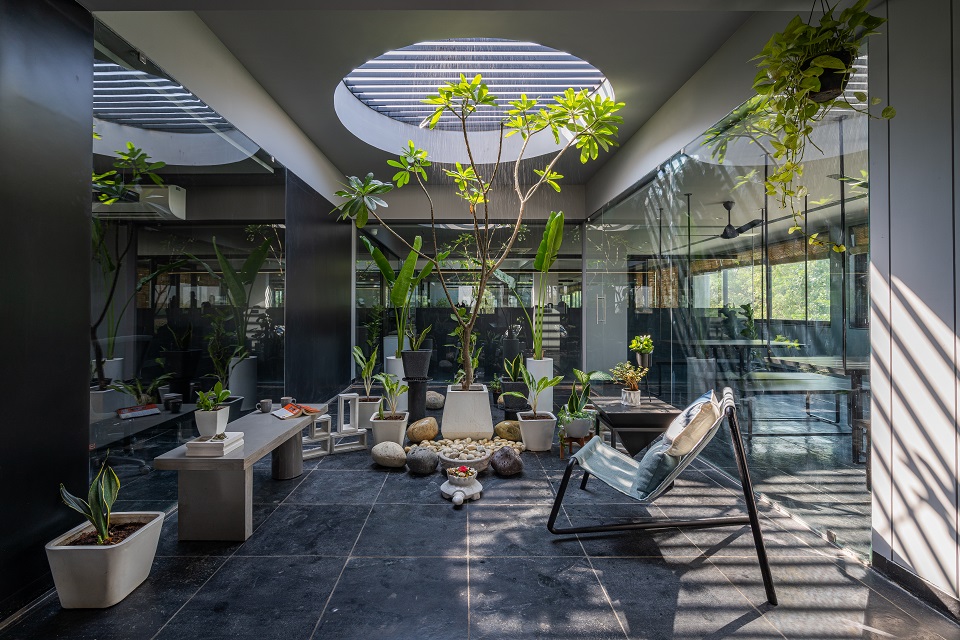
Three space-defining, sequential, open-to-sky courtyards have been placed along the central core of workstations and standalone units. “The 10-foot diameter skylights of these courtyards help trace the sun’s movement through the day, making patterns of light and shadow with the pergolas, while offering a thoroughfare for birds and rain!” explains Tarun.
The spatial flow
Planned in a way to afford choices to a user, the flow of the office can be bifurcated into two: exploring it via the discovery of the courtyards, which prompt a break. Or, observe and absorb the abundant nature outdoors, while on the adjoining shop floor along the peripheral verandah, which is designed to be a consolidated and interconnected passageway. “On sunny/rainy days one can take the shaded verandah, while on more pleasant days, the courtyards are bound to get busier!” states Tarun.
The material and colour palettes
In order to implement the idea of accentuating the nature-dominated theme of the interiors, an inverse canvas, using black, was created. Cuddapah stone in cathedral finish flows across the floors, and the greens of foliage have been used to break its monotony. Meanwhile, bamboo blinds cover the windows. The juxtaposition of colours and materials creates a canvas similar to the one outdoors.
The challenges
In defense against the arid climate of Ahmedabad, a substantial portion of usable floor space has been devoted to the verandah and the courtyards. This is the core intervention that prevents resorting to artificial climate-control measures. “These three courtyards are the lungs of this space, they purify the air and cool down the ambient temperature,” the architects tell us.
The highlights
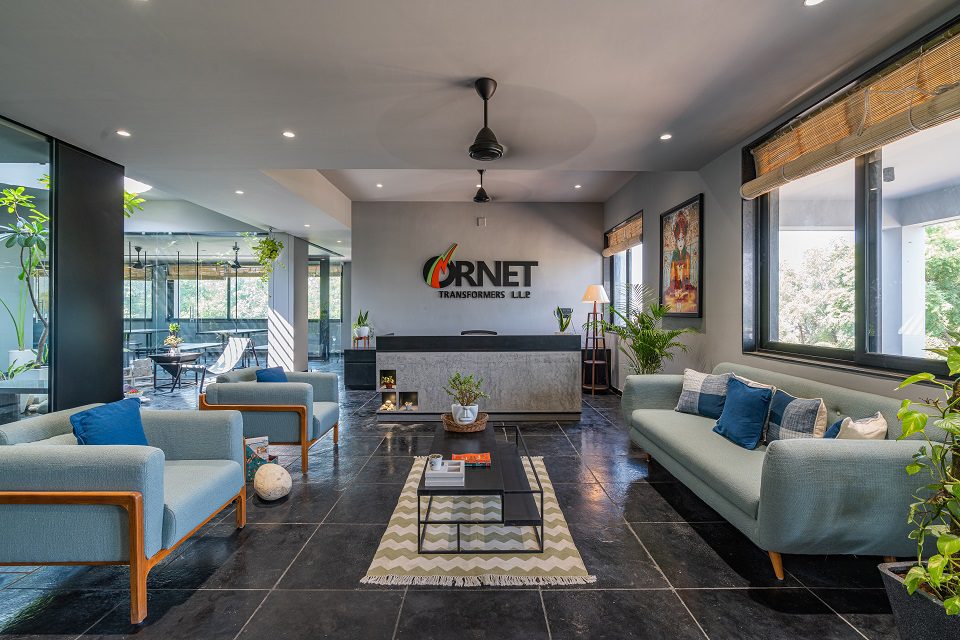
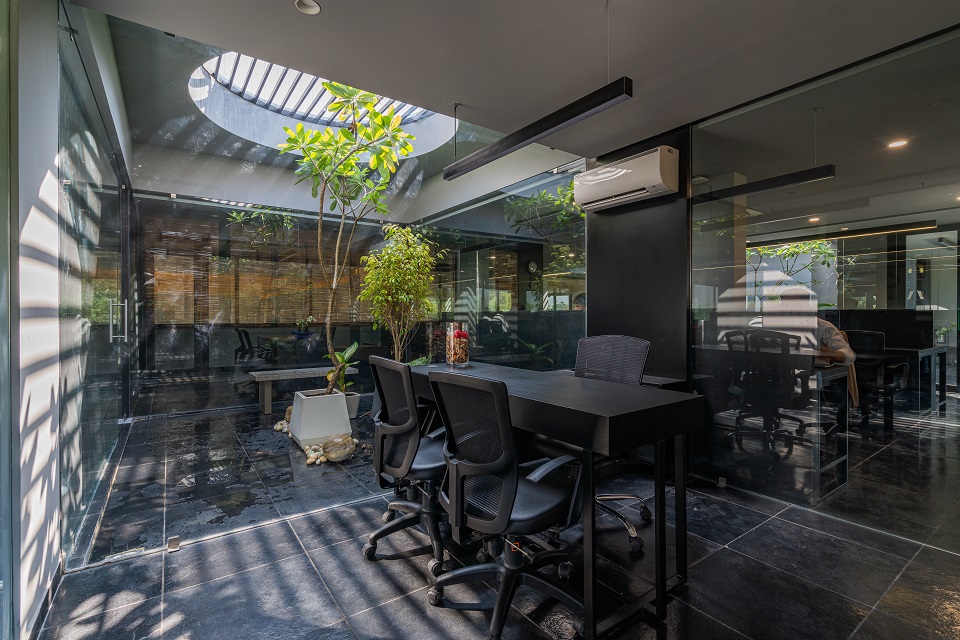
The open-plan layout of the office is manifest not only in its physical space, but also in the vibe it generates. The central core comprises workstations and units, the receiving lounge, the conference room and the directors’ offices are all designed uniformly, and have the same view, and the adjoining courtyards. Every user of this office space moves through these courtyards, experiencing the same stimulus of joy.
The takeaway
The inspiring and dedicated work put in to create a work space, without compromising on the innate need of humans to remain connected to nature, to their surroundings, places the Ornate Transformers’s office a step above the rest. “Our courtyards have started attracting a myriad species of birds from the nearby bird sanctuary. Our biggest takeaway was that it is possible to bring minimal to zero interference to the natural habitat, in all our projects irrespective of its size and use,” says Tarun.
Fact file
Project: A Rare Continuum
Location: Thol Lake, Mehsana, Gujarat
Area: 6,000 sq ft
Principal architects: Vipul Jiyani and Tarun Patel
Design team: Rahul Jariwala, Anand Jasani, Mitesh Patel and Pratap Suthar
Add a Comment