

Atmosphere Design Lab creates a facade that impresses with its unique design, and a charming practical office space which allows two companies to co-exist peacefully — both at Manath Enclave in Kochi.
Curated by: Deepa Nair
Photographs: Justin Sebastian; courtesy Atmosphere Design Lab


The site
Atmosphere Design Lab’s latest project, Manath Enclave, is an office building in Kochi which harbours their office on the third floor — a space they share with Mecone Construction Contractors. The site for the building is abutted by roads on all four sides, and is situated right behind Olimughal Juma Masjid on the Seaport-Airport Road of Kochi. Architects Mohammed Shaheen and Nikhil Rajan of Atmosphere Design Lab received the building with almost 80 per cent of its construction already in place. This ground plus three floors building is spread across 12,000 sq ft, with each floor spanning 3,000 sq ft.
The brief
The client, MI Mohammed, wanted a captivating facade design for the building… one that would stand out from the crowd, a landmark in that area. The third floor of the building which would house the offices for the client and Atmosphere Design Lab was also to be designed by the architects. The design brief for the two offices included a staff area for 20 people, cabins for the directors of Mecone Construction Contractors and the principal architect of Atmosphere Design Lab, a conference room, file storage room, server room, pantry areas and washrooms. Additionally, the studio also created co-lab spaces and discussion areas for their team meetings.
The facade design
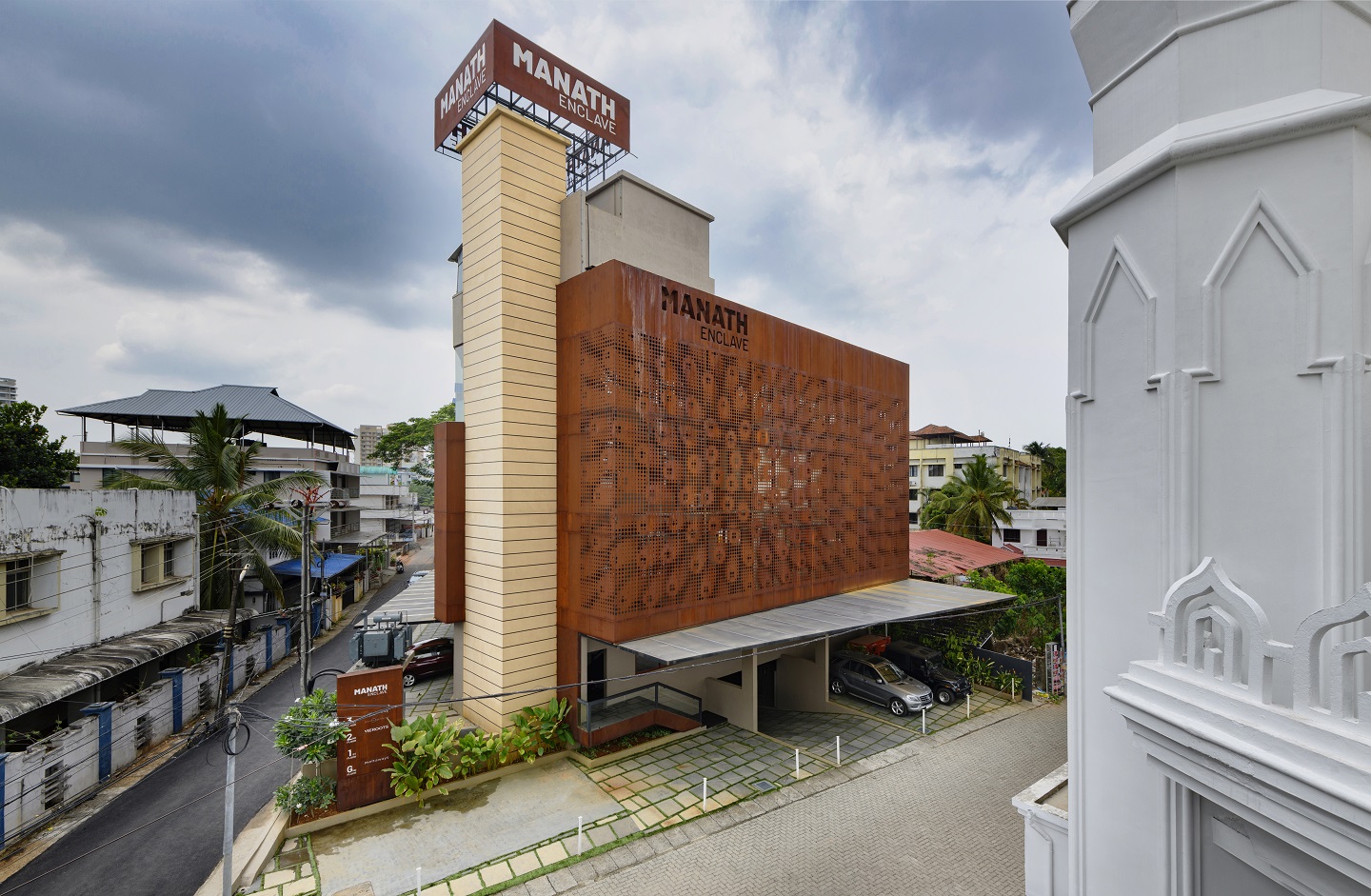
The facade design called for an efficiency-oriented structure with minimal sacrifice for aesthetics. Being in a tropical humid city, a climate responsive facade was required to reduce operating costs. The facade is made using weathering steel (Corton steel) — a steel alloy which forms a stable rust-like appearance after exposure to weather for several months. The rusting process facilitated by the forces of nature and panel orientation, evolves with time to form a unique contextual pattern. “Corten steel colours naturally and the shades vary with respect to the seasonal changes, from bright shades in summer to darker shades of rusty brown during monsoon. The pattern of the rain marks after a monsoon shower is a diverse character of the material, which heals during a warm day,” says Nikhil.
This painting of rust made by nature is complimented by the laser-cut perforated pointillism patterns embedded in the whole facade. “The pointillism artwork is a parametric design of dynamic 3D radiation pattern. The facade acts like a parasol covering the building surface like a sun-breaker mitigating the daytime heat intake. The light shafts shimmering through the perforations light up the interiors like a series of fairy lights on evenings,” explains Mohammed.
The design intent
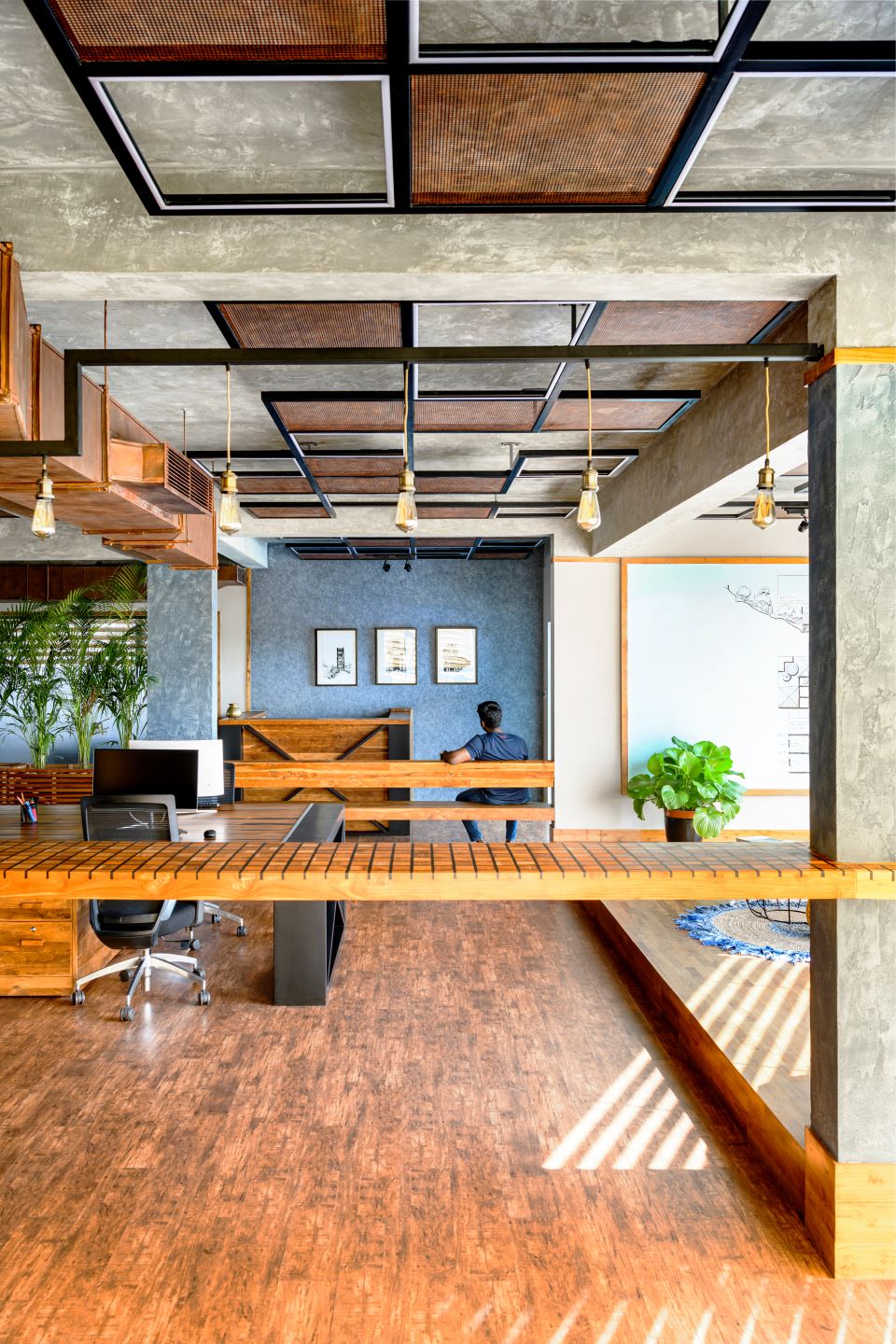
As third floor was to cater to the needs of two offices, the architects created an open plan work area and separated them by usable and aesthetic design elements (read furniture) which would not hinder their functioning. Some civil interventions had to be made to execute this vision: a solid wall with conventional window opening was replaced with a floor-to-ceiling glass opening which streams in natural light into the work spaces. Further, all the walls for the cabins was consciously made with gypsum cement panels.
The spatial configuration
Starting from the entrance lift lobby the shared office has been zoned as public, semi-public and private spaces. At the lobby, the wall facing the lift is finished in cement concrete texture with the logos of both the offices finished in black powder-coating, and stuck on a Corten steel plane. One enters the reception with a waiting bench after passing through a large glass door. This waiting area gives a clear view of the office and its functions. A row of tall green planters here act as a screen and helps in defining the circulation.
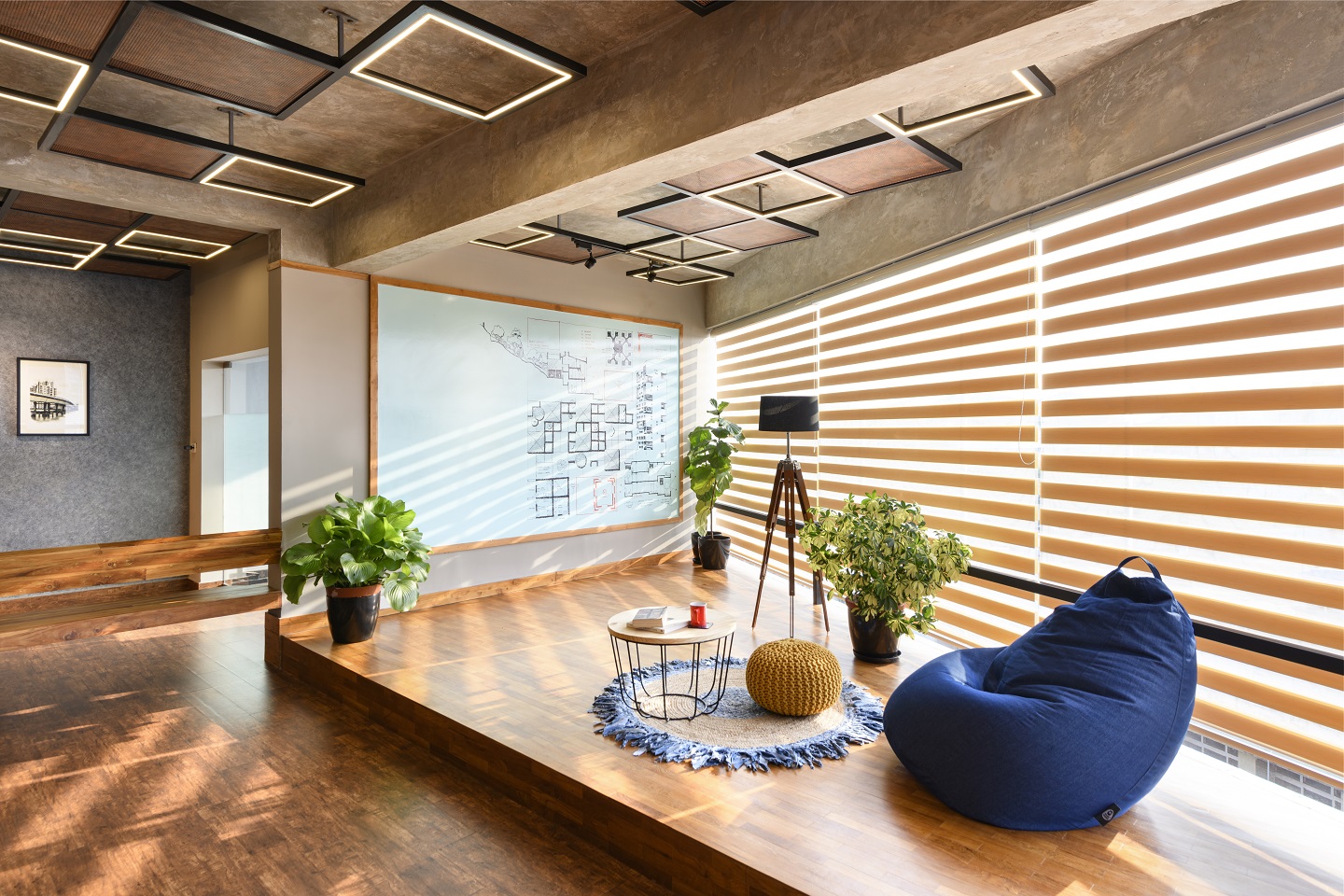
The main attraction of this open plan office are two massive workstations which divides the spaces without any restrictions. A casual discussion area has also been created where beanbags and pouffes are used for seating. This semi-public zone is an open co-lab space which can be used by both the offices. It faces a wall finished with writable paint which serves as a white board.
The cabins — a larger cabin for the two managing directors of Mecone Construction Contractors and smaller cabin for the principal architect of Atmosphere Design Lab — line the boundary of semi-public zone and are separated by toughened glass walls with partial frosting. The cabins have a white gypsum ceiling with minimal lines of profile LED lights, and a cove for mood lighting. The conference room is placed in the corner adjoining the main cabins and has a large 12-seater 11ft conference table. The other private areas such as the pantry and washrooms are positioned on the southern side of the building.
The material palette
The material palette includes warm wooden shades of teak for the tables and other accents. To break the wooden monotony, a grey concrete texture has been used for the ceilings and columns. An oceanic blue has been used on the wall behind the workstations along with various blue and rustic tones to mimic the movement of water. The duct and custom lights were painted a rustic bronze for breaking the monotonous grey concrete of the ceiling.
All the furniture pieces were custom made for the project and has a unique story to tell. The two large epoxy workstations in both the offices required skilled and trained workmanship. These six metre long furniture pieces which can accommodate eight people was conceived as a monolith epoxy river table. “The epoxy required skilled workmanship, so the local carpenters were trained by an experienced professional from Chimique Sol, Surat. The whole process — from preparation to pouring and removing the mould — were taught to the carpenters. The table was polished to level the epoxy and wood to the same level using a matte wood polish and sanding machine, and required a specific sanding paper grade for this work. The tables were huge and required massive support sections on both ends, so a custom-made rectangular metal section of 8inch X 2inch was customised for the support,” explains Mohammed.
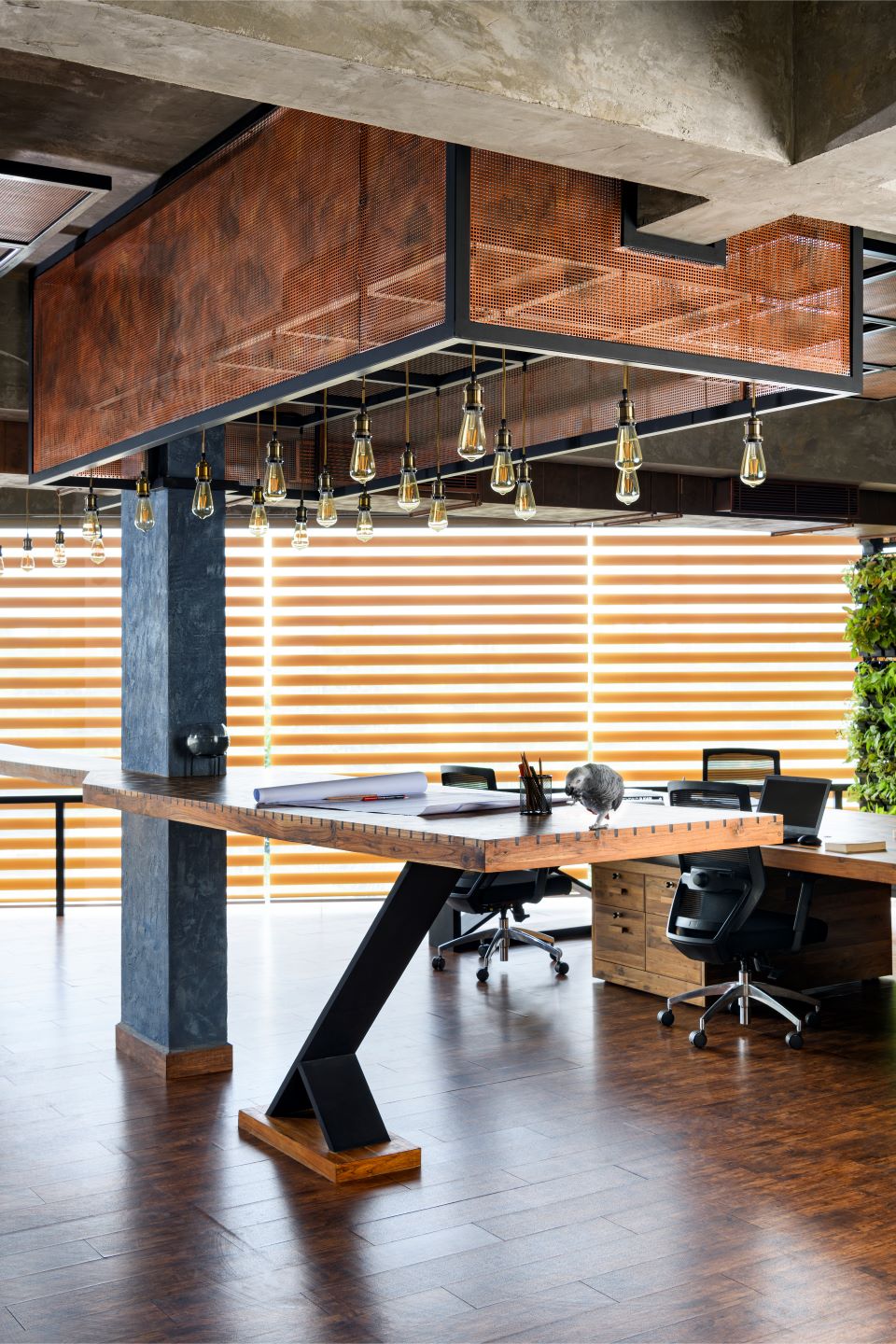
Other epoxy tables, the ones in the cabins and the conference room, were crafted in a similar manner, and have been cut to the size fit for the rooms. All the tables however see a different epoxy resin colour — dark blue has been used on the workstation tables, a white opaque in the architect’s cabin, a blueish-green shade for the directors’ cabins, and a bright blue translucent epoxy for the conference room.
Fact File
Project: Manath Enclave
Location: Kakkanad, Kochi
Area: 12,000 sq ft
Principal architects: Mohammed Shaheen and Nikhil Rajan
Client: MI Mohammed
Add a Comment