

Home to three generations, Ahmedabad’s Play House, a UA Design project, melds the intangible spirit of an old city house with a spirited, modern expression.
Curated by: Rupali Sebastian
Photographs: Photographix India, courtesy UA Design

The brief
This was a home to be designed for a client who resided in the old city of Amdavad and didn’t want to relocate. Instead, he was willing to raze the existing structure on site and build from scratch. Built on a fairly compact piece of land, this home to three generations had to feel more spacious than it could possibly be. Multiple members and generations also spelled the need for everybody’s privacy alongside spaces to greet and gather in.
The design intent
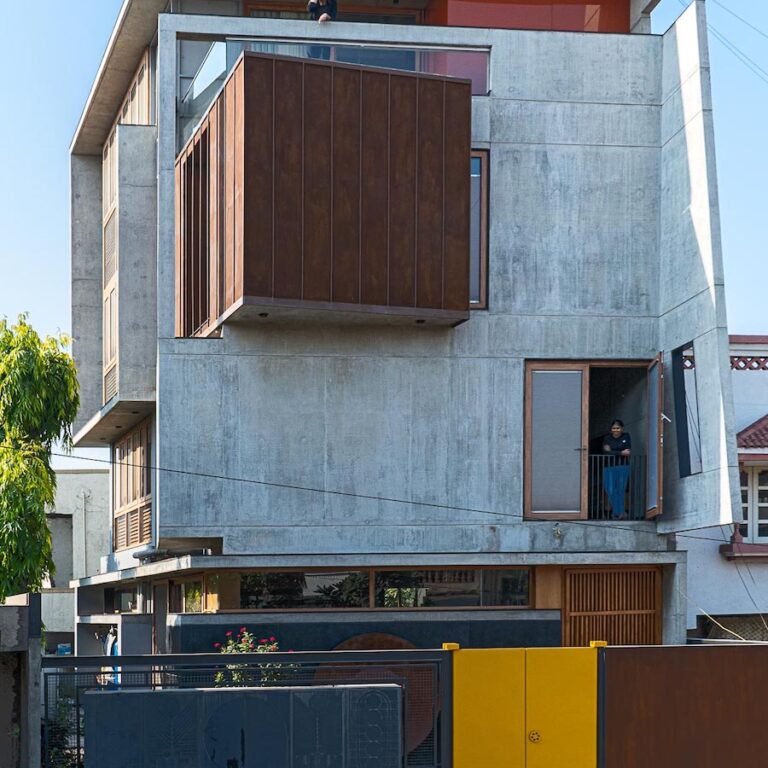
“Our role as architects was fortunately very clear from the beginning,” Umang Goswami, principal architect and founder, UA Design, tells us. “We knew we had to build them a modern house, yet one that embodied the old city spirit. However, we were careful to recreate the intangible spirit of an old city house, and not a photogenic collage of its vintage charm.” You can see this thought play out on the elevation through the elaborately detailed window system on the south façade that is directly borrowed from this place’s vernacular expression. “It helped us plant the house in its context, like a new-born in its family,” adds the architect. The idea was to build a modern house that belonged, not an alien ship. Also, from the beginning, a spirit of playfulness was subconsciously at the heart of the design.”
The spatial flow
The house is admittedly extroverted. The compound wall and gate reflect the geometric abstractions of Raza, a renowned Indian modern artist. This feature becomes a sculpture for the street.
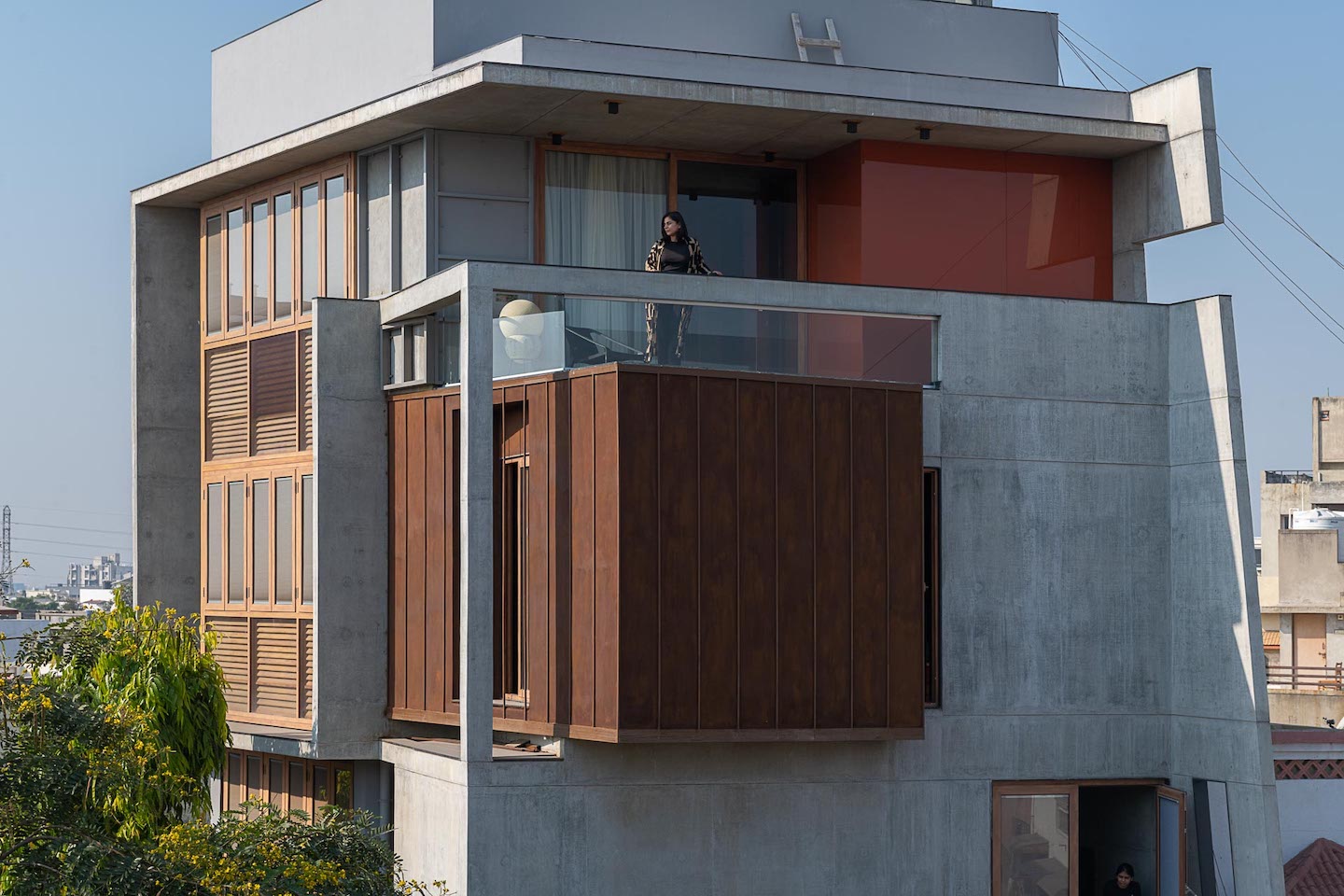
The house was conceived as a stack of shifting floor plates that enjoy a playful chemistry with each other. The ground serves as a shared space with a living, a dining, a kitchen and an open-to-sky sit-out. The three floors above function as private and independent units for their users.
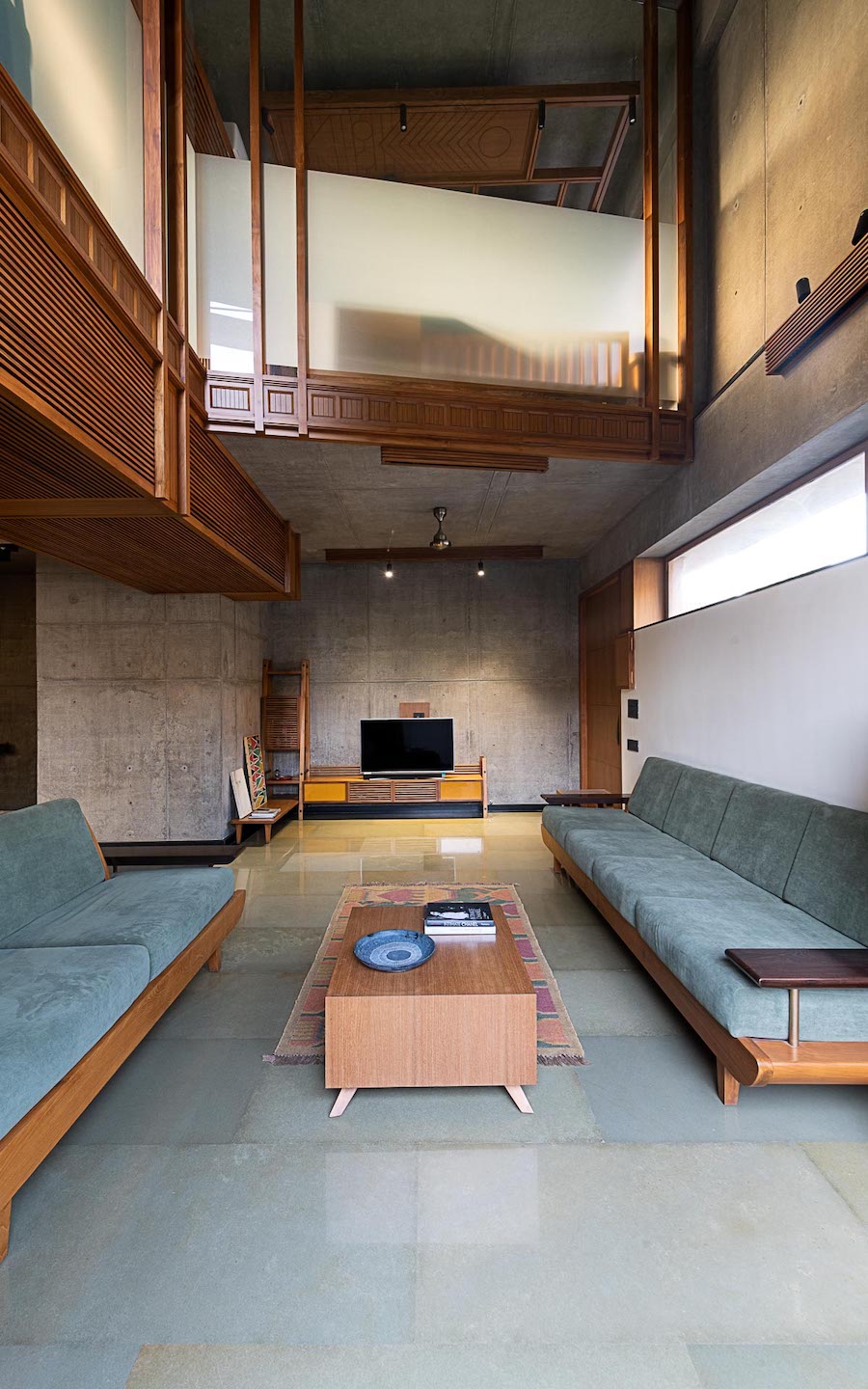
Just as you set foot indoors, this seemingly tiny dwelling stretches up into a double height, as if declaring itself a free spirit and refusing to be defined by any conventional characteristics of small-scale living. The living room walls stretch up till the lintel to give way to a horizontal strip window under the ceiling. With not much space to spare for a satisfying buffer between the street and the house, these horizontal strip windows allow the interiors to capture only the best parts of the street – the lush crowns of trees. The strip windows also allow the gaze to travel, if just a little bit more, beyond the physical limits of the house. This creates a sense of seamlessness and an illusion of largeness.
The harsh west sun is screened through the staircase well. Here, the dark colour palette of black granite and hardwood softens the light before it permeates into the living spaces. Also, the stairwell’s verticality makes it an ideal heat buffer, as it carries the heat up to escape while keeping the living spaces cool.
The material palette
Thoughtful details in mild steel, local kota and black granite stone, teak wood and glazed ceramic tiles against the exposed concrete walls elevate the living experience. Surprise pops of colour in the stairwell beckon you upwards, further playing on continuation and seamlessness of space. Vernacular elements like a hanging bed, an Indian diwan seating, a modern jharokha infuse the spaces with nostalgia.
Fact File
Project: Play House
Location: Ahmedabad
Area: 150 sq m (site)
Principal architect: Umang Goswami
Design team: Vaishakhi S Mehta, Bhavesh Mevada and Naitri Soni
Add a Comment