
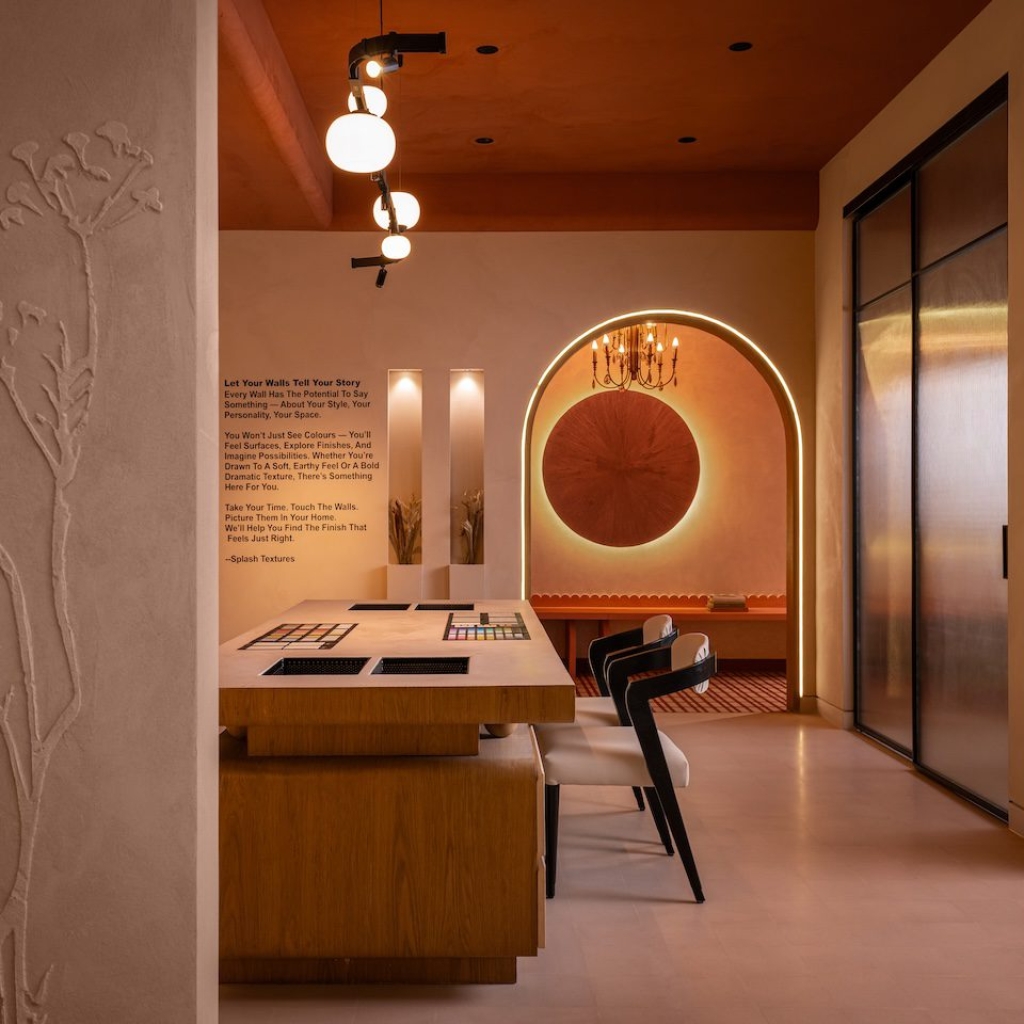
Moving beyond display, House of Ruya creates a material-driven gallery for Splash Textures in Bengaluru where paint is experienced not merely as a finish, but as art.
Curated by: Deepa Nair
Photographs: Jubin Johnson; courtesy House of Ruya
The brief
In JP Nagar, Bengaluru, House of Ruya reimagines the conventional showroom as an immersive material gallery for Splash Textures. Spanning 1,300 sq ft, the project moves away from transactional retail environments and instead positions itself as an experiential laboratory where texture paint becomes the primary architectural language. The intent was not to decorate a space, but to design one that allows finishes to be perceived, tested, and understood in context.
“The brief from the client was intentionally open-ended. They were not looking for a themed interior or a conventional store layout; their primary expectation was to create a space that could function as an experience centre rather than a retail showroom,” shares Aishwarya Govind, principal designer, House of Ruya. “They wanted the textures to be the focal point—displayed in a manner that allowed visitors to see, touch, and understand the finishes in context. Equally important was the need for a comfortable setting to host clients, enabling discussions and material exploration without the formality of a typical commercial space,” she adds.
The site
The project began within a completely raw shell, defined only by external walls and structural columns. Handed over as an undeveloped floor plate, the space had no internal partitions, finishes, or services in place. It existed as a blank structural framework, open and unresolved, awaiting both programme and identity. The gallery shares its floor plate with an adjoining tile store, which was simultaneously being designed by another designer. This condition required clear spatial definition while maintaining construction coordination within a shared commercial envelope.
This clarity of intent shaped the concept from the outset. The design moved away from a product-display model and instead adopted a spatial narrative that encourages interaction, tactility, and pause, allowing the material palette to define the character of the interior.
The design intent
The designer wanted to construct an immersive material landscape where texture paint takes centre stage. The design deliberately moves away from the grammar of a conventional retail showroom, and instead envisions a gallery that invites exploration, and engagement with the finishes on display. “The philosophy was rooted in restraint — allowing architecture to act as a quiet framework while the textures take visual precedence. Spatial openness, soft curves, and a neutral earthy envelope were consciously adopted to prevent visual clutter and ensure clarity of display the compact footprint,” explains Aishwarya.
Light plays an instrumental role in this narrative. Carefully positioned to accentuate shadow lines and surface variation, it heightens the perceptual qualities of each finish, enabling visitors to experience materiality rather than merely observe it. Walls, ceilings, and partitions are conceived not as passive backdrops, but as active canvases that demonstrate the expressive potential of texture paint. Ultimately, the space was conceived to transform the perception of paint—from a mere background finish to an art form that can be seen, touched, and experienced.
The civil intervention
Received as a bare structural shell, the floor plate demanded a complete internal build-out. With only external walls and structural columns in place, House of Ruya approached the project as an exercise in defining programme within openness, carefully inserting function without compromising spatial flow.
The primary intervention lay in articulating distinct zones while preserving the visual continuity of the main display hall. Gypsum and plywood partitions were introduced to carve out enclosed areas including the Manager’s Cabin, Office, Store, Discussion Room, and the Luxury Room. These volumes were positioned along the periphery, allowing the central gallery to remain open, and easy for movement.
New flooring established a cohesive base palette, grounding the finishes displayed above. Ceiling treatments were integrated to conceal services, coordinate lighting, and introduce a unifying design layer that complements the textured surfaces. Electrical and display infrastructure were meticulously planned so that each wall could function as a potential canvas, accommodating varied finishes without visual disruption.
The spatial configuration
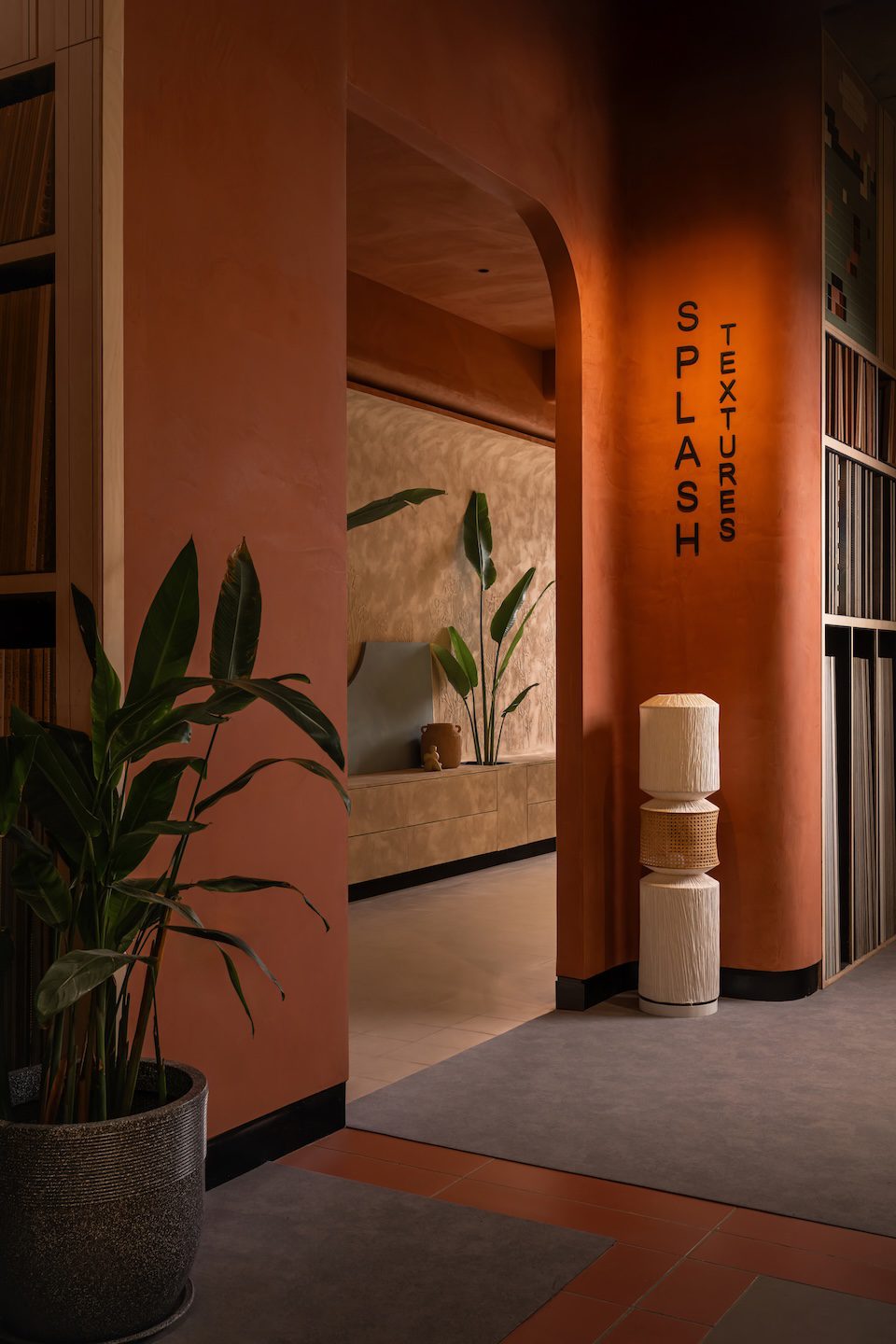
One is welcomed at the Splash Textures showroom quite warmly at the entrance where a sculptural curved wall clad in rust-orange textured paint subtly communicates the brand’s material identity. A short transitional corridor follows, easing visitors into the space. This pause allows for observation before the gallery expands into its primary volume.
The corridor opens into the open and breathable main display hall which is designed for fluid circulation and interaction. Lining the periphery are enclosed functional spaces: the Manager’s Cabin, Office, Store, and Discussion Room… each articulated through subtle variations of textured finishes. The spatial narrative culminates in the Luxury Room, accessed through a softly arched opening.
The design and material details
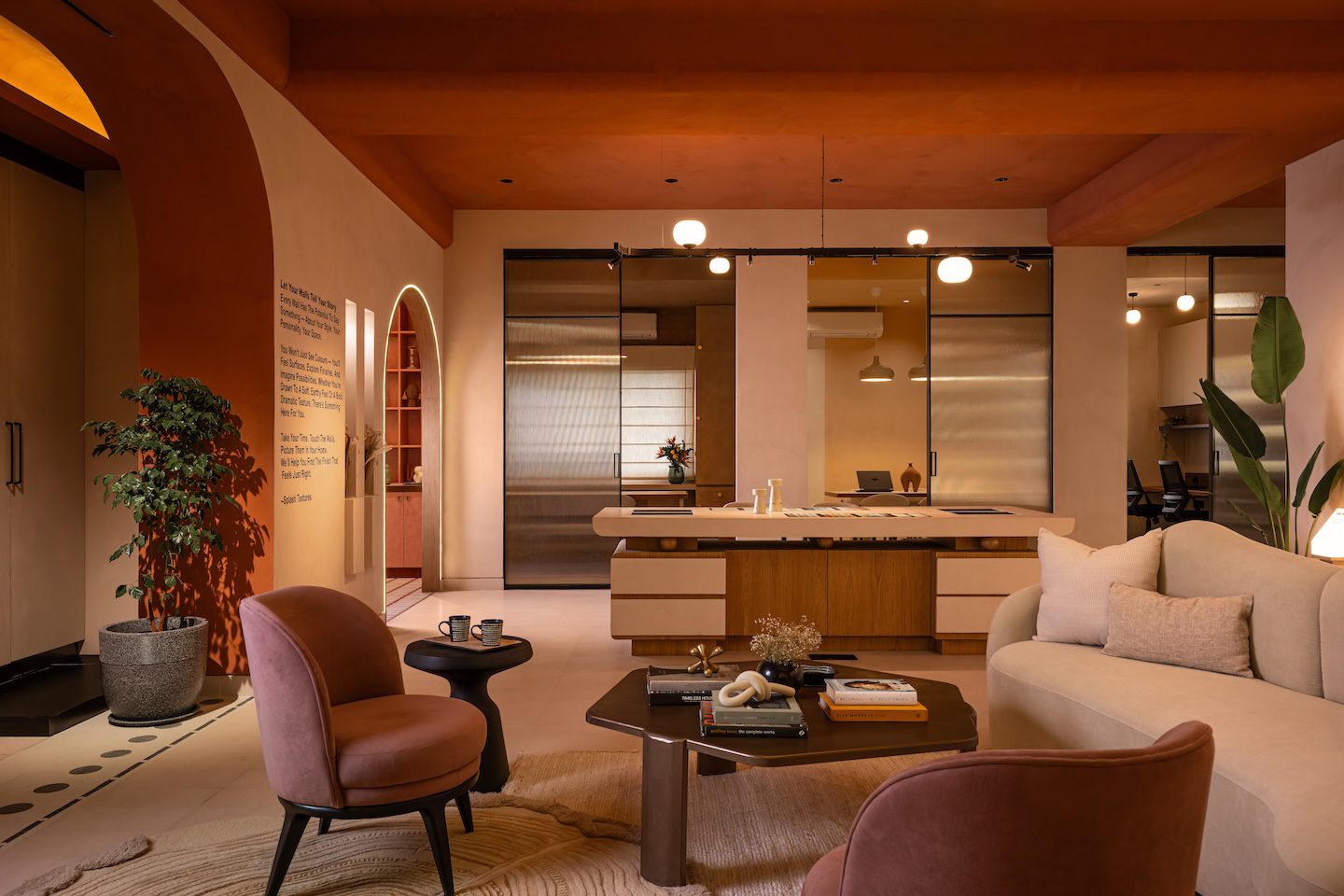
The experience begins at the entrance, where a sculptural curved wall finished in rust-orange textured paint establishes warmth and introduces the brand’s material identity from the outset. The curvature softens the rectilinear shell and introduces the rounded design language that recurs throughout the space, with the surface itself acting as the first display canvas.
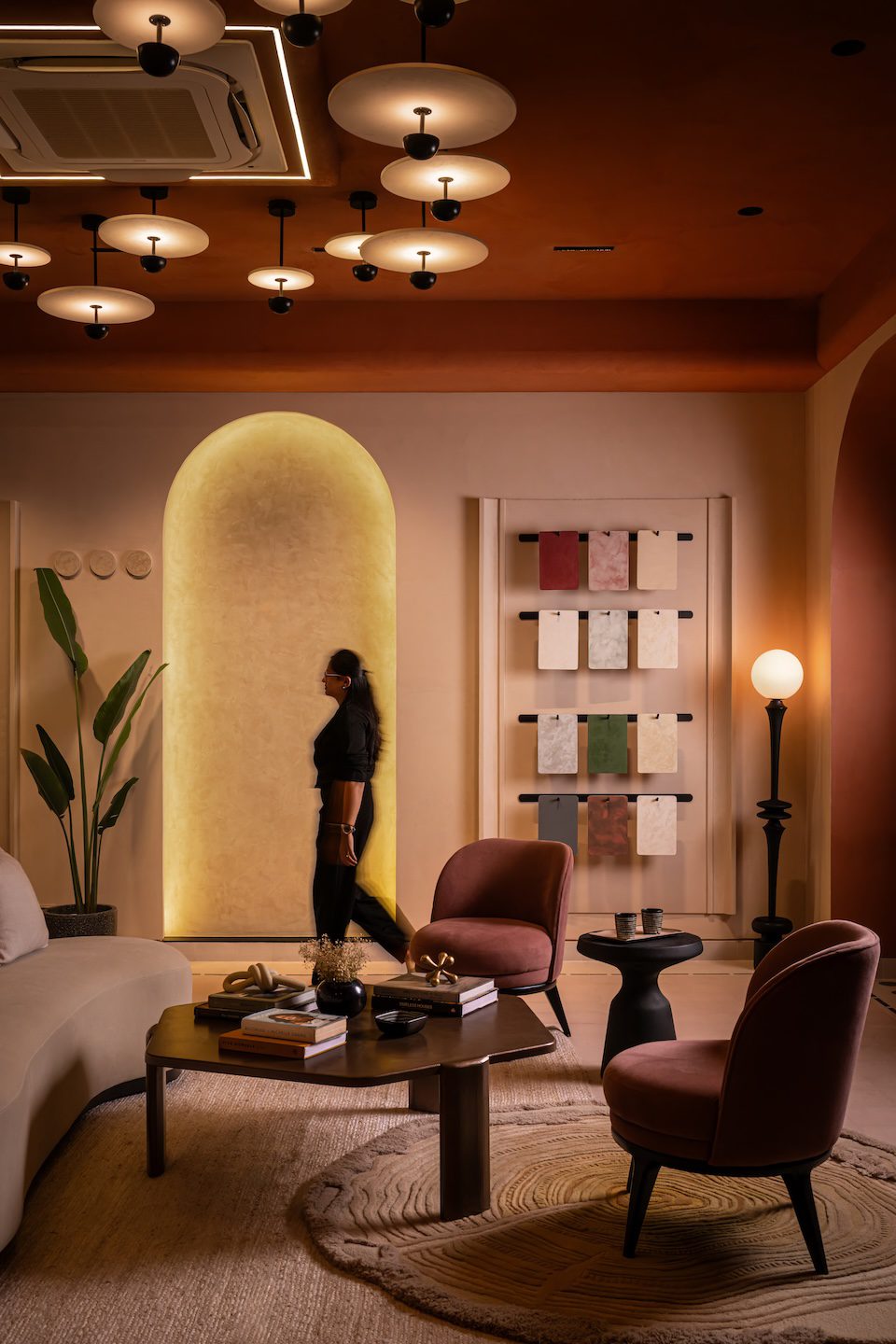
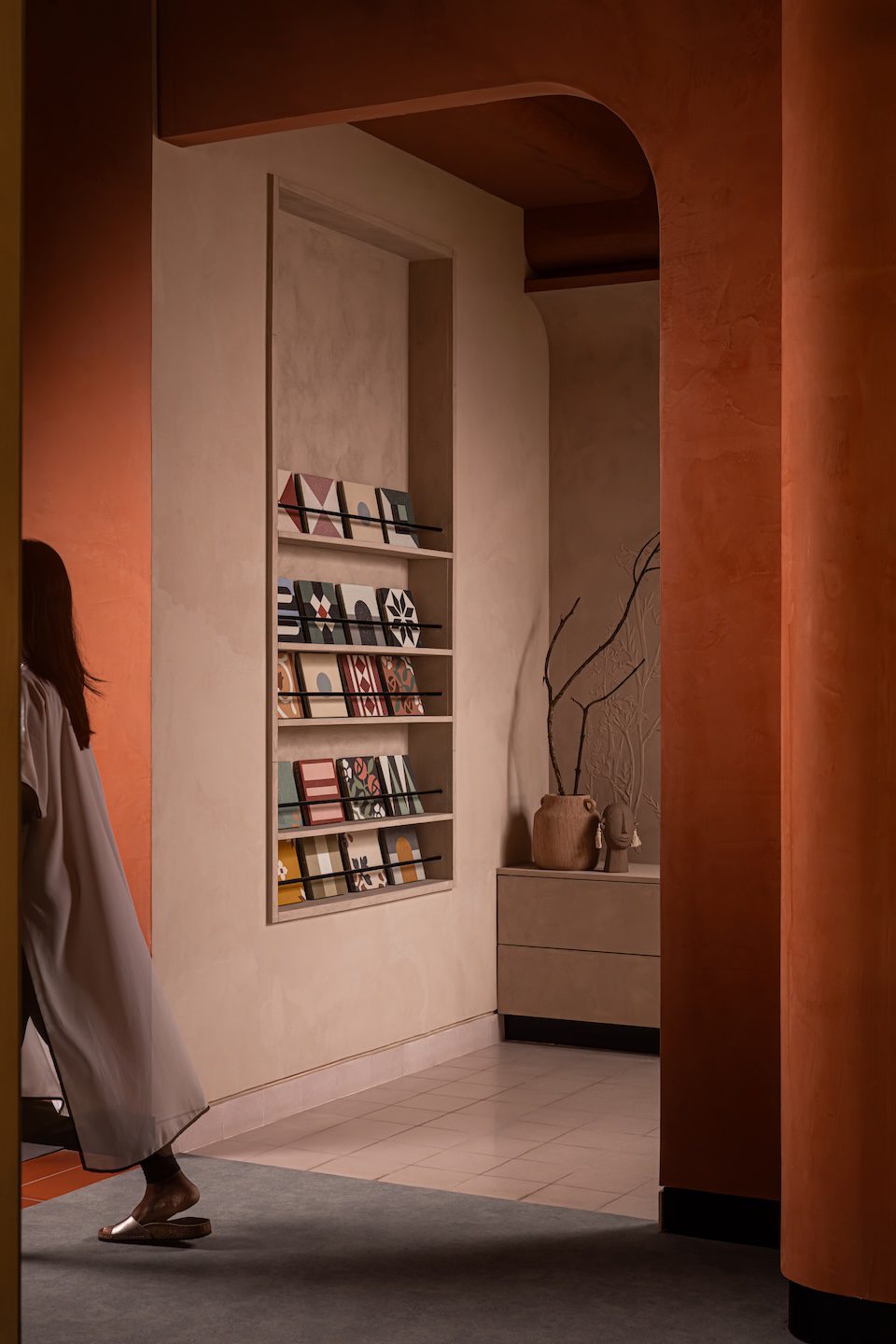
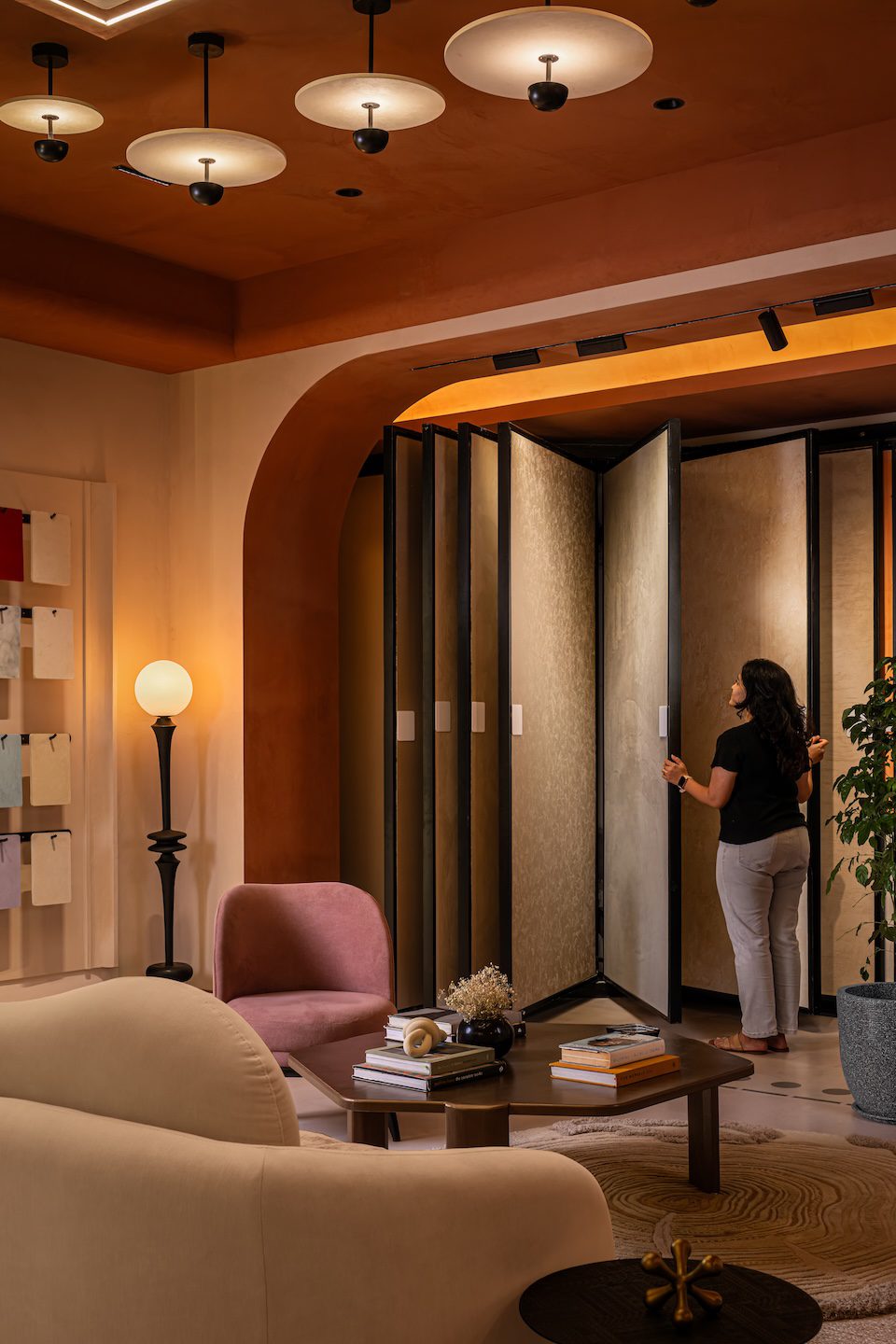
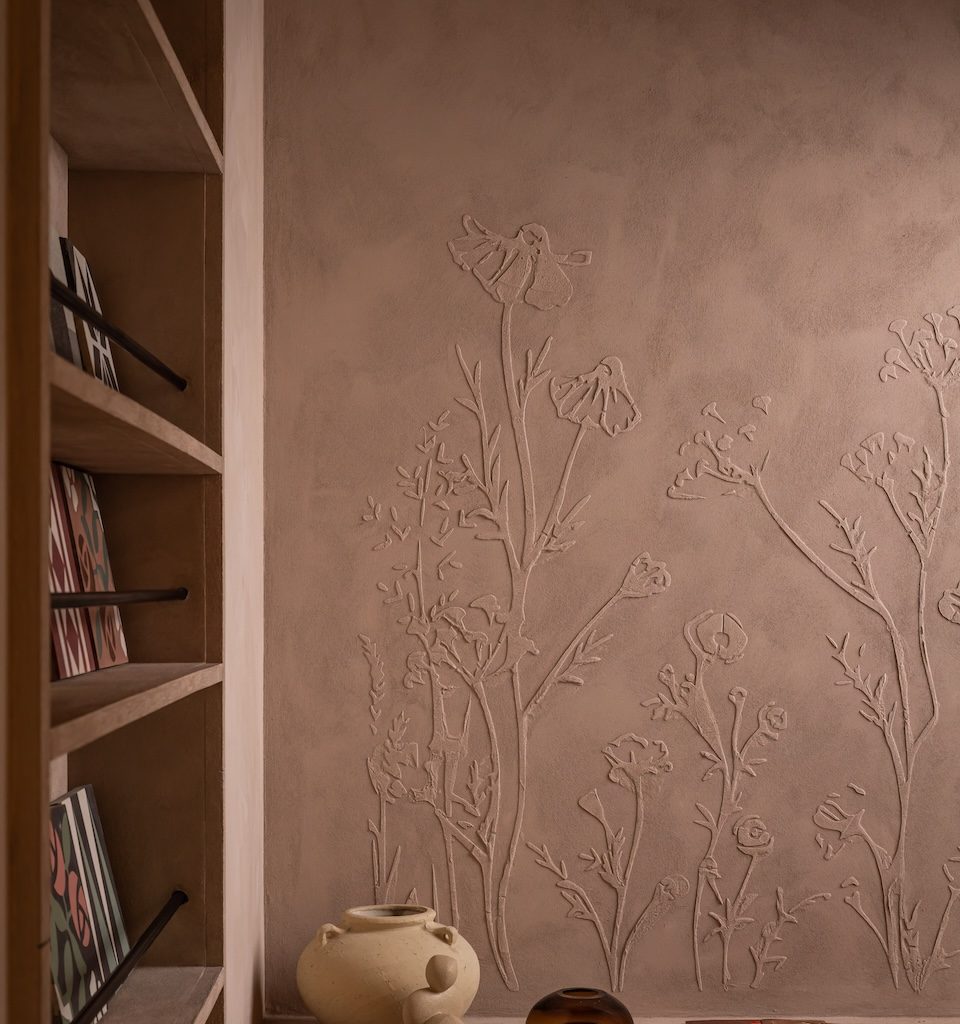
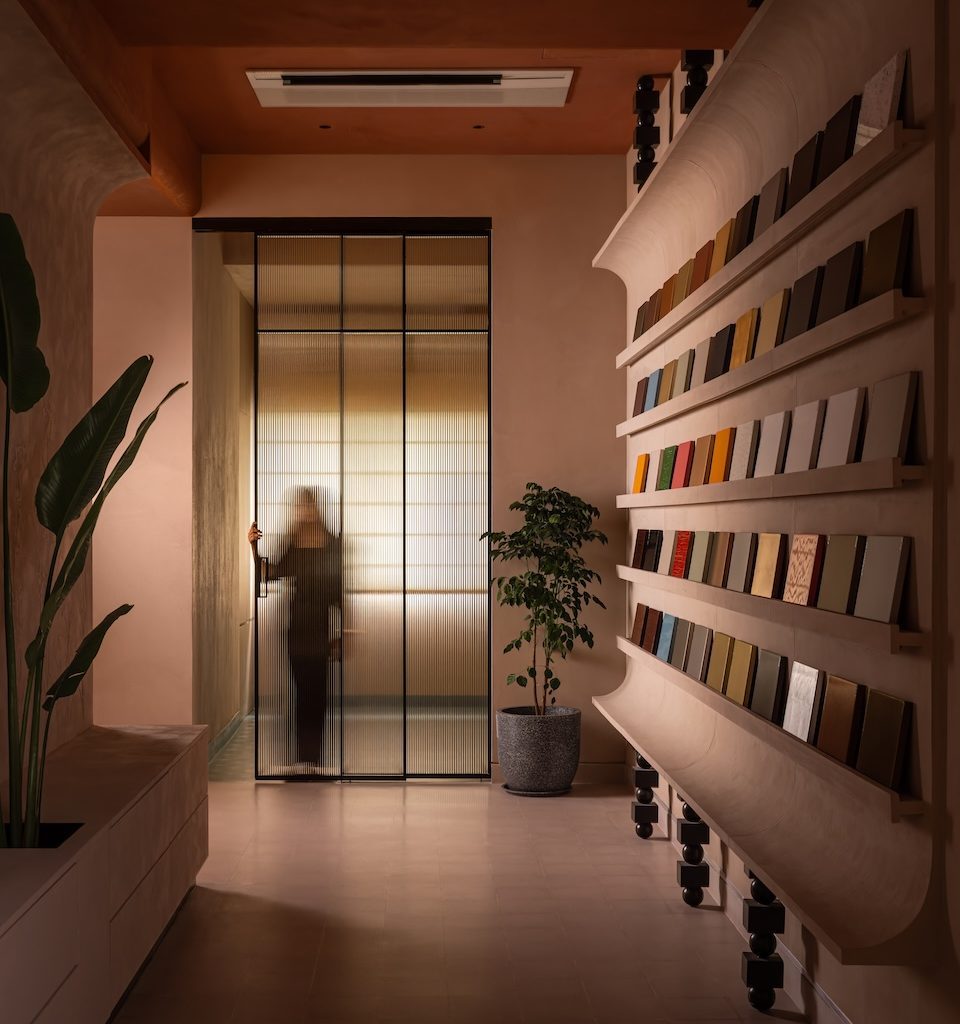
A short transitional corridor follows, easing visitors into the space. Here, a muted beige stencil-textured wall offers the first tactile encounter. Opposite, a custom linear display unit fabricated in plywood and clad with HDHMR is finished in a neutral textured paint, allowing it to integrate seamlessly with the surrounding surfaces. Cement-based Cubit tiles continue underfoot, maintaining an earthy and cohesive base palette. This pause allows for observation before the gallery expands into its primary volume.
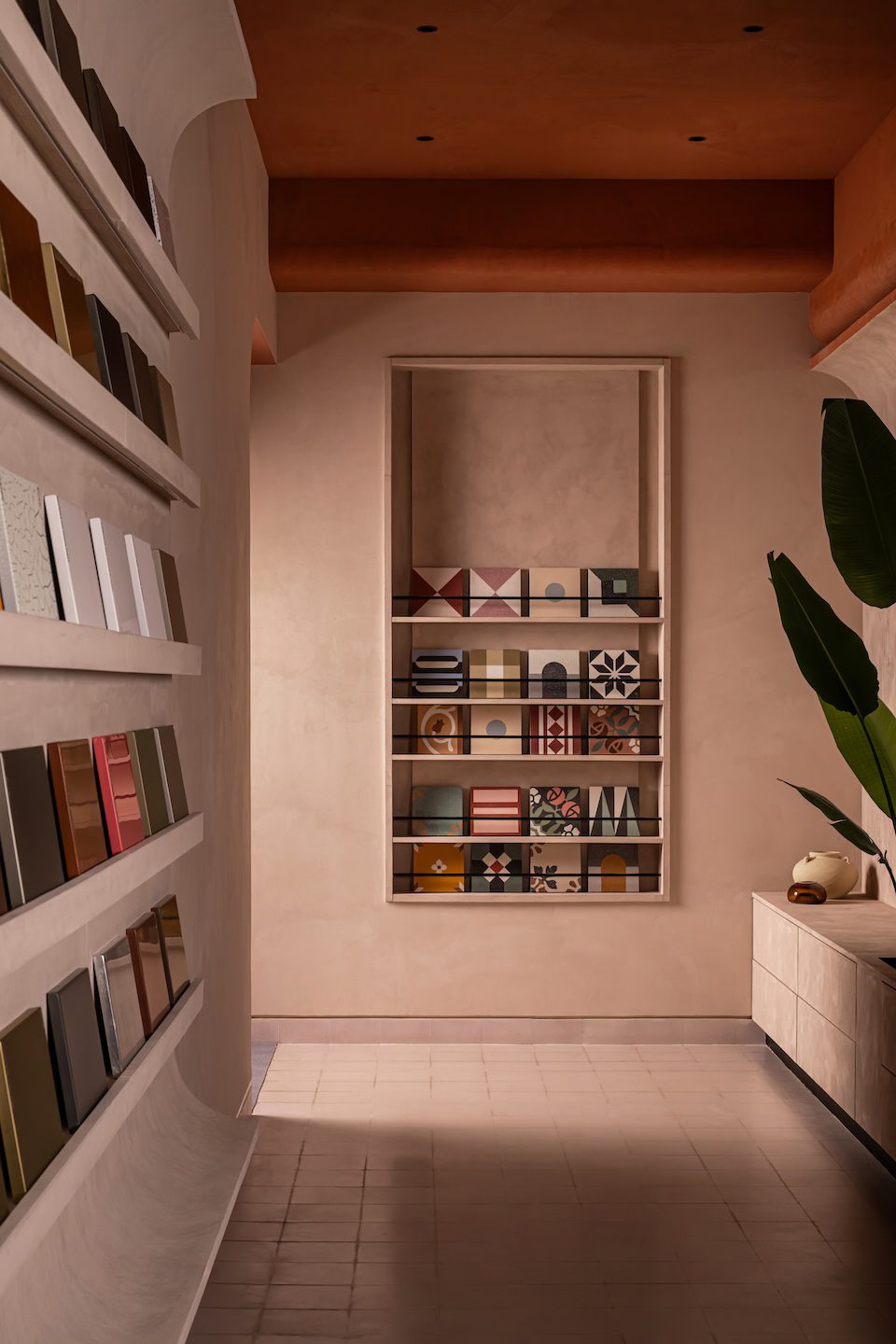
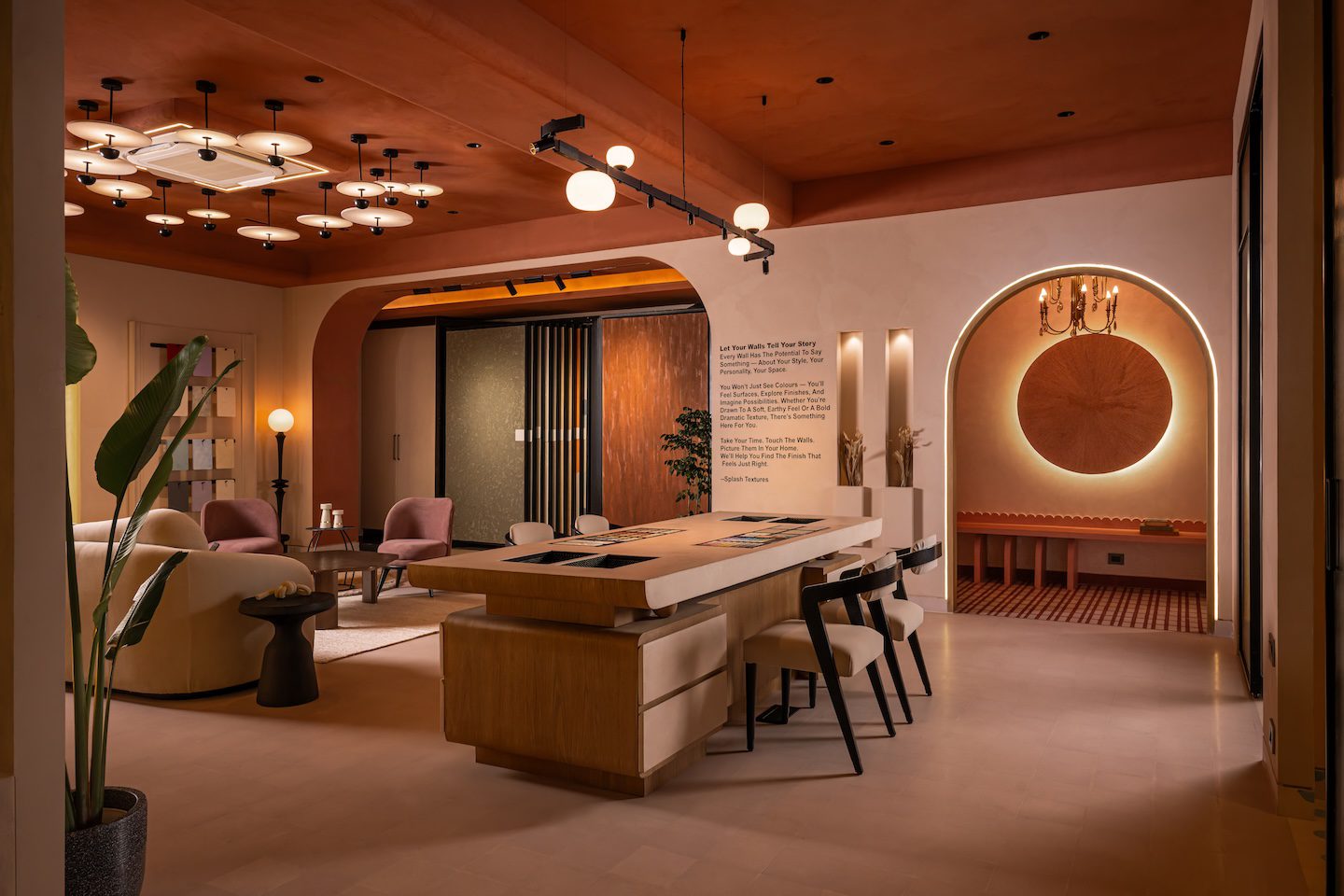
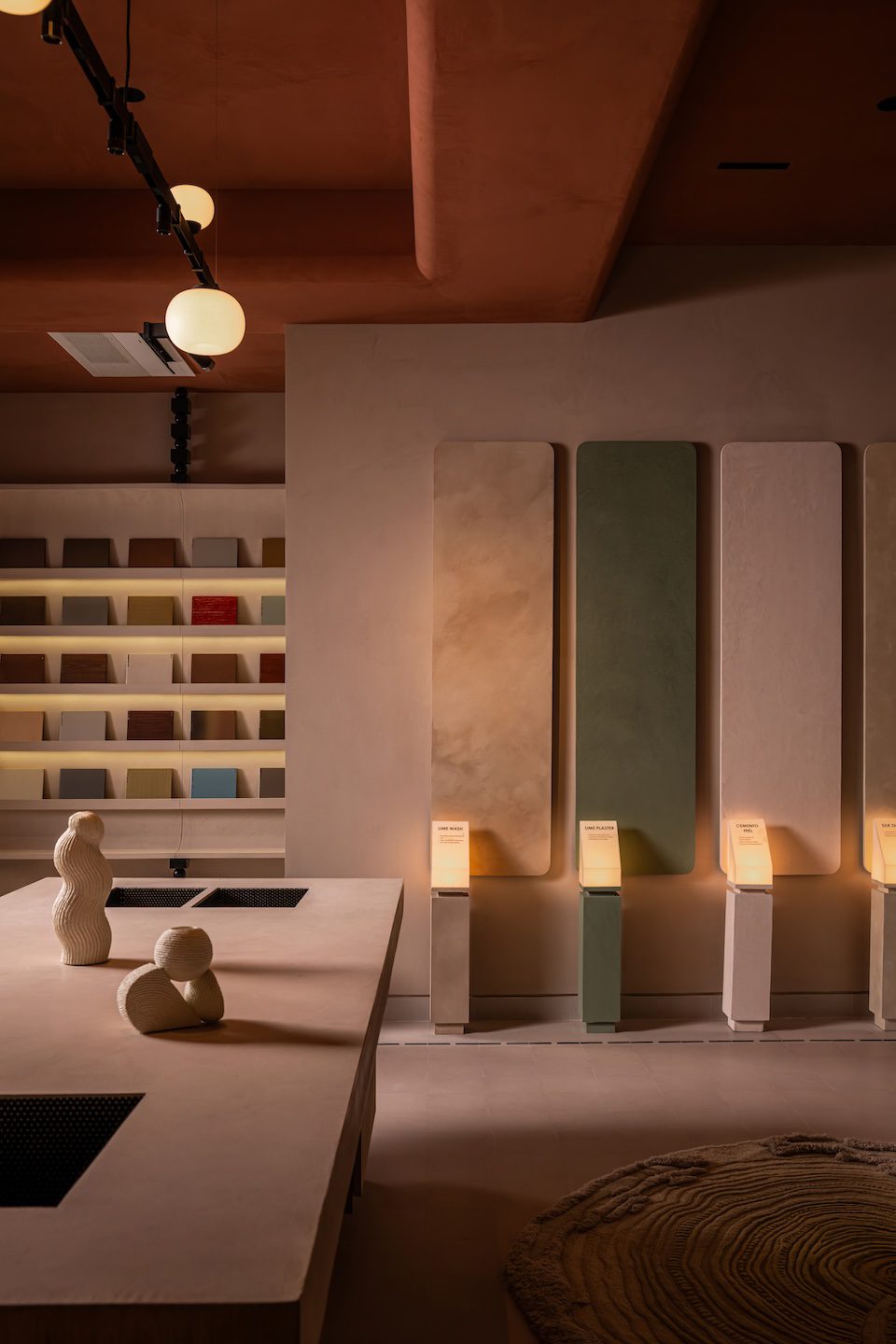
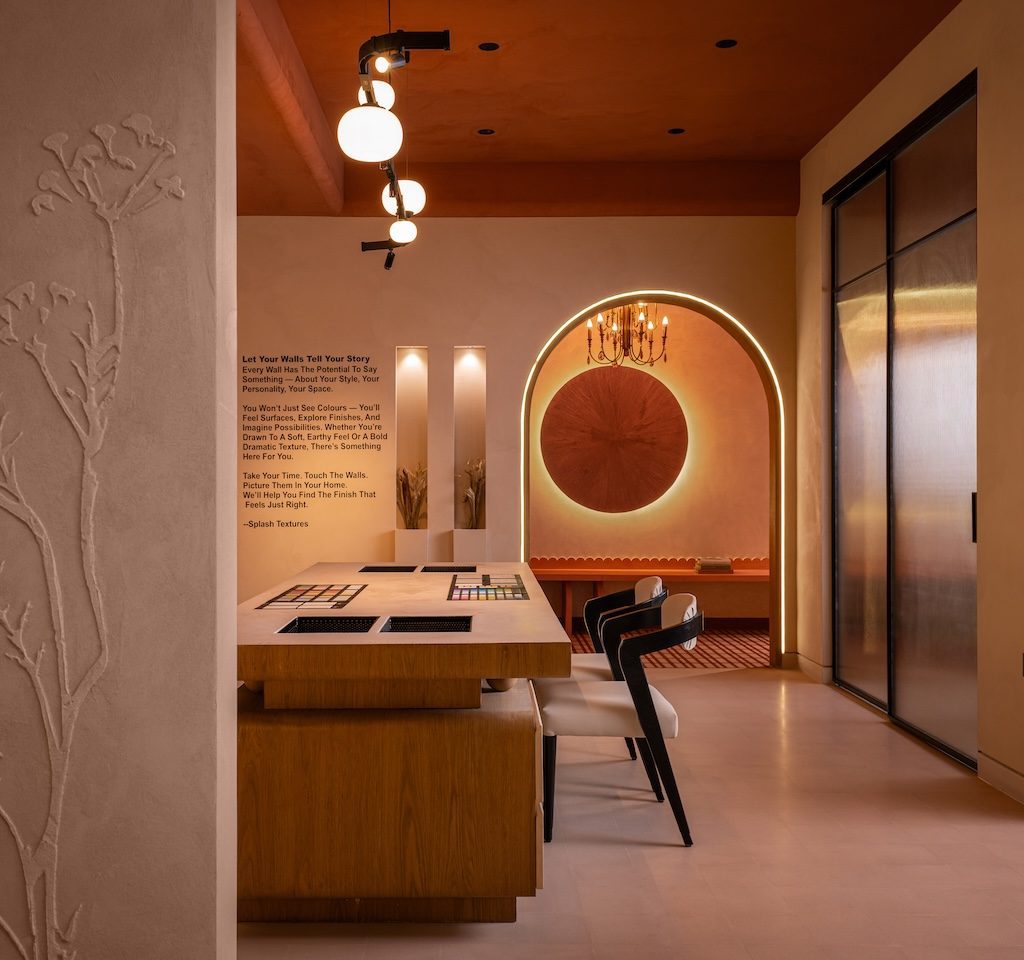
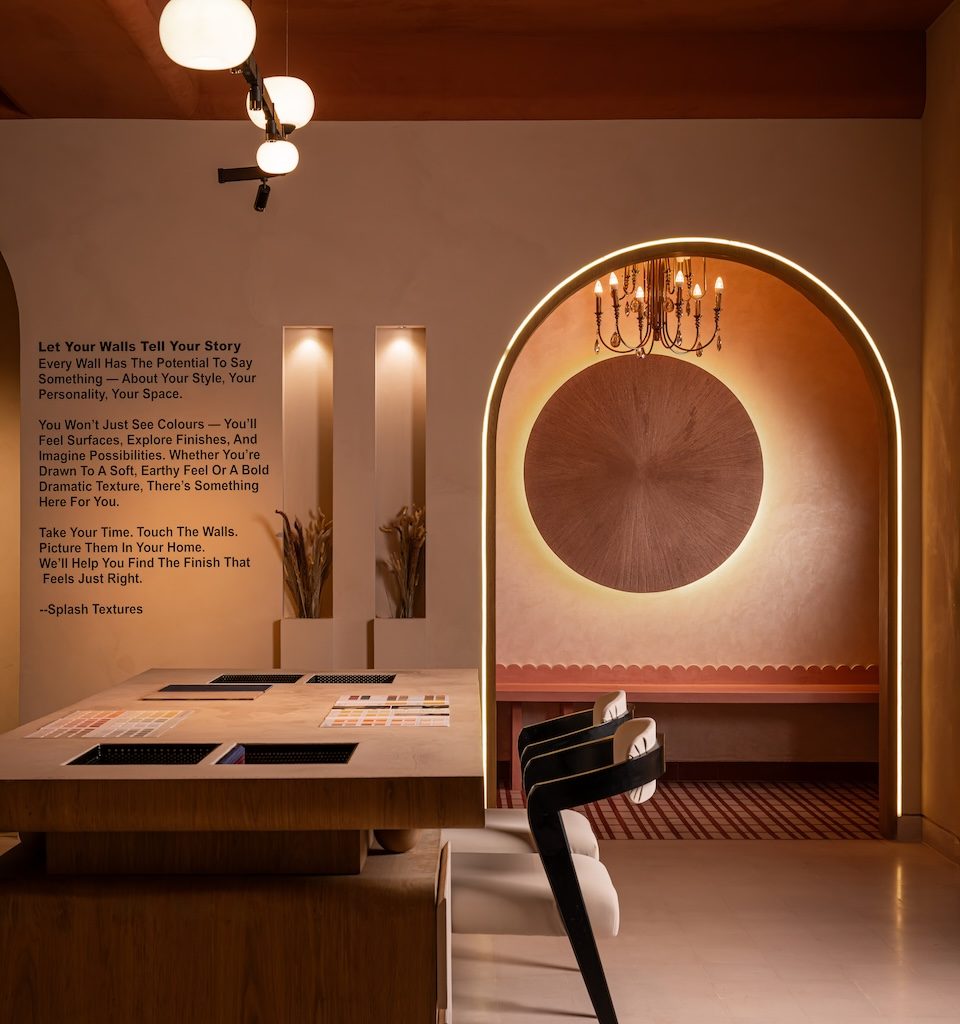
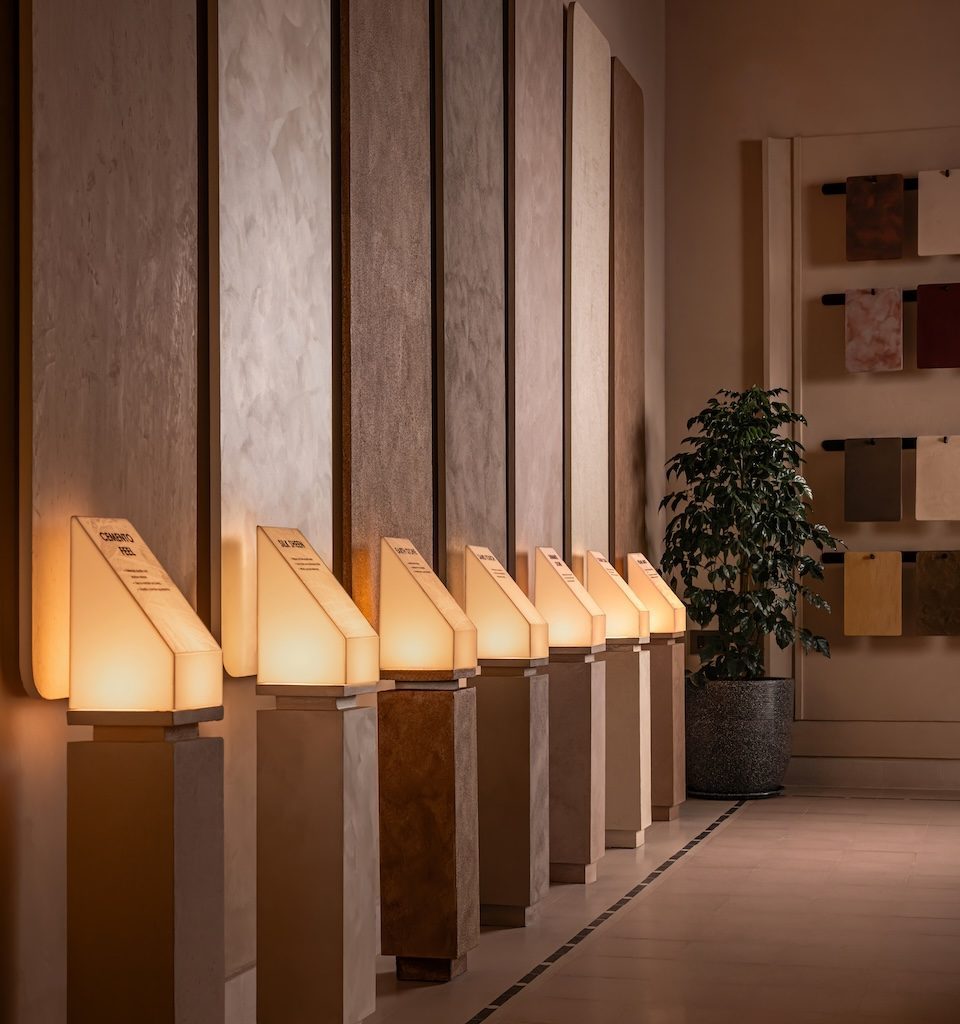
At the heart of the 1,300 sq ft layout lies the main display hall, conceived as an open gallery-like volume. Base walls in warm greys and sand-toned textured paints provide a restrained backdrop for large-format texture panels showcasing varied finishes and layered compositions. Acrylic pedestals with subtle underlighting present samples with clarity, while gazette-style installations integrate information into the display language. A custom central table in plywood and HDHMR, finished in Splash Textures paint, anchors the space, complemented by a textured rug by Loops by LJ. The ceiling, finished in rustic-orange textured paint, visually ties back to the entrance, while layered ambient, task, and accent lighting enhances surface character.
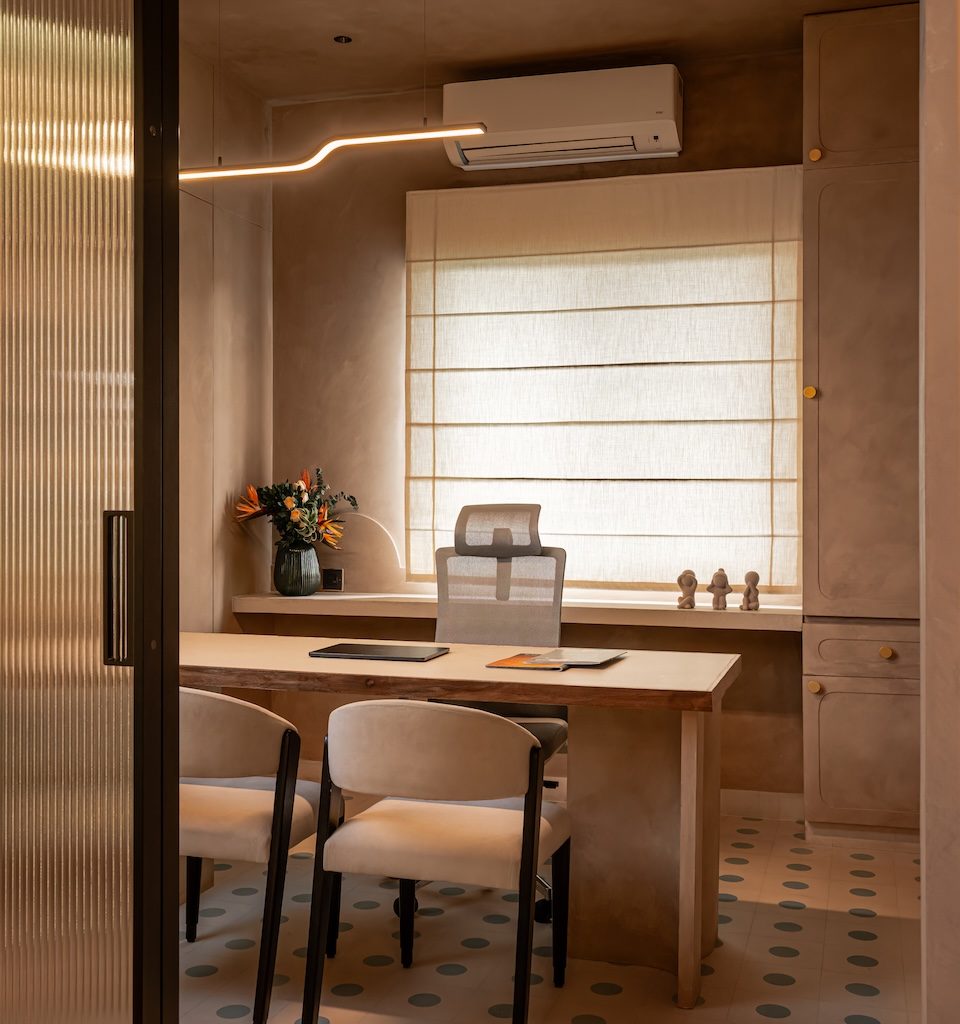
The Manager’s Cabin continues the restrained material language of the gallery. The walls here are finished in muted neutral textured paint, which create a composed backdrop that allows the finishes to be experienced without distraction. The partitions constructed in plywood and gypsum, are clad with HDHMR to ensure surface stability and durability. Custom furniture in plywood, finished with textured paint, reinforces continuity across spaces. The result is a room that functions efficiently as a workspace while quietly demonstrating the versatility of the material palette.
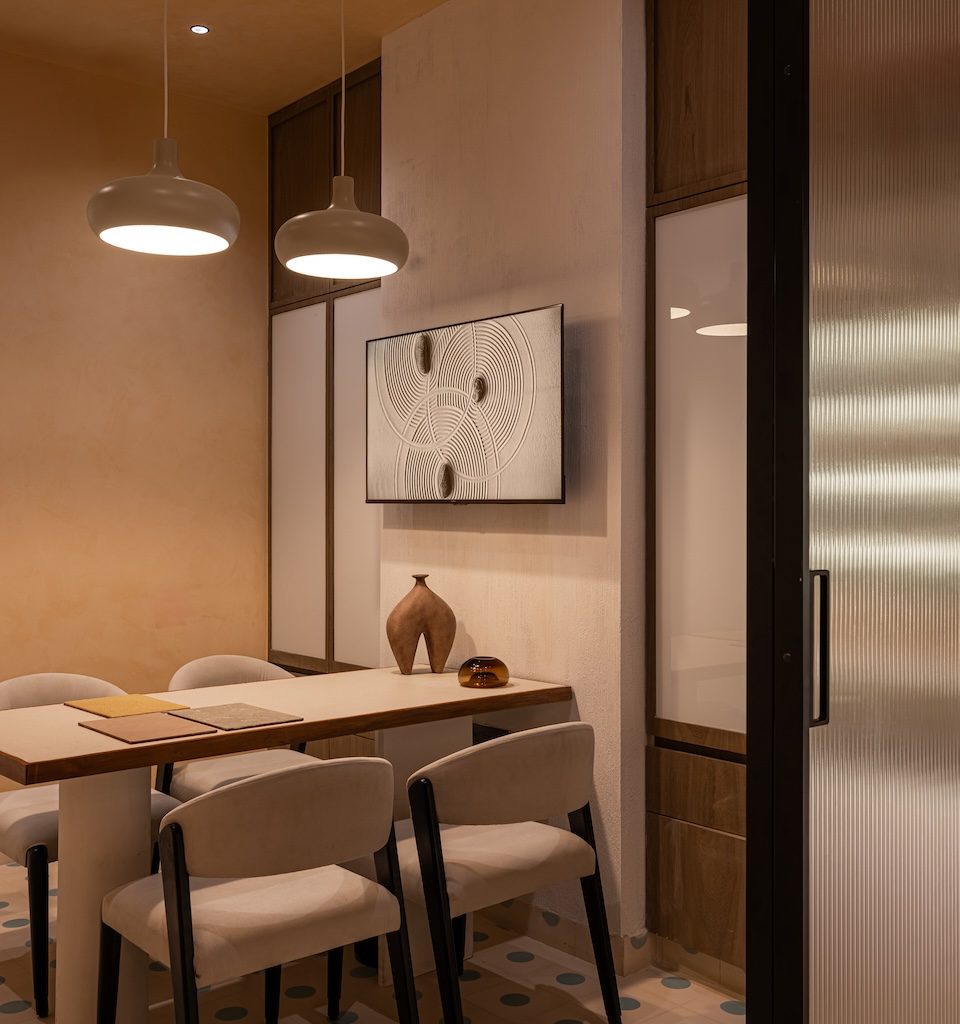
The Discussion Room and Office adopt a slightly warmer character. Textured finishes in beige and taupe tones create a more intimate atmosphere suited to client conversations and presentations. A custom-designed discussion table, paired with coordinated seating, anchors the space, supporting interaction while maintaining visual cohesion with the gallery’s broader aesthetic.
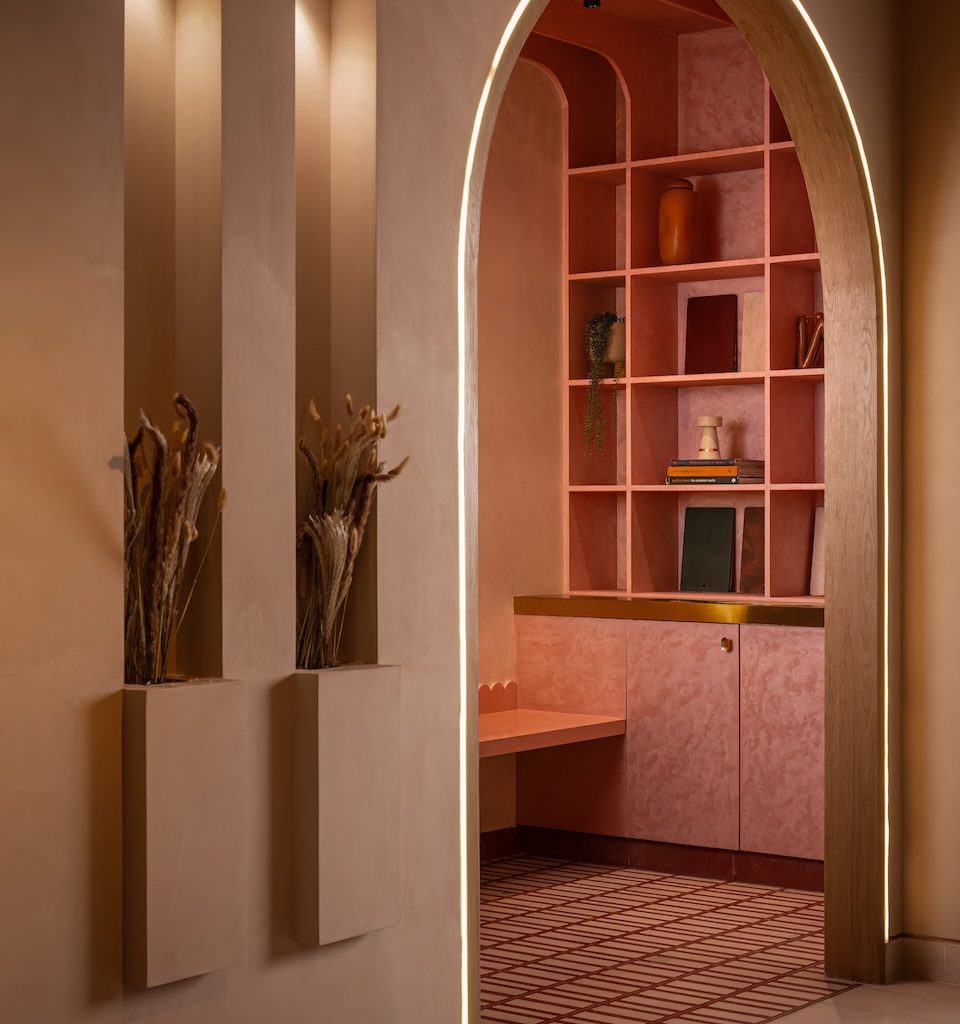
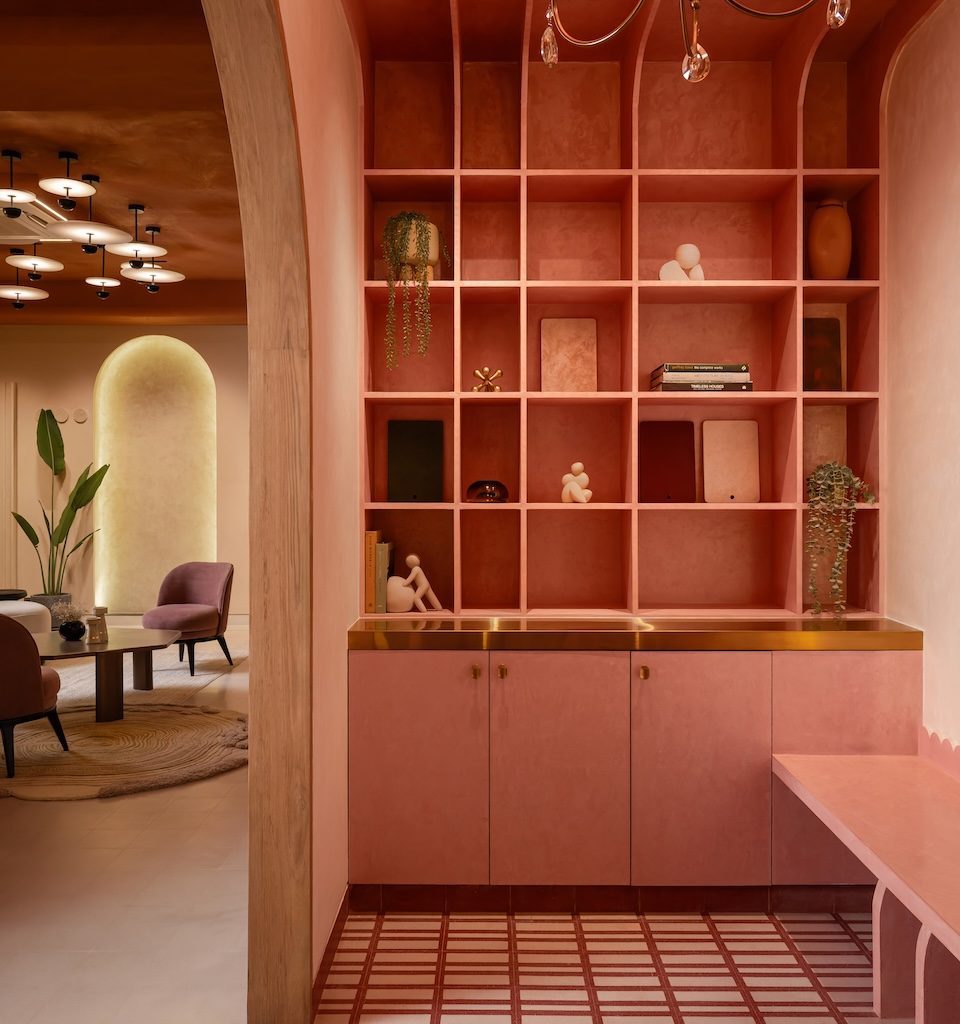
The Luxury Room marks the experiential crescendo of the sequence. Accessed through a softly arched opening, it introduces a deliberate moment of transition. Blush-pink shimmery textured paint from the premium range envelops the room, its subtle sheen enhancing depth and exclusivity. Opposite the arch, a circular feature panel carries a custom radial texture treatment, with lines emanating outward to establish a formal visual axis. Deep reddish-maroon patterned Cubit tiles ground the space, contrasting with the softness of the walls. Custom storage units topped with brushed brass countertops introduce a refined metallic accent, while velvet-lined sample folders elevate the presentation.
Across all spaces, every architectural surface is treated as a potential canvas. The plywood-HDHMR substrate system ensures precision in finish application, allowing the earthy base palette to foreground textured paint as the defining design language.
The challenges
“One of the key challenges was ensuring the texture paints were represented accurately under varying lighting conditions. As the finishes are the core of the experience, it was essential that each texture and colour was clearly visible and impactful from different angles and distances,” says Aishwarya.
To address this, lighting became a critical design tool. Carefully positioned ambient, task, and accent lighting was used to highlight the surfaces, enhance depth, and create a visually engaging display. The integration of subtle underlighting on display pedestals and panels further ensured that each finish could stand out independently, transforming the space into a self-explanatory and immersive showcase.
Fact File
Project: Tint & Touch (Splash Textures)
Location: JP Nagar, Bengaluru
Area: 1,300 sq ft
Principal designer: Aishwarya Govind
Design team: Swarali Ambewadi
Add a Comment