
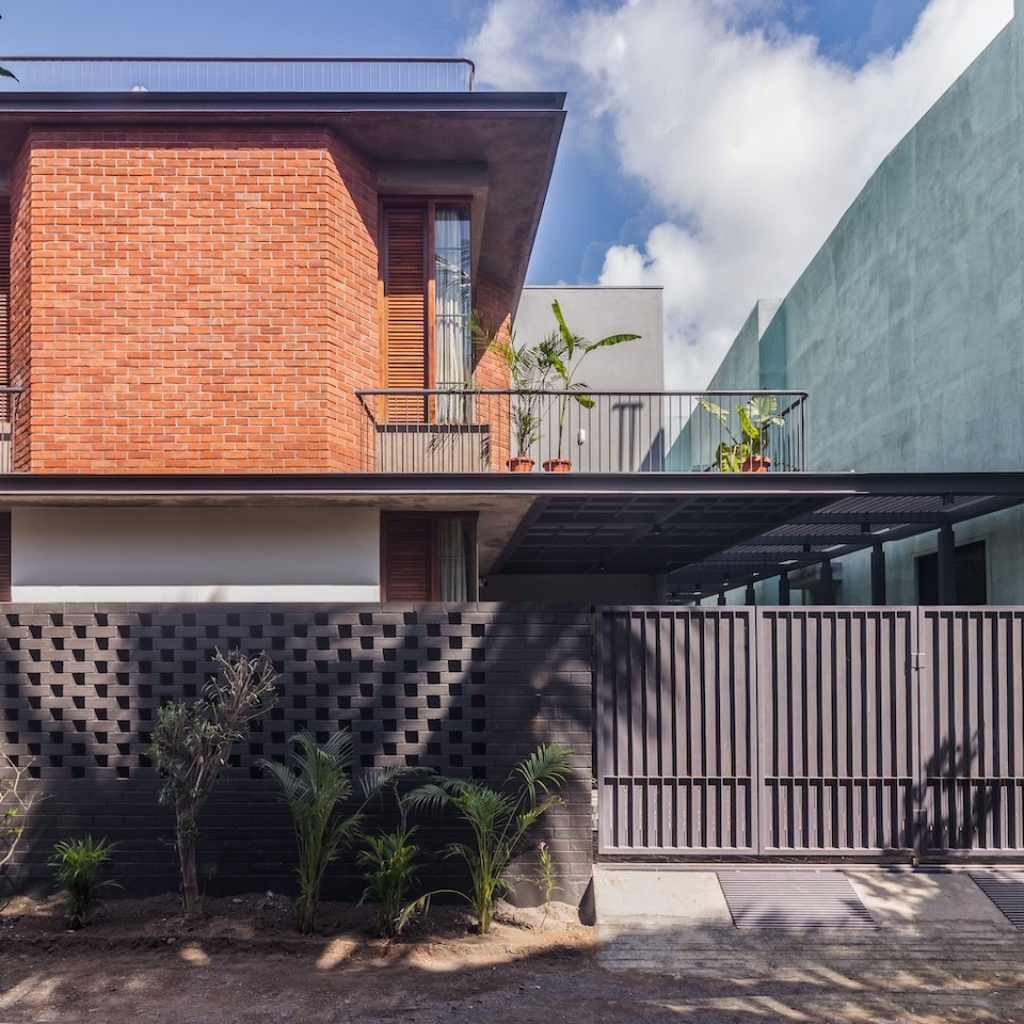
House of Design Stories use traditional materials and building techniques to build a striking home in a dense residential neighbourhood.
Curated by: Rupali Sebastian
Photographs: Chidambaram Chitti; courtesy House of Design Stories
The site
The site is a south-facing plot and lies at the end of one of the conservative streets of Pondicherry. The neighbourhood is very tight with a very narrow frontage.
The brief
“Our client had a good sense of design,” reveal architects Arul Maniyan and Anu Krithika of House of Design Stories (HODS). “His ideas were inclined towards the elements he saw in their ancestral home. The design brief included keywords like traditional, rustic, ancestral rootedness. Apart from these, we were also given a limited budget.”
The design intent
Embracing a quiet reflection of modern lifestyle and traditional nuances, was the design take for this multi-generational family of five. “We utilised creative techniques to deliver a functional yet aesthetic structure by incorporating cost-effective techniques and solutions at every step of the process,” states the duo. “This exciting journey led us to explore the intersection of design, art, and affordability.”
The plan
The architects implemented a straightforward and context-driven plan, integrating their design philosophy and the family’s character, beliefs, and personality.
The focus was to create a well-connected node within the house. Thus, the living room was given a double height to achieve horizontal and vertical interactions. The project also aims to maximise the use of natural light and ventilation in every area, achieved with strategic positioning of large windows throughout. Additionally, the north wall was intentionally designed to allow soft north light to flow into the living room.
The living room connects itself with the entrance, pooja, kitchen and the bedrooms horizontally.
The first floor is wrapped with terraces on the north, west and south faces. The north and the west terraces are vertically connected with the living. It creates a buffer from the surrounding plots to maintain the light and ventilation into the living room.
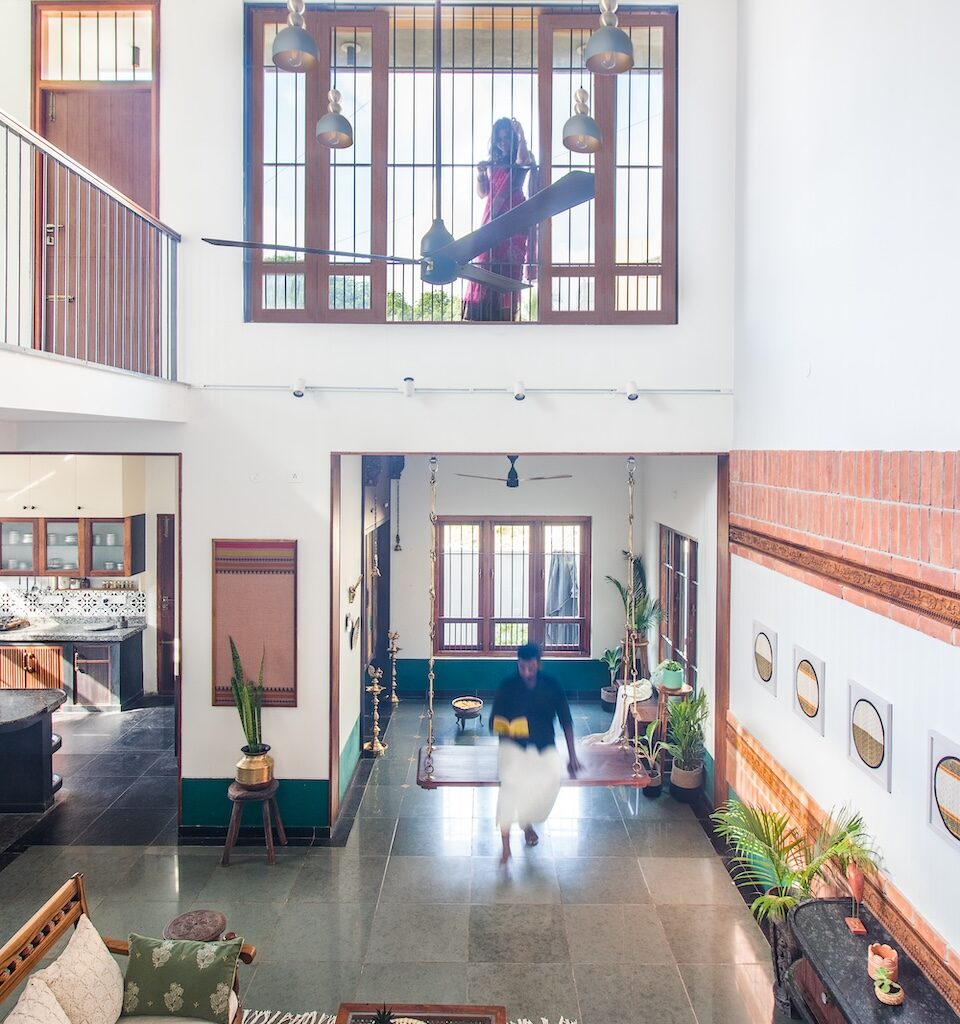
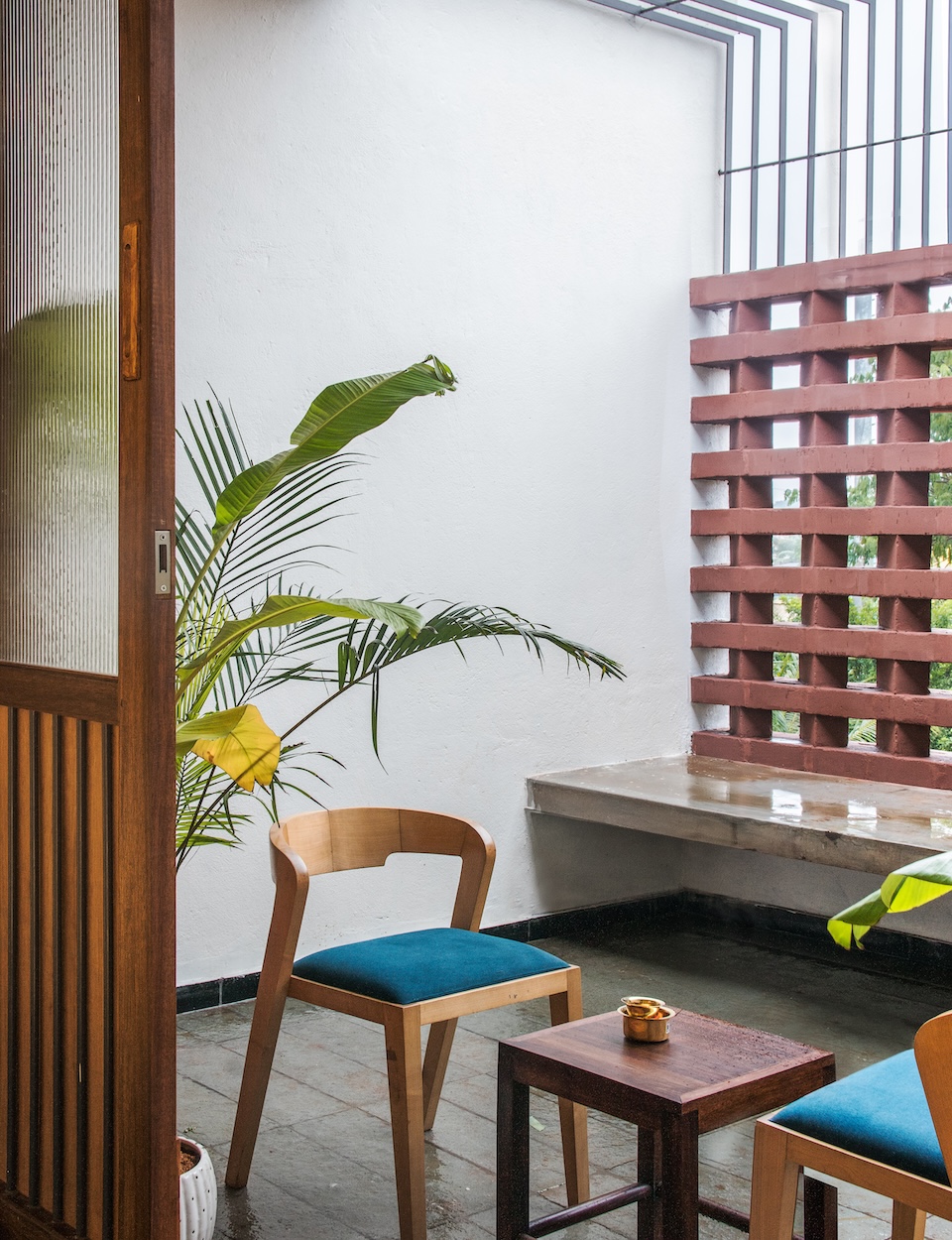
A corridor opens into the west terrace which is partly covered, serving as a versatile informal living throughout the year with a brick jaali work for privacy. The north terrace has been designed with a covered window seater, primarily for the kid’s tuition classes that stays connected to the living room window, allowing the family to oversee the activity with a direct view from the living room.
A home tour
This minimalist two-level residence is articulated as a brick block featuring angles and recessions, sandwiched between metal lined concrete plates atop a solid white block. This harmonious interplay of brick, white and grey creates an elegant palette. The brick block acts as a canvas for the foliage to run over it. The boundary wall’s exposed brick jaali has worked as an affordable design solution, also acting as a statement to the main block.
The entrance to the plot is combined with the parking, which together has a metal canopy. This metal roof converts itself into a habitable terrace to the first-floor master bedroom, also extending as a pergola over the entrance-foyer passage. This entrance indeed is a perfect romance between the pergola, kadappa and tropics.
The main door and its gate behave as a striking element to the foyer. A beautifully carved wooden panel to the door top, giving an authentic and divine feel to the entrance. All openings are adorned with vengai (Indian Kino) wood due to its naturally warm tone and termite resistance. Most of the vengai wood were salvaged from old houses, which on a positive side exhibited different shades throughout the house enhancing its beauty.
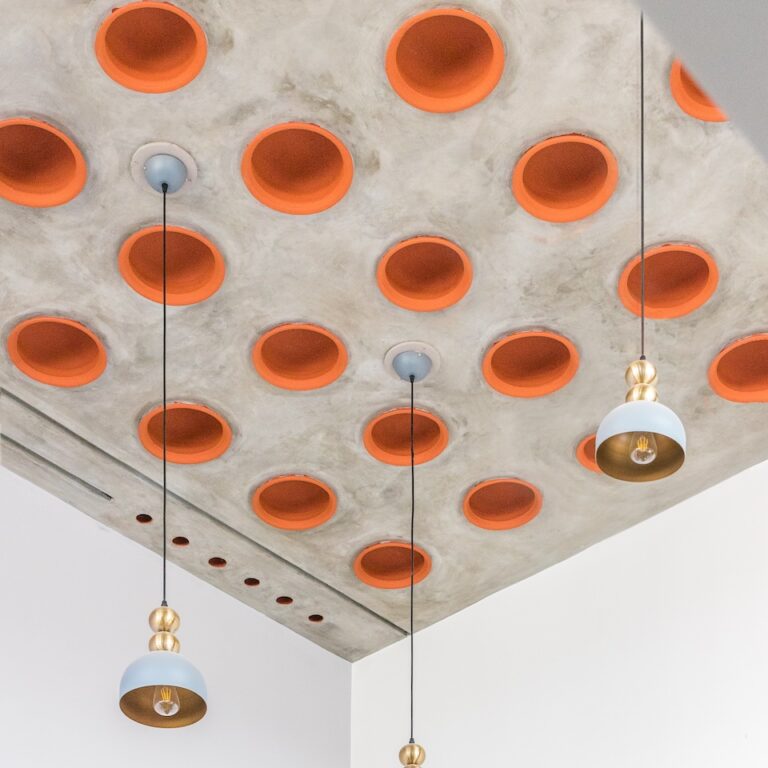
Complementing the emphasis on natural lighting, the interior palette was carefully selected to be soft and muted, creating a soothing and calming ambience. Bottle green accents and grey Kota flooring add contrasting elements.
Furniture pieces were kept to a minimum and the project utilises refurbished pieces which were slightly modified to blend with the setting.
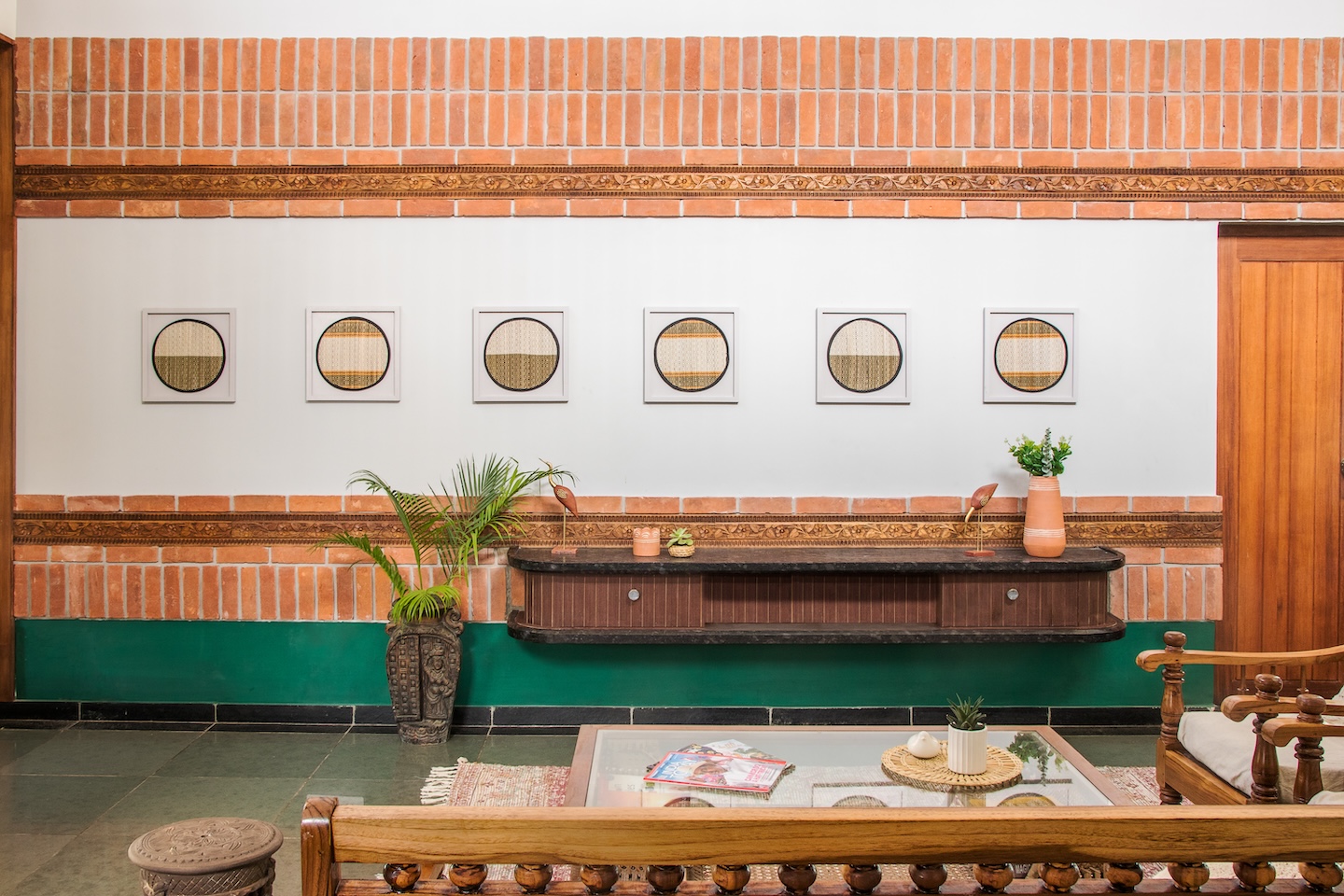
The living room is thoughtfully kept rustic and earthy. The accent wall, featuring leftover cladding bricks and reclaimed wooden carved panels, is inspired by the traditional South Indian sari’s pallu. This design highlight is paired framed pieces of woven grass mats.
The pooja space with its abundance of natural light from the north and east along with its artistically adorned manjal (yellow) door creates a bright and auspicious ambience. The addition of a bench positioned in front of a large window allows for a unique experience, surrounded by both indoor and outdoor tropics, resulting in a refreshing and revitalising prayer space. The colour palette embraced natural hues.
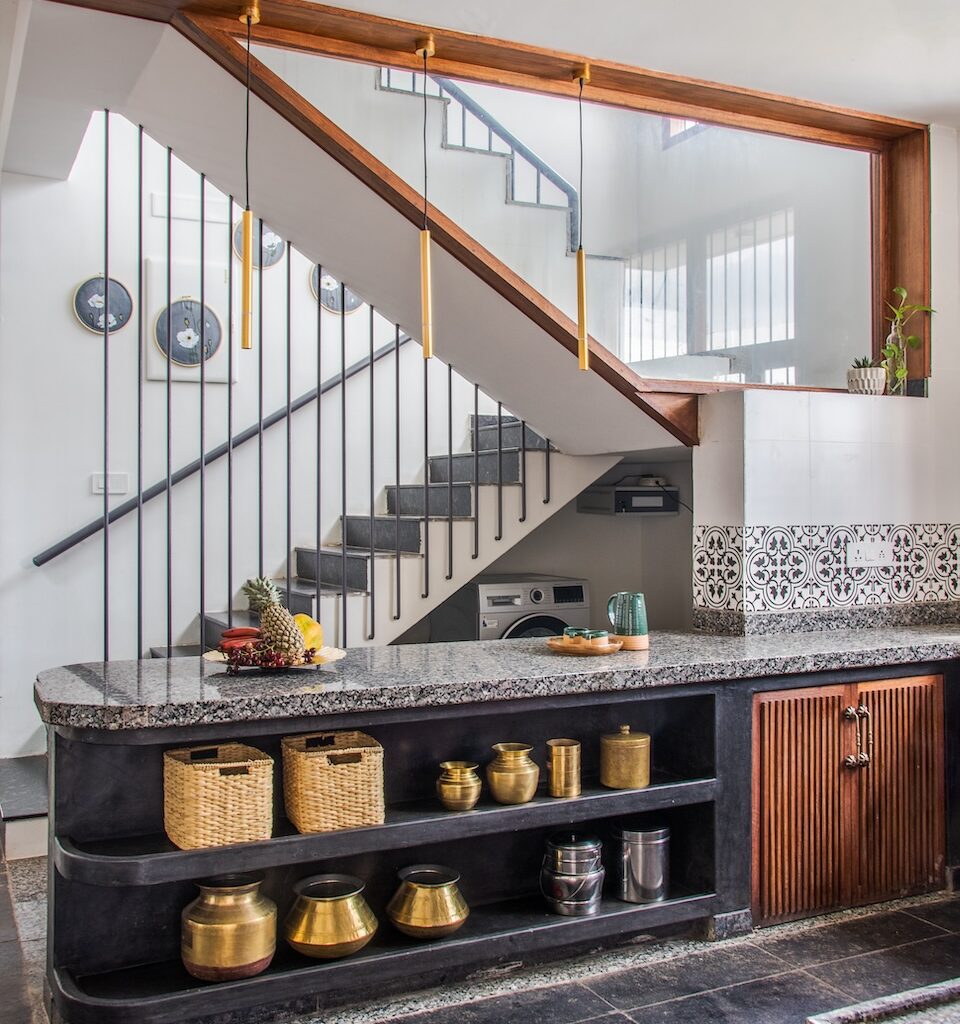
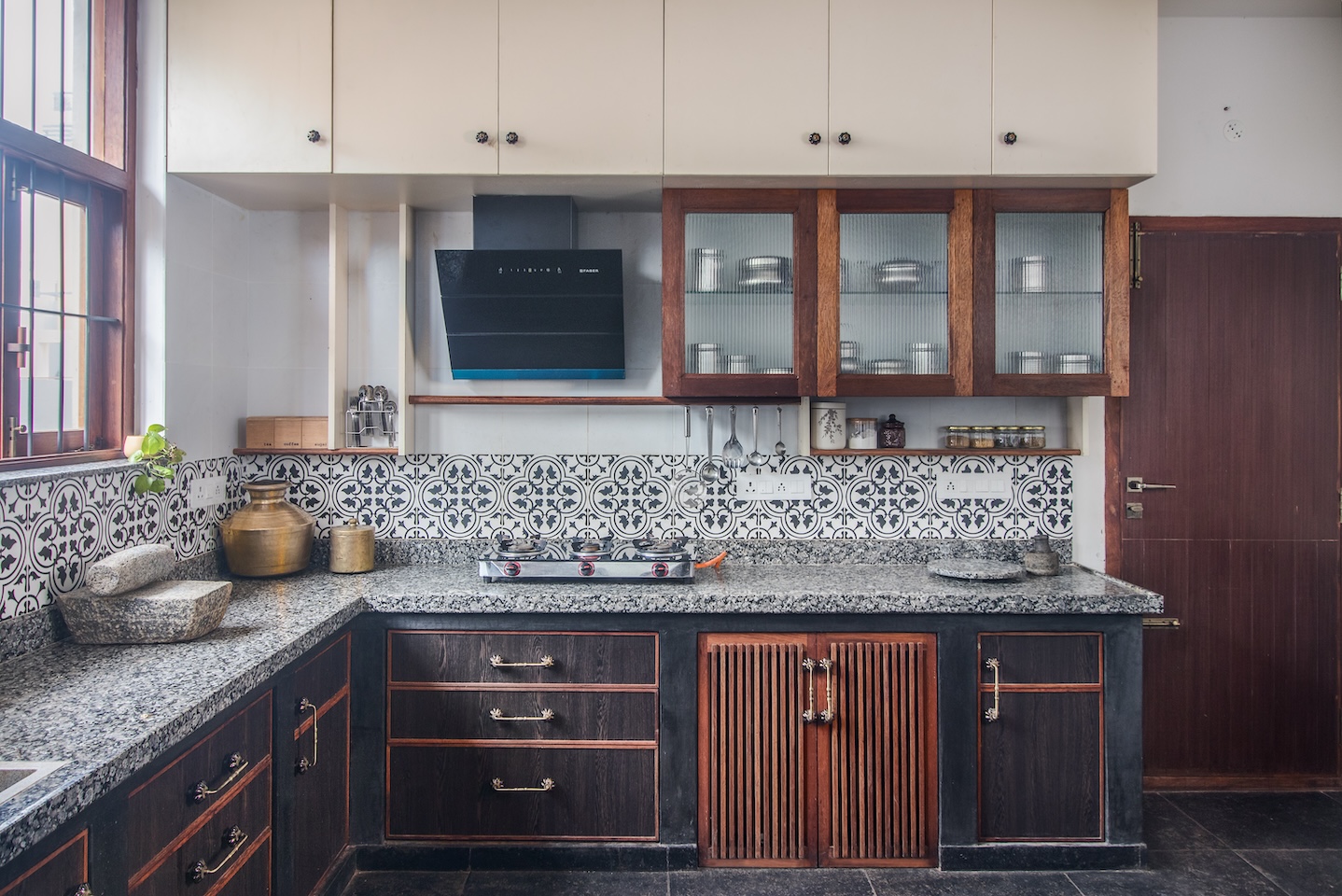
The open kitchen is equipped with an economical modular setup, which is achieved by combining traditional and modern solutions. Just like a traditional kitchen, the lower storage is designed with brick partitions, in combination with modular fittings and kadappa shelves. These brick surfaces were then dressed with black oxide, a traditional finishing technique. Since the family did not require a conventional dining space, a breakfast table was planned as part of the kitchen.
The master bedrooms on both levels make use of southeastern openings for natural light. As a cost-effective solution built in wardrobes and benches were incorporated. The first master bedroom was styled with beautiful pichhwai art wallpapers, dark grey oxide and painted meenakari wall plates.
The master bedroom on level 1 has a private terrace and utilises double wall construction on the south and east sides for protection from summer heat. A wardrobe and study niche were incorporated into the double wall, while the study table was designed with leftover materials. The taupe on the walls amplifies the brightness to its maximum. Wardrobe is dressed with blue oxide, while the shutters were designed with bespoke embroidered fabric.
The highlights
Interiors and styling were intricately planned to make it cohesively connected as part of the shell and creatively utilising leftover materials in a few areas. The entrance wall features ’10 frames of elegance’, an economical interior solution handcrafted with leftover wood, an old cotton sari and locally sourced printing blocks.
Windows and doors were crafted with vengai wood. The handles for the windows were made at site with the leftover wooden pieces. These pieces looked stylish as well as were a very cost-effective solution.
The challenges
Given that the site was tucked inside a dense residential neighbourhood, capturing the light and ventilation within the building was the foremost concern. “We opted for an open spatial planning with every space connected to the central node—in our case the living room,”disclose the architects. “The central node was made a double-height and terraces were included around the house on level 2 which creates a buffer from the surrounding, allowing ample light into the house at every point of the day.”
This project was also an attempt at crafting an aesthetically pleasing and art-filled residence while working within a tight budget. Most elements such as filler slabs, oxide finish, concrete finish—which typically required (expensive) skilled artisans—were achieved through a hands-on approach by training unskilled workers. Similarly, the boundary wall’s painted exposed brick jaali was rendered from second quality bricks, while some of the vengai wood is salvaged.

The interiors, on the other hand, were incorporated as part of the base structure itself forming one cohesive unit. This was done to reduce the cost. The art pieces were custom made on a budget to not compromise on the aesthetics and styling of the house.
Fact file
Project: Indie Tales
Location: Pondicherry
Area: 1,700 sq ft
Principal architects: Arul Maniyan and Anu Krithika
Add a Comment