
The Vayal farm house designed by Bhogar Studio in Sakkottai, Tamil Nadu, pays homage to the land and revives its architectural material history.
Curated by: Ambica Sharma
Photographs: Bhogar Studio
The site
A 3.5-acre mango farm land at Sakkottai village, Tamil Nadu, is home to the 3,100 sq ft, Vayal farmhouse designed by Chennai-based Bhogar Studio. It is the last farm on the road, and is hemmed by a coconut grove on one side and a small settlement on the other. “The land seemed to have been ignored for almost a decade, and our client was all set to revive it, and build a farmhouse for his family,” says Prithy Ramadurai and Karthick Chidambaram, principal architects, Bhogar Studio. The land was already broadly divided into two parts — a mango orchard and the farm area. A walk through the mango orchard was enough to identify a patch of land for the house to nest amidst the trees.
The brief
For the purpose of the gathering of a large extended family, the client required the home to be able to house 50 members. There had to be spaces for celebrations, and private spaces, too. “The client has a large family and the village is where they hail from. It is customary for the entire family to congregate in the village for festivals and special occasions,” explains Prithy.
The design intent
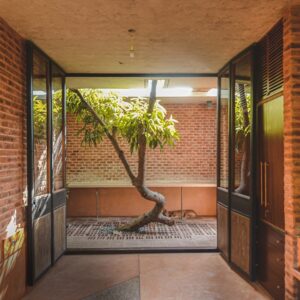
Though the Vayal farmhouse is inspired by the rich architectural history of Chettinad, it has been created for contemporary times and people. A clean-lined space had to be planned without giving up the local connect, or distracting from the natural beauty of the plot. “The place is filled with mansions that have south Indian vernacular to art deco influences. While selecting the patch of land we were mindful of this aspect, and we also made sure no existing trees were removed. In fact, most of our spaces envelope the existing trees,” says Karthick.
The spatial flow
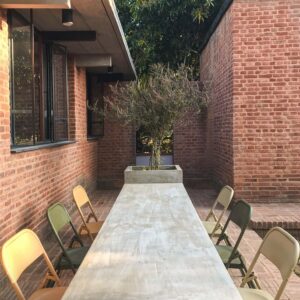
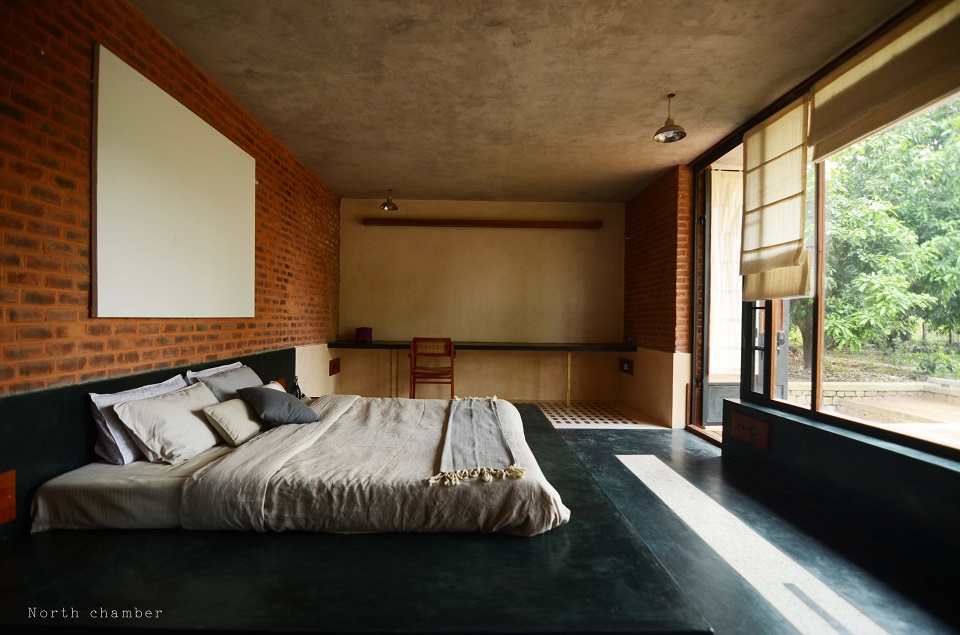
The spatial flow has a straightforward approach — four blocks with bedroom chambers, kitchen and study, and a semi-basement with a plunge-tank on top, all placed around a large central courtyard. The approach to the house from the main gate was purposefully made lengthy so that one could leave behind the village and get into a hermit mode. The bedrooms have their private sit-outs and toilets. The study is in the north-east, visually away from the central courtyard, to add to private and retreatable spaces. The plunge-tank was raised above ground level, to provide a view of the surrounding tree line. Each space was designed to wrap itself around the abundant trees the site offered.
The material palette
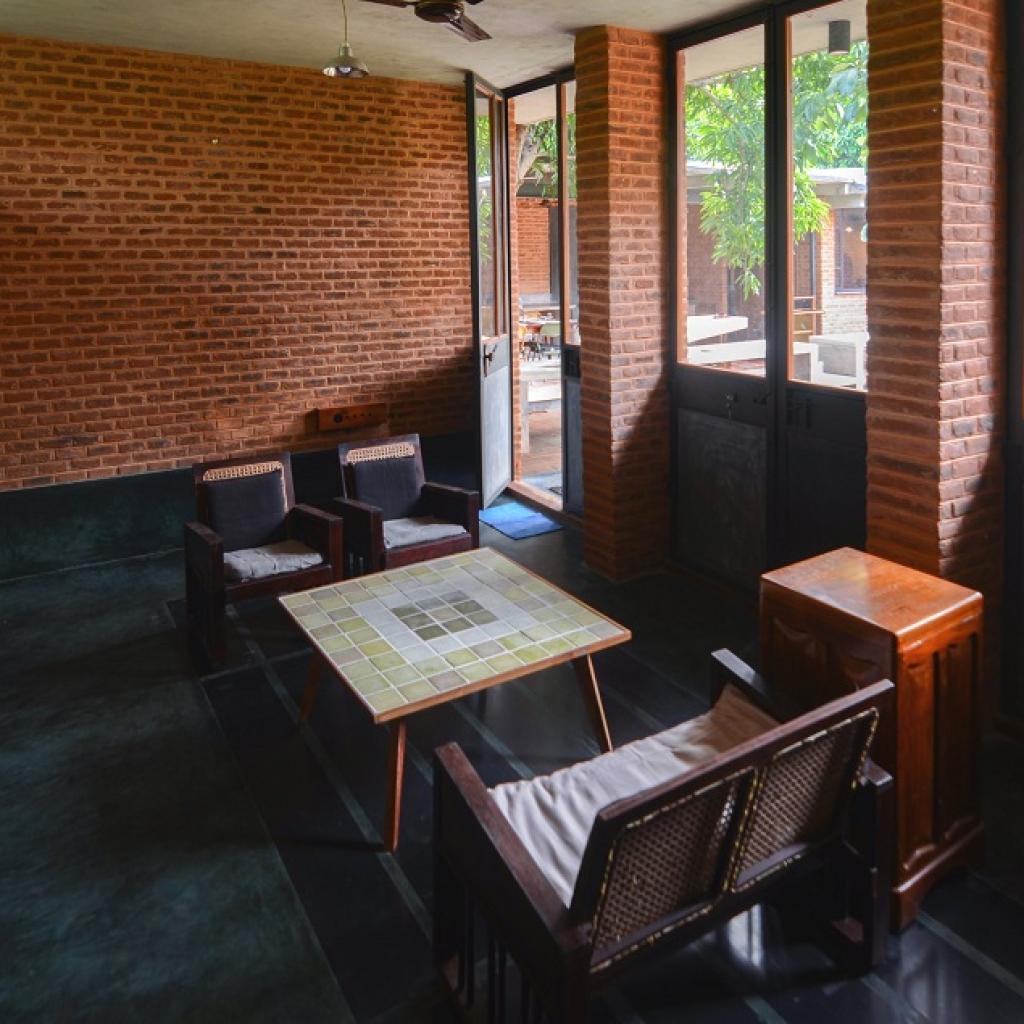
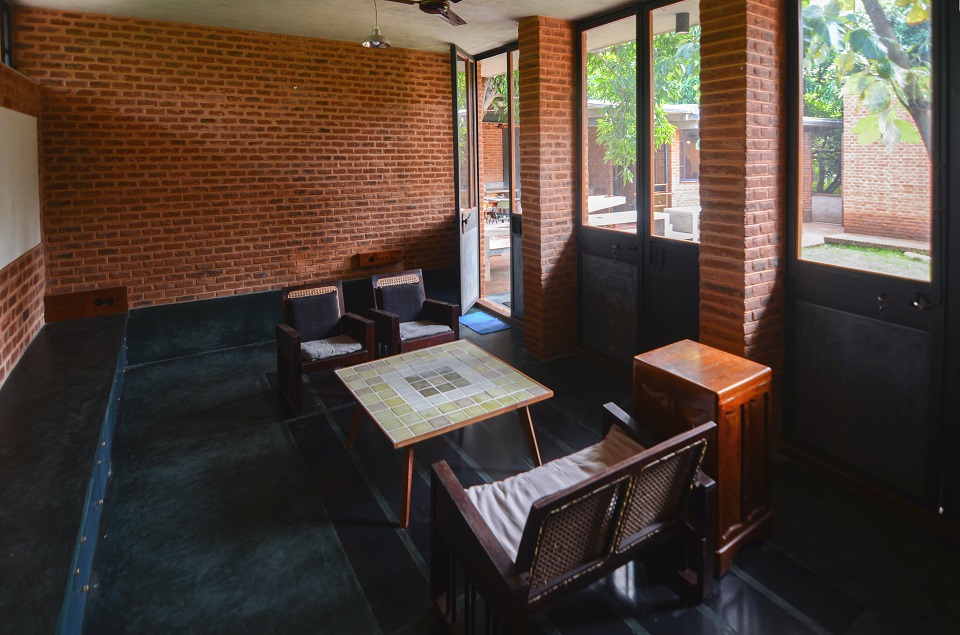
In order to counter the hot and dry climate of Sakkottai, the walls were made one-foot-thick, and are load bearing. The decision to make an exposed-brick house was inspired by the soil of the site. The architects wanted the house to look like the earth rather than plastering it — they wanted it to feel like a part of the visual landscape rather than standing out from it. The doors and windows are made from steel, to enable large span openings with thinner sections. Pigmented IPS floors, cuddapah inlays, mosaic, stone, and brick, clad the floors and the walls. “We experimented a lot on pigments in this project. We credit this to the myriad colours used in the regional Athangudi tiles, and the handloom industry. We as a studio love getting into the smallest of details, and believe that the scope of design is endless,” asserts Karthick.
The challenge
In order to set apart the visual of their exposed-brickwork, from the traditional one, Bhogar Studio created customised brick, in order to manipulate the facade, as per their design. “We tried several sizes: 12” x 6” x 2”, 9” x 4.5” x 3”, 9” x 4.5” x 2” … Some failed, some worked, and this was our biggest challenge,” informs Prithy.
Favourite aspect of the project
With the aim of crafting a building, rather than just building it, Bhogar Studio dived deep into detailing every aspect of the project. “We particularly loved playing with the pigments for coming up with flooring patterns, and executing the sculptural water feature in the central courtyard,” say the architects.
Fact file
Project: Vayal at Sakkottai
Location: Sakkottai, Tamil Nadu
Area: 3,100 sq ft approximately
Principal architects: Prithy Ramadurai and Karthick Chidambaram
Design team: Sreemayi Prasanna, Prithy Ramadurai, and Karthick Chidambaram
Add a Comment